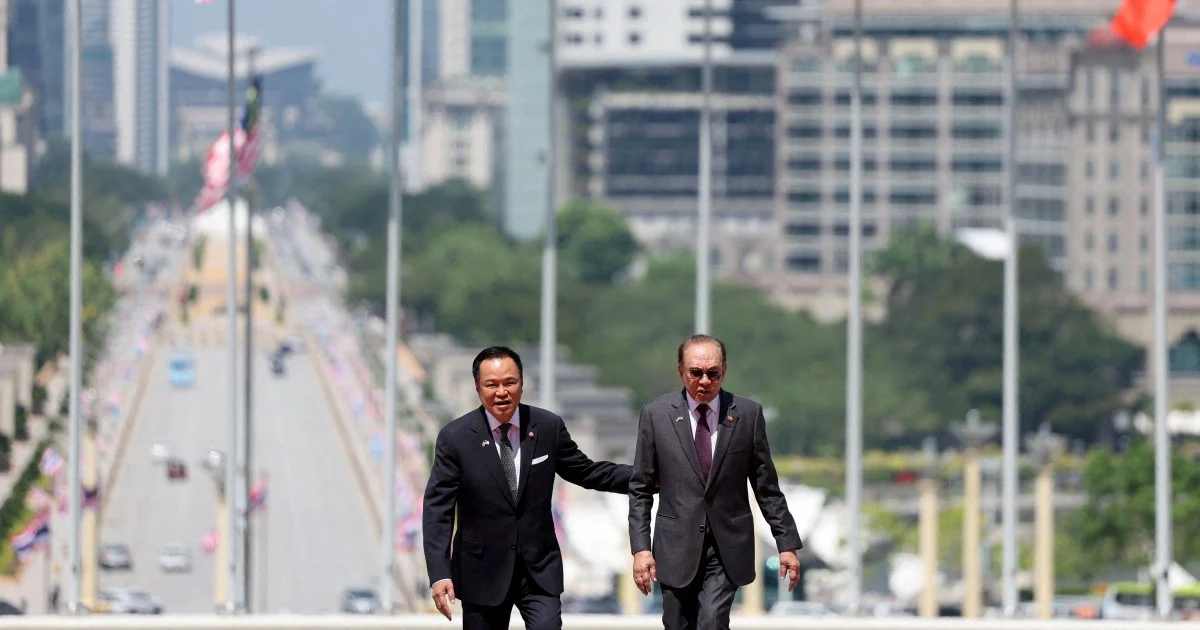
Prime Minister Datuk Seri Anwar Ibrahim has articulated Malaysia's position that resolving the protracted Myanmar conflict demands a foundation of inclusive dialogue encompassing all relevant actors and interest groups. Speaking from Putrajaya, Anwar emphasised that sustainable peace in the country cannot materialise through exclusionary approaches or by marginalising particular factions, but rather hinges on bringing diverse stakeholders—military leadership, civilian representatives, ethnic armed organisations, and civil society—to the negotiating table. This stance reflects Malaysia's broader regional philosophy of consensus-building and collective problem-solving within ASEAN framework.
The Prime Minister's pronouncement underscores Malaysia's commitment to employing its diplomatic leverage as the current or recent ASEAN chair to facilitate dialogue in Myanmar. Malaysia has historically positioned itself as a bridge-builder in Southeast Asian conflicts, drawing on its experience navigating complex communal and political divisions domestically. By emphasising inclusivity, Anwar signals that Malaysia rejects externally-imposed solutions or agreements reached between limited parties that exclude substantial segments of Myanmar's population. This approach acknowledges that durable peace settlements require buy-in from those wielding significant influence on the ground.
Central to Malaysia's perspective is the principle of self-determination—the notion that Myanmar's people themselves must ultimately decide their country's political trajectory and governance structures. This principle carries particular resonance within ASEAN discourse, which traditionally privileges national sovereignty and non-interference in member states' internal affairs. By framing Myanmar's resolution around self-determination, Anwar positions Malaysia as defending both ASEAN orthodoxy and universal democratic principles, attempting to bridge the tension between these sometimes-competing priorities.
The Myanmar crisis has proven exceptionally intractable since the military coup in February 2021 displaced Aung San Suu Kyi's democratically-elected government. The ensuing conflict has splintered along multiple fault lines: the Tatmadaw military establishment versus the National Unity Government and parallel governance structures; competing ethnic armed organisations with divergent agendas; and broader regional powers with conflicting interests. Malaysia's insistence on inclusivity implicitly acknowledges that no single actor possesses sufficient authority to unilaterally resolve the conflict, and that attempts by the military junta to impose order without dialogue have only deepened fragmentation.
For Malaysia specifically, Myanmar's instability presents immediate security and humanitarian concerns. The country hosts significant Myanmar refugee populations and faces ongoing challenges from transnational militant groups operating in border regions. Myanmar's disorder creates ungoverned spaces that can harbour criminal networks, human traffickers, and extremist organisations, potentially threatening Malaysian territory and citizens. Moreover, economic disruption in Myanmar reverberates through regional supply chains and trade networks that Malaysian businesses depend upon.
Malaysia's diplomatic approach also reflects pragmatic acknowledgment of the limited leverage any single ASEAN member possesses over Myanmar's trajectory. Neighbouring Thailand and Laos maintain closer relationships with the junta; Singapore and Indonesia pursue alternative diplomatic channels. Rather than attempting coercive pressure—which would likely prove counterproductive and fracture ASEAN consensus—Malaysia emphasises the moral and practical imperative for dialogue. This inclusive approach allows Malaysia to occupy a constructive middle ground without appearing to favour particular factions or undermine ASEAN solidarity.
The emphasis on stakeholder inclusion also implicitly recognises the reality that Myanmar contains multiple vision-holders regarding the country's future governance. Ethnic minorities, particularly those in border regions, harbour grievances predating the recent coup and seek greater autonomy or federal arrangements. Urban populations supporting the National Unity Government prioritise democratic restoration. The military establishment claims its intervention was necessary to prevent democratic backsliding. Without negotiation between these constituencies, any settlement imposed unilaterally would likely face resistance and prove unsustainable.
Anwar's framing of Myanmar's resolution within an inclusive paradigm also positions Malaysia as advancing a Southeast Asian rather than globally-aligned approach. Major powers like the United States and China have attempted to shape Myanmar's trajectory according to their strategic interests, potentially complicating genuine Myanmar-owned solutions. By emphasising that Myanmar's people must determine their future, Malaysia subtly cautions against excessive external involvement while maintaining space for ASEAN mediation.
The practical implementation of Anwar's inclusive engagement vision remains substantially uncertain. Achieving dialogue between parties that view each other with profound mistrust and mutual recrimination represents an extraordinary diplomatic challenge. The military junta has demonstrated limited willingness to negotiate substantively; the National Unity Government and allied forces have consequently rejected talking without preconditions. Fragmentation among ethnic armed organisations means that even if certain groups engage, others may refuse, complicating any agreement's legitimacy and enforceability.
Malaysia's advocacy for inclusive engagement nonetheless establishes important principles that should guide any eventual Myanmar dialogue, whenever circumstances permit negotiation to occur. The commitment to self-determination resists external prescription of Myanmar's political future. The insistence on stakeholder inclusion recognises that durable peace requires addressing the interests and grievances of diverse communities rather than imposing solutions from above. These principles, while not immediately resolving Myanmar's immediate humanitarian catastrophe or security challenges, map the conceptual terrain within which lasting settlement might eventually become possible.

