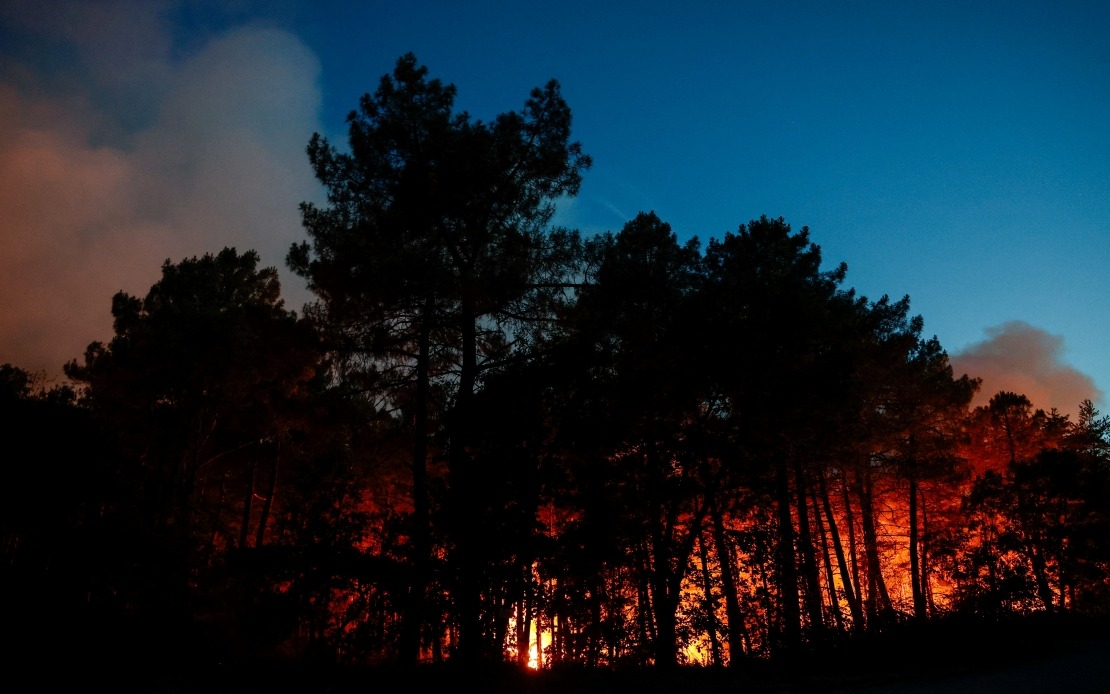
A devastating wildfire tore through the renowned Fontainebleau forest south of Paris on Monday, with approximately 400 firefighters deployed to contain the rapidly spreading blaze that ignited late Sunday evening. The fire has already claimed 800 hectares of woodland in the historic forest, one of Western Europe's largest continuous forested areas and home to the iconic Château de Fontainebleau, raising serious concerns about environmental damage and cultural heritage preservation in the region.
The scale of the operation reflects the severity of the situation, with authorities drawing on significant resources to combat the advancing flames. Two water-bombing aircraft joined the firefighting effort, extracting water directly from the Seine river to maximise their operational capacity. The Seine-et-Marne department coordinated these aerial operations alongside ground crews, demonstrating the multi-layered approach required to tackle such an extensive conflagration in a densely wooded area with challenging terrain.
French Interior Minister Laurent Nuñez visited the scene and delivered a troubling assessment regarding the fire's origins. His observations pointed to the possibility of deliberate arson, based on evidence that multiple fire outbreaks had occurred within just a 1,000-metre radius. This clustering pattern typically suggests human involvement rather than natural causes such as lightning strikes. The gendarmerie subsequently opened an formal investigation into the incidents, signalling that authorities were treating the outbreak as a potential criminal matter requiring rigorous forensic examination.
The human toll of the disaster became evident as evacuation efforts expanded across the affected area. More than 1,000 residents and tourists fled their homes and accommodation in the surrounding villages, with Le Vaudoué particularly vulnerable to the advancing flames. The mayor of Le Vaudoué provided vivid testimony to the terrifying nature of the emergency, describing "a wall of flames" moving with frightening speed toward residential properties at the forest's edge. Such descriptions underscore the intensity of the fire and the urgency with which authorities moved to prevent further loss of life and property.
The French government responded to the crisis by mobilizing all available resources and framing the situation in terms that conveyed exceptional gravity. Government spokeswoman Maud Bregeon characterised the conditions as "exceptional," emphasizing that deployment of every conceivable asset had commenced to constrain the blaze's expansion. Her remarks also highlighted a significant concern for France: wildfires of this magnitude have become increasingly unusual in the northern regions of the country, suggesting that environmental or climatic shifts may be altering traditional fire patterns and seasonal risks.
The wildfire is occurring within a broader context of extreme heat affecting France throughout the summer. The country endured its third major heatwave during the year, creating the parched landscape and elevated temperatures that wildfire specialists identify as critical enabling factors. Météo-France, the national weather service, underscored the intensity of conditions by issuing its highest-level red heat alert across 37 departments at the beginning of the week, indicating that numerous regions across the nation faced dangerous thermal conditions.
Fire crews elsewhere in France were simultaneously battling additional blazes triggered by the same heatwave conditions, stretching national firefighting capacity and resources. This concurrent crisis situation across multiple departments demanded careful coordination and prioritization of available personnel and equipment. The Fontainebleau fire represented one particularly significant emergency among several competing demands on France's emergency response infrastructure, illustrating how widespread heat events can overwhelm firefighting systems when multiple fires ignite simultaneously across different regions.
The Fontainebleau forest holds substantial historical and ecological significance that extends well beyond French borders. As one of Western Europe's largest intact forested areas, it represents an important ecological zone and serves as a global asset for biodiversity and carbon sequestration. The presence of the Château de Fontainebleau, a UNESCO World Heritage site and former royal residence with centuries of cultural importance, added another dimension of concern to the disaster, as damage to surrounding woodland threatens the setting and integrity of this irreplaceable monument.
For Southeast Asian observers, the Fontainebleau fire offers instructive lessons regarding wildfire management during extreme heat events. Malaysia and other ASEAN nations have experienced their own serious wildfire and haze episodes, particularly during El Niño years when drought conditions intensify across the region. The French experience demonstrates how even technologically advanced nations with substantial resources can face severe challenges when multiple fires ignite during periods of extreme heat, and how investigation of suspicious fire patterns requires immediate coordination between law enforcement and emergency management authorities.
The investigation into potential arson carries implications beyond France's borders, as international experience suggests that deliberate fire-setting during high-risk periods represents a serious criminal matter with catastrophic consequences. Understanding motivations for such acts and implementing preventive measures remains an ongoing challenge for fire management agencies worldwide. The formal involvement of the gendarmerie indicates that French authorities intend to pursue a rigorous investigation that could yield insights applicable to other nations' fire prevention strategies.
Longer-term concerns centre on whether the Fontainebleau fire represents an anomaly or signals a troubling new trend toward larger wildfires in formerly low-risk regions. Climate scientists have repeatedly warned that changing atmospheric patterns are expanding the geographical zones where wildfire conditions become possible during summer months. If northern France experiences more frequent large-scale fires, this would represent a significant shift in regional environmental risk and necessitate substantial adjustments to firefighting preparedness, equipment deployment, and resource allocation across the nation and potentially across the European Union.
The evacuation of over 1,000 people from the Fontainebleau region underscores the human dimensions of natural disasters and the importance of maintaining effective emergency response protocols. Early evacuation decisions, despite their disruptive impact on residents and tourism, likely prevented casualties and protected lives as the fire advanced toward residential areas. This aspect of crisis management demonstrates how coordination between local officials, regional authorities, and emergency services can determine outcomes when disaster strikes populated areas adjacent to natural resources.

