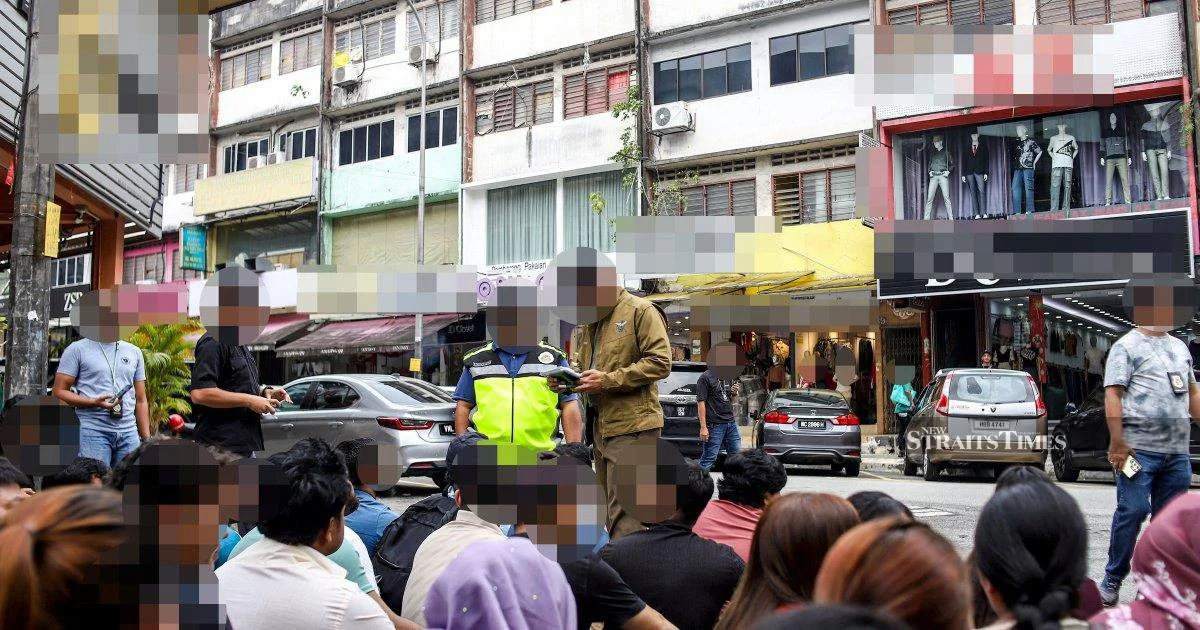
Authorities descended on the bustling wholesale garment district along Jalan Kenanga in Kuala Lumpur today, executing a coordinated enforcement operation that resulted in the apprehension of 111 individuals found to be residing and working in the country without valid documentation. The immigration raid represents a significant crackdown on what has long been a nexus of informal labour activity in the capital's retail sector.
The Jalan Kenanga precinct, renowned throughout Malaysia as a major distribution centre for clothing wholesalers and fashion retailers, has historically attracted migrant workers seeking employment opportunities. The densely packed commercial zone, with its labyrinthine network of shops and storage facilities, provides numerous places where undocumented workers can blend into the daily commercial bustle. Today's operation targeted this vulnerability, with immigration officers systematically processing the commercial area to identify individuals lacking proper work permits or residency status.
The scale of today's enforcement action underscores the ongoing challenge faced by Malaysian immigration authorities in managing irregular migration, particularly within labour-intensive sectors. Undocumented workers represent a persistent concern for policymakers, as they operate outside regulatory frameworks, often accepting below-minimum wages and working in substandard conditions. Their presence simultaneously displaces documented workers and depresses wage standards across affected industries. The wholesale fashion sector has proven particularly susceptible to this dynamic, given its seasonal demand fluctuations and reliance on flexible, lower-cost labour arrangements.
Jalan Kenanga's position as a critical commercial hub means that disruptions to its operations carry ripple effects across Malaysia's retail supply chains. Many smaller retailers throughout the Klang Valley source inventory from wholesalers concentrated in this district, making any enforcement action with significant scale immediately consequential for business continuity. Shop owners and wholesalers now face potential labour shortages if substantial portions of their workforce lacked proper documentation, though such enforcement operations typically provide advance warnings through official channels to minimize economic disruption.
The timing of this operation reflects broader immigration enforcement priorities under Malaysia's current policy framework. Regular raids on high-density commercial and industrial zones have become standard practice, balancing labour compliance with the nation's dependence on migrant workers across numerous sectors. Unlike operations in domestic helper or construction contexts, retail enforcement tends to generate less political attention, despite often yielding comparatively large arrest numbers due to the concentration of workers in confined spaces.
Immigration authorities have worked to streamline their enforcement protocols, coordinating across multiple agencies to ensure efficiency and safety during operations. The wholesale sector's structure—with multiple employers operating from individual shop units—creates particular logistical challenges, as officers must navigate complex tenancy arrangements and determine individual employment status rather than addressing a single employer with clear responsibility. This fragmented labour structure also facilitates worker dispersal when enforcement activities are anticipated, potentially explaining why some operations yield higher arrest numbers than others.
Those apprehended during today's raid will undergo processing at immigration detention facilities, where their cases will be individually assessed. Procedures typically involve documentation verification, nationality determination, and proceedings that may result in deportation. The immigration department maintains a network of detention centres throughout the Klang Valley to manage the substantial throughput from ongoing enforcement activities. Processing times can extend significantly when individuals lack identifying documents or when verification with their countries of origin proves complicated.
The broader context of irregular migration in Malaysia reflects both structural economic factors and regional dynamics. Workers from Bangladesh, Myanmar, Indonesia, and other neighbouring nations continue to migrate toward Malaysia seeking higher wages than available domestically, often accepting risks associated with undocumented status. At the same time, Malaysian employers across multiple sectors maintain demand for migrant labour willing to accept employment terms that documented workers may reject. This supply-demand mismatch perpetuates irregular migration despite sustained enforcement efforts.
From a Malaysian employment perspective, these enforcement operations theoretically create opportunities for documented workers to access positions previously filled by undocumented migrants. However, evidence suggests that wage adjustments and job vacancy patterns following raids often prove modest, as employers adjust recruitment strategies or shift operations to less-scrutinised locations rather than substantially increasing compensation for documented workers. The competitive pressure from irregular labour therefore persists even following major enforcement actions.
The Jalan Kenanga operation also highlights how enforcement activity concentrates in visible commercial zones where operations can be conducted relatively safely and efficiently, while irregular migration persists across residential areas, agricultural zones, and less accessible manufacturing facilities. This geographic selectivity means that while headline arrest numbers from commercial raids capture public attention, the national undocumented worker population continues evolving in response to enforcement patterns. Long-term solutions to irregular migration require coordinated approaches addressing employment regulations, wage standards, and bilateral cooperation with source countries—dimensions extending well beyond tactical enforcement operations.

