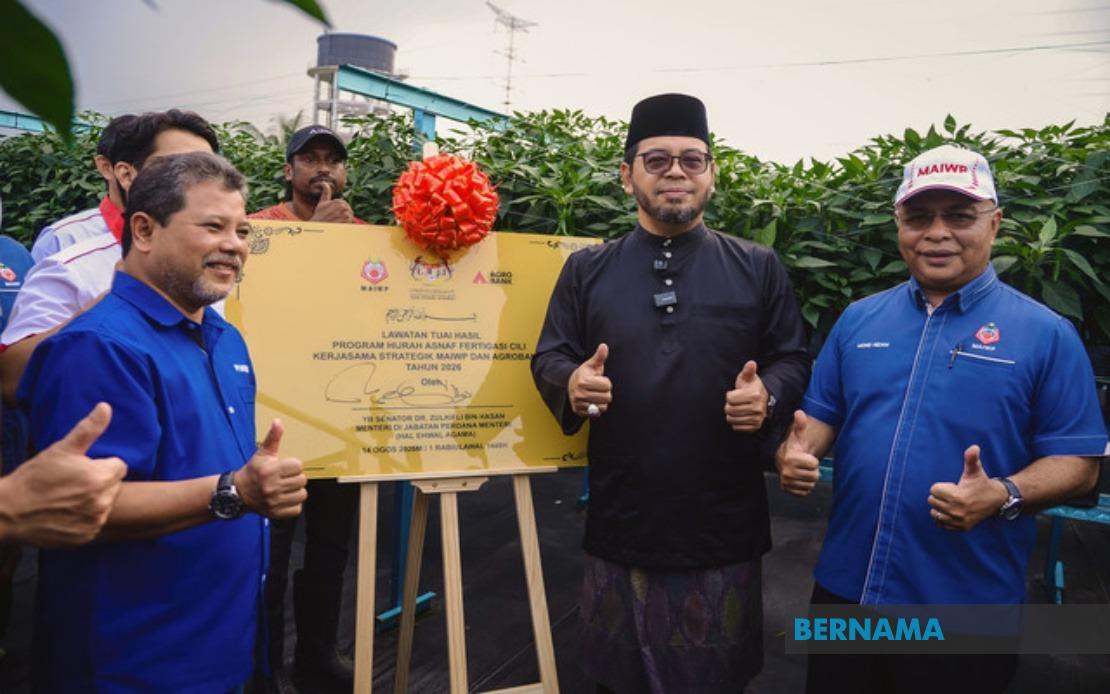
The Ministry in the Prime Minister's Department (Religious Affairs), through its mouthpiece Dr Zulkifli Hasan, announced the successful expansion of the asnaf chilli fertigation project to five acres, marking a significant scaling of an initiative that has already demonstrated remarkable commercial viability and social impact. The programme represents a structured approach to empowering Malaysia's marginalised communities through agricultural technology transfer and market-oriented farming practices.
The initial phase of the project produced measurably impressive results that justified the expansion decision. The first harvest alone generated more than 16.7 tonnes of chillies, yielding returns that exceeded RM207,000 for participating asnaf members. These figures underscore the commercial potential of precision agriculture techniques in the Malaysian context, where traditional farming methods often result in inconsistent yields and market vulnerability. The fertigation system—which delivers nutrients and water directly to plant root zones with minimal waste—addresses both productivity and sustainability concerns that have long challenged smallholder farmers in Malaysia.
Beyond immediate agricultural output, the programme has deliberately integrated value-chain development into its design. Participants are being encouraged and equipped to engage in downstream processing and manufacturing, transforming raw chilli output into differentiated products with higher margins. This vertical integration approach acknowledges a persistent weakness in Malaysian agricultural value chains, where primary producers typically capture only a fraction of the retail price while intermediaries and processors retain the bulk of margin. By enabling farmers to move into product development, the initiative potentially unlocks sustainable competitive advantages for participating asnaf members.
The human dimension of the project finds expression through testimonials like that of Alinda Rosely, a 49-year-old single mother whose participation has fundamentally altered her economic trajectory. Her experience illustrates how knowledge transfer in agricultural technology can operate as a genuine tool for poverty alleviation and social reintegration. Within a single six-month period during favourable market conditions, she earned RM40,000 through chilli cultivation—a sum representing substantial economic uplift for a household previously operating at subsistence margins. Her narrative reflects the programme's dual mandate: generating tangible income while restoring dignity and self-reliance among vulnerable populations.
The expansion initiative sits within a broader institutional framework. MAIWP, the Islamic Religious Council of the Federal Territories, operates as the principal instrument through which zakat funds—the obligatory Islamic charitable contribution—are channelled toward welfare and development objectives in Kuala Lumpur, Labuan, and Putrajaya. This alignment with zakat-funded interventions carries particular significance because zakat operates under Islamic jurisprudential parameters that distinguish it from conventional welfare systems, emphasising capability-building and economic self-sufficiency over dependency management. The chilli project exemplifies this philosophy in practice.
The scale of MAIWP's welfare operations provides essential context for understanding this specific initiative's place within a larger ecosystem. As of August 12, 2026, the organisation had distributed RM699.57 million in zakat disbursements across 38 distinct welfare assistance schemes. This portfolio encompasses traditional cash assistance, but increasingly focuses on capability development and income-generating interventions. The chilli fertigation project represents a deliberate strategic pivot toward sustainable livelihoods, moving beyond palliative welfare toward transformative economic participation.
From a policy perspective, the expansion warrants consideration as a potential replicable model for addressing structural inequalities in Malaysia's agricultural sector. The targeting of asnaf—defined in Islamic terminology as the eight categories eligible for zakat support, primarily encompassing the poor and those facing economic hardship—creates a focused beneficiary population whose needs align with agricultural development objectives. The use of precision technology reduces land-use inefficiency, an increasingly important consideration given rising property values and competing land demands across Malaysia's urban and semi-urban zones where many asnaf communities concentrate.
The programme also addresses a critical knowledge gap in Malaysian smallholder agriculture. Fertigation technology, while increasingly adopted in commercial horticulture internationally, remains underutilised among subsistence and semi-commercial farmers in Malaysia. Structured training in system design, maintenance, nutrient management, and market-responsive cultivation practices represents a form of human capital accumulation that typically proves inaccessible to economically marginalised farmers operating outside formal extension networks. By embedding technology transfer within a supportive institutional framework, MAIWP effectively overcomes barriers that have historically restricted adoption of productivity-enhancing practices.
The economic returns documented thus far suggest potential for regional application and replication. Southeast Asian markets for fresh and processed chillies remain undersupplied relative to demand, particularly for premium products meeting specific quality standards. Malaysian farmers equipped with consistent production capabilities and processing capacity could potentially capture higher-value market segments, including exports to Singapore, Brunei, and regional food manufacturing hubs. The project's demonstration effect may catalyse broader recognition of agriculture's potential as a poverty-reduction instrument within the Muslim charitable landscape across Southeast Asia.
Looking forward, the success metrics for the expanded five-acre initiative will merit close monitoring. Key performance indicators should encompass not only production volume and revenue generation, but also participant retention, skill development depth, and progression into higher-value processing activities. Secondary outcomes—including household food security, educational investments enabled by farming income, and social integration of previously marginalised participants—carry equal policy significance. The initiative will likely generate valuable data regarding optimal scale, technology deployment costs, market linkage requirements, and institutional support structures necessary for sustainable asnaf-focused agricultural development in Malaysian contexts.

