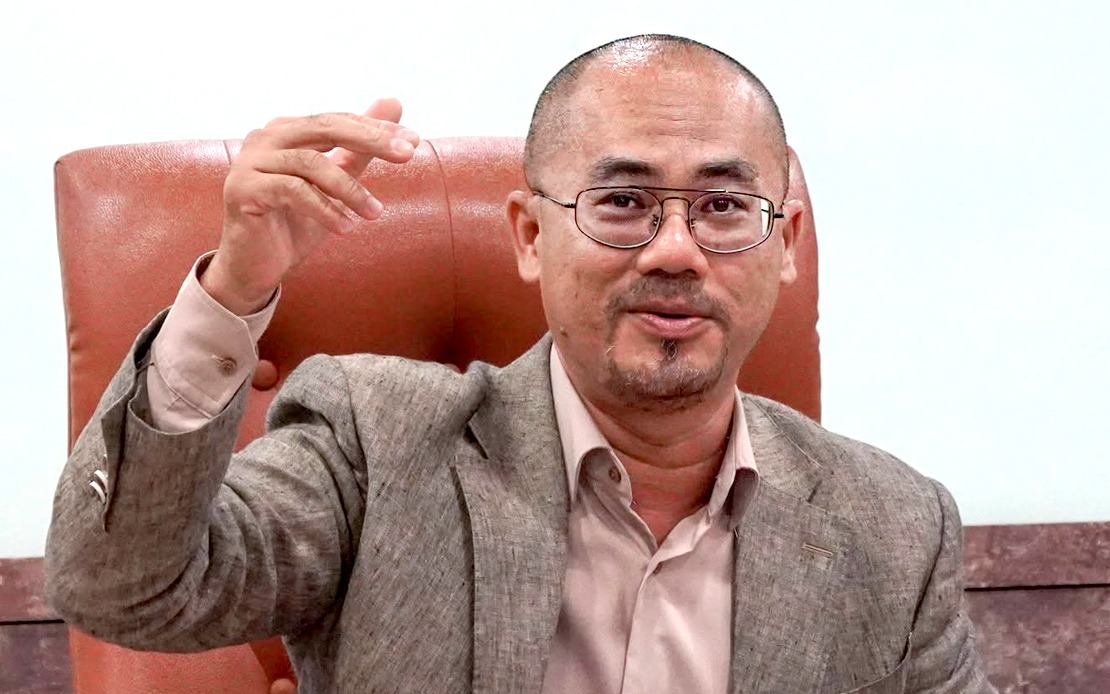
The Perak Islamic Religious and Malay Customs Council (MAIPk) has moved to quash speculation that it forcibly removed traders from a commercial site near Jalan Panglima Bukit Gantang Wahab in Ipoh, following allegations made on social media that characterised the water disconnection as an eviction order. Speaking at the closing of the 2026 Perak State Mosque Committee Convention at the Casuarina Convention Centre, chief executive officer Syamsul Hazeman Md Salleh stressed that no directive was issued requiring business operators to vacate the premises, clarifying instead that the council had issued a notice to explain its position following complications with the property's infrastructure and finances.
The disputed notice emerged in response to what Syamsul Hazeman described as longstanding defects in the site's water supply system and an accumulated bill totalling approximately RM100,000. He explained that during a dialogue with traders held on July 14, MAIPk conveyed the necessity of temporarily suspending water connections to allow maintenance crews to address the leaking main water pipeline and settle the outstanding arrears. The council's position, he maintained, was purely informational, designed to clarify MAIPk's responsibilities and to shield the institution from misrepresentation in public discourse. The notice was not, he insisted, a demand for traders to abandon their businesses.
The circumstances underlying the debt reveal a more complex institutional narrative. MAIPk acquired ownership of the land only in 2024, after which point it discovered that the property carried a problematic history spanning years. The defects in the main water pipeline were not recent developments but rather issues inherited along with the title transfer, and similarly the water arrears had accumulated long before MAIPk's stewardship began. Crucially, Syamsul Hazeman emphasised that the RM100,000 debt did not stem from consumption by the traders themselves, who he said paid their individual usage charges in accordance with their respective meter readings. Rather, the arrears reflected systemic failures and losses embedded in the infrastructure serving the entire premises, matters beyond the direct control or responsibility of the business operators who occupied the space.
The council's financial and legal constraints in addressing the problem underscore the practical bind MAIPk faces. Syamsul Hazeman acknowledged that the scale and nature of the debt exceeded the council's capacity to resolve unilaterally, particularly given that zakat and waqf funds—the two primary revenue streams available to Islamic religious organisations in Malaysia—cannot be redirected toward settling such arrears according to Islamic jurisprudential principles and state regulations. This distinction carries weight in Malaysia's framework for managing Islamic institutions, where funds designated for charitable and endowment purposes maintain strict legal segregation from operational liabilities of the host organisation.
Recognising the complexity, MAIPk has initiated engagement with the Perak Water Board to negotiate a resolution. Beyond dialogue with the water utility, the council has also sought intervention from the state government, reflecting the view that the problem transcends what a single institution can manage independently. Syamsul Hazeman expressed measured optimism that a solution would materialise, though he cautioned that resolution would require patience and time, signalling that this is not a matter susceptible to rapid closure. The approach mirrors how local authorities in Malaysia often handle infrastructure debts at commercial sites, requiring coordination across multiple agencies.
Once the arrears question is settled and repair works have been completed, MAIPk intends to establish new commercial leasing arrangements with traders through freshly executed contracts. This approach would allow the council to reset the operational parameters and ensure clarity regarding tenant obligations and property management protocols going forward. However, this interim phase of stabilisation may face disruption from a separate development plan that remains in preliminary stages. MAIPk has indicated that a proposed Perak Islamic Religious Department Complex is slated for eventual construction at the site, though no definitive timeline has been established and the decision rests with state government authorities rather than the council itself.
The proposed development introduces an additional layer of uncertainty for the traders currently occupying the premises. Syamsul Hazeman made clear that should the complex project proceed, traders would be expected to vacate and make way for construction. However, his statement that "we do not know when the project will take place" reflects the distance between conceptual planning and implementation in Malaysia's bureaucratic apparatus. The vagueness surrounding timelines means traders face a situation of indefinite liminality—their businesses are not presently threatened, yet the long-term security of their tenancies remains contingent on decisions made at government level beyond MAIPk's purview.
The entire episode illustrates how institutional transitions in property ownership and management, common across Malaysian religious and civic establishments, can create communication gaps and operational friction. MAIPk's acquisition of the site triggered the discovery of pre-existing liabilities and infrastructure defects that neither the new owners nor the incumbent traders had fully anticipated or acknowledged. The dispute that erupted on social media reflected a broader anxiety among small traders in Malaysia, who frequently operate on thin margins and face precariousness regarding tenure and operational costs. The council's defensive posture—insisting it issued merely a "clarification" rather than an eviction mandate—reveals how sensitive such matters are in local commerce, where the rumour of displacement can itself destabilise confidence and livelihoods.
For Malaysian business owners and traders, the case carries lessons about institutional transparency and the importance of formalised communication in property disputes. The fact that social media allegations prompted a public statement from the council's chief executive underscores how digital platforms have become staging grounds for local grievances, particularly when official channels appear unresponsive or unclear. MAIPk's response, while technically exculpatory, also reveals the limits of what religious institutions can achieve when saddled with inherited infrastructure problems and financial liabilities accumulated under previous management or ownership regimes.
As the council works toward resolution with the water authority and state government, the traders at the Jalan Panglima Bukit Gantang Wahab site remain in a state of practical suspension. Their businesses continue, water remains temporarily disconnected or severely restricted, and the prospect of eventual displacement for the proposed religious department complex looms without schedule or certainty. The unfolding situation reflects broader tensions in Malaysia's urban and semi-urban commercial landscapes, where religious institutions, state authorities, and small-scale traders navigate competing interests and limited resources.

