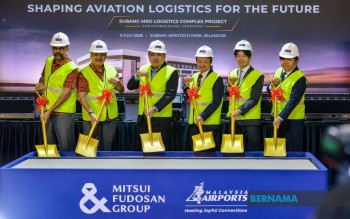
Malaysia Airports Holdings Bhd (MAHB) and Mitsui Fudosan Group, a prominent Japanese real estate and logistics operator, have officially launched construction of a RM80 million air cargo and maintenance logistics facility at Subang Airport, marking a significant milestone in the country's aviation infrastructure expansion. The groundbreaking ceremony, held on Thursday at Subang Aerotech Park, signals the growing momentum to modernise airport-adjacent industrial zones and attract international investment into Malaysia's logistics sector. Through the joint venture entity MFMA Industrial Sdn Bhd, MAHB will retain a 30 per cent shareholding while its Japanese partner commands a controlling 70 per cent stake in the project.
Transport Minister Anthony Loke Siew Fook characterised the arrangement as a carefully calibrated strategy to unlock value from MAHB's substantial real estate holdings whilst mitigating operational and development risks. Rather than assuming sole responsibility for complex logistics operations, the airport authority has chosen to partner with an entity possessing proven expertise in establishing and managing specialised cargo facilities. Mitsui Fudosan's track record managing similar operations at Tokyo's Haneda Airport—one of the world's busiest aviation hubs—provides demonstrable confidence in its ability to execute the project competently and operate it to international standards. This risk-sharing approach reflects a broader trend among Malaysian infrastructure operators to pursue strategic alliances with experienced international counterparts rather than pursuing entirely domestic-led initiatives.
The Subang facility will focus specifically on maintenance, repair, and overhaul (MRO) services alongside general air cargo handling, positioning it to serve the growing aerospace and aviation maintenance ecosystem that has clustered around Subang Airport over the past two decades. The MRO sector has become increasingly attractive to Malaysian policymakers as a value-added activity that generates employment in skilled engineering roles and supports the broader aircraft servicing supply chain. By dedicating dedicated logistics infrastructure to support these operations, the partnership aims to reduce bottlenecks and enhance the efficiency of aircraft maintenance workflows, potentially attracting additional MRO operators to establish or expand operations at Subang.
Locating the complex within Subang Aerotech Park creates significant advantages for tenants by ensuring seamless integration with existing aerospace facilities and reducing the friction costs of moving components and equipment between maintenance hangars and cargo handling points. The park has evolved over two decades into a concentrated hub for aviation-related manufacturing, component testing, and engineering services, drawing multinational aerospace suppliers and regional maintenance providers. Adding purpose-built logistics capability addresses a recognised gap in the ecosystem, providing companies with the warehouse, ground handling, and transportation infrastructure necessary to operate efficiently within the precinct.
Mitsui Fudosan's involvement signals growing Japanese corporate confidence in Malaysia's long-term aviation sector prospects and infrastructure stability. The company's willingness to deploy capital in a non-core markets reflects broader patterns of Japanese conglomerates diversifying geographically to reduce dependency on domestic markets whilst capturing growth opportunities across East and Southeast Asia. The partnership demonstrates how Japanese operational expertise in running large-scale logistics networks can be adapted to Malaysian conditions, potentially yielding lessons applicable elsewhere in the region's emerging infrastructure ecosystem.
The RM80 million investment size, whilst modest compared to massive airport expansion projects, represents meaningful commitment to supporting the intermediate aviation services market rather than only passenger-facing infrastructure. This distinction matters because air cargo and MRO operations generate steady revenue streams with lower volatility compared to passenger terminal operations, which fluctuate sharply with travel demand cycles and geopolitical disruptions. The logistics complex therefore offers MAHB revenue diversification whilst contributing to Subang Airport's strategic positioning as a specialist aviation services hub rather than primarily a passenger gateway.
From a Malaysian perspective, the project reinforces Subang's emerging role as the country's dedicated aviation and aerospace services centre, complementing Kuala Lumpur International Airport's passenger-focused operations. This functional specialisation allows each facility to optimise infrastructure and service offerings rather than attempting to serve all aviation needs at every airport. Subang's concentration of MRO operators, aerospace suppliers, and now dedicated logistics infrastructure creates competitive advantages that should attract additional regional investment in aircraft maintenance and component manufacturing over coming years.
The partnership structure also carries implications for how Malaysia Airports approaches future airport land monetisation. By establishing templates for joint ventures with capable international operators, MAHB creates pathways to develop underutilised assets without burdening its own operational or financial capacity. This model could potentially be replicated at other MAHB-controlled airports where suitable strategic partners and market opportunities align, suggesting a broader shift toward privatised management of airport-adjacent commercial activities.
The timing of the development, coinciding with gradual aviation sector recovery following pandemic disruptions, positions the facility to benefit from pent-up demand for maintenance services and cargo handling capacity. As air freight markets stabilise and regional aircraft utilisation increases, facilities offering reliable specialised logistics services will become increasingly valuable to operators seeking to optimise turnaround times and reduce ground handling costs.

