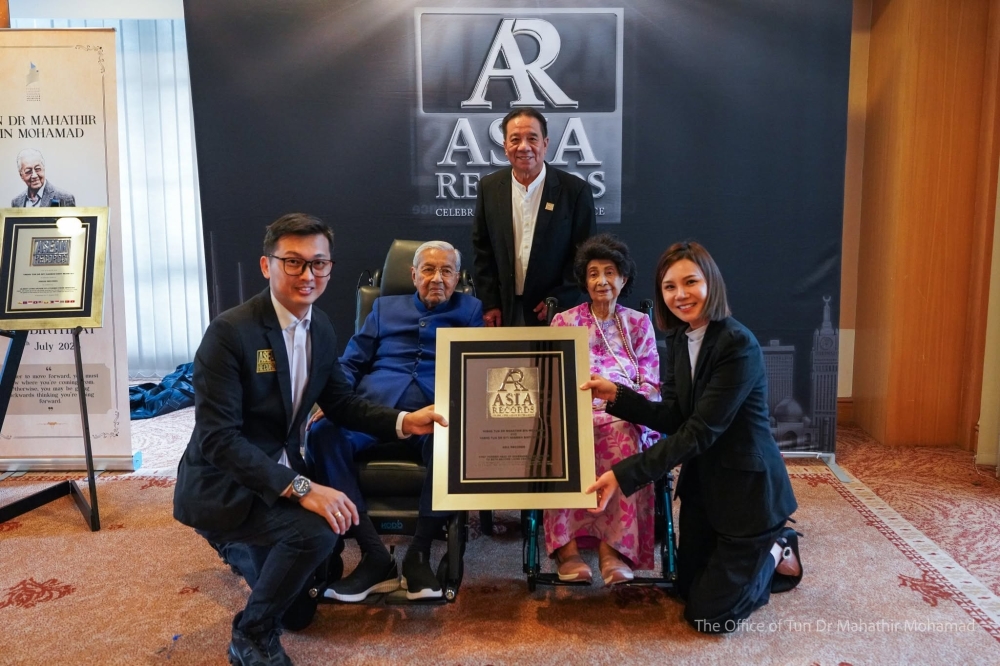
Former Prime Minister Tun Dr Mahathir Mohamad and his wife Tun Dr Siti Hasmah Mohd Ali have achieved a remarkable distinction by securing three Guinness World Records following their entry into the centenarian club. The recognition underscores the exceptional longevity of Malaysia's most prominent political couple and adds to their already substantial historical legacy spanning nearly seven decades of public life.
The couple's achievement represents a unique milestone in Malaysia's modern history. Dr Mahathir, who served as Prime Minister during two separate periods—from 1981 to 2003 and again from 2018 to 2020—has become a symbol of political endurance and continued relevance well into his twilight years. His wife, Dr Siti Hasmah, equally instrumental in supporting Malaysia's development during those formative decades, stands as a dignified pillar of the nation's institutional memory. Their joint longevity transcends typical celebrity status, embodying a generational bridge between Malaysia's post-independence era and its contemporary governance landscape.
The Guinness World Records recognition carries particular significance for a nation often preoccupied with demographic trends and ageing populations. Southeast Asia faces mounting pressures from rapidly ageing societies, with Malaysia projected to become an ageing nation by 2040. The Mahathir-Siti Hasmah achievement offers a compelling narrative about healthy ageing and active engagement in public discourse, challenging conventional assumptions about capacity and contribution in advanced years. Their records serve as an inspiration across the region, demonstrating that longevity paired with intellectual vitality need not signal withdrawal from public engagement.
Dr Mahathir's continued prominence in Malaysian political conversation, despite his formal retirement from electoral politics, reflects a phenomenon uncommon in Southeast Asian democracies. Unlike many former leaders who fade from public view, Dr Mahathir has maintained an active presence through media appearances, public statements, and involvement in civil society discussions. His advanced age has not diminished his willingness to critique government policies or engage in debate, maintaining a role as an elder statesman whose perspectives command attention across political divides. This sustained visibility has kept both him and Dr Siti Hasmah in the national consciousness in ways that transcend mere nostalgia.
The recognition by Guinness World Records validates not merely their reaching 100 years of age but potentially encompasses other dimensions of their remarkable partnership. Whether the records relate to longevity as a married couple, their combined contributions to public life, or their sustained influence as centenarians, the achievement speaks to the exceptional nature of their lifelong partnership. In an era where marital stability and mutual support systems correlate strongly with longevity outcomes, their enduring relationship offers genuine insight into factors contributing to extended lifespan.
For the Malaysian public, the records affirm the extraordinary position both occupy in the nation's consciousness. Dr Mahathir's tenure as Prime Minister coincided with Malaysia's transformation into a middle-income economy and the implementation of the ambitious Vision 2020 development framework. Dr Siti Hasmah's role as First Lady during those critical decades, coupled with her advocacy for health and wellness initiatives, established her as an independent figure worthy of recognition beyond spousal association. Their joint achievement at 100 allows both to be acknowledged for their individual and combined contributions.
The Guinness recognition also arrives at a moment when Malaysia continues grappling with questions of political leadership and legacy. As the nation navigates contemporary challenges ranging from racial and religious tensions to economic pressures and democratic governance debates, the presence of living elder figures who bridged different political eras provides valuable continuity. Their centenarian status lends them a peculiar authority—they are witnesses to transformation, repositories of institutional memory, and symbols of continuity in an era of rapid change.
Beyond Malaysia's borders, the achievement resonates across Southeast Asia and within diaspora communities worldwide. Malaysians living abroad have observed with pride the international recognition bestowed upon their former leaders, while neighbouring nations take note of how Malaysia celebrates its elder statesmen. The Guinness World Records distinction elevates the achievement beyond national discourse into the realm of global recognition, positioning Malaysia favourably within international narratives about ageing societies and elder contributions.
The health trajectory of both centenarians offers valuable data points for gerontological research and public health planners. Malaysia's healthcare system, which enabled both to reach 100 in reasonable health, reflects decades of investment in medical infrastructure and wellness initiatives that largely coincided with Dr Mahathir's tenure. Their longevity validates, in some measure, policy choices made during their years in office regarding healthcare accessibility and public health prioritisation.
Looking forward, the Guinness recognition ensures that Dr Mahathir and Dr Siti Hasmah's story will be documented in the official canon of human achievement. Their records become permanent fixtures in the archive of the extraordinary, ensuring that future generations encountering Malaysia's history will understand the exceptional longevity and influence of this couple. For a nation still consolidating its identity and historical narrative, such international validation carries symbolic weight beyond typical achievement metrics.
The three records, whatever their specific classifications, collectively affirm that Dr Mahathir and Dr Siti Hasmah represent something genuinely exceptional—not merely in Malaysian terms but on a global stage. Their achievement invites reflection on how nations recognise, celebrate, and integrate the contributions of elder figures, particularly those whose influence extended across multiple decades and defined entire eras of national development.

