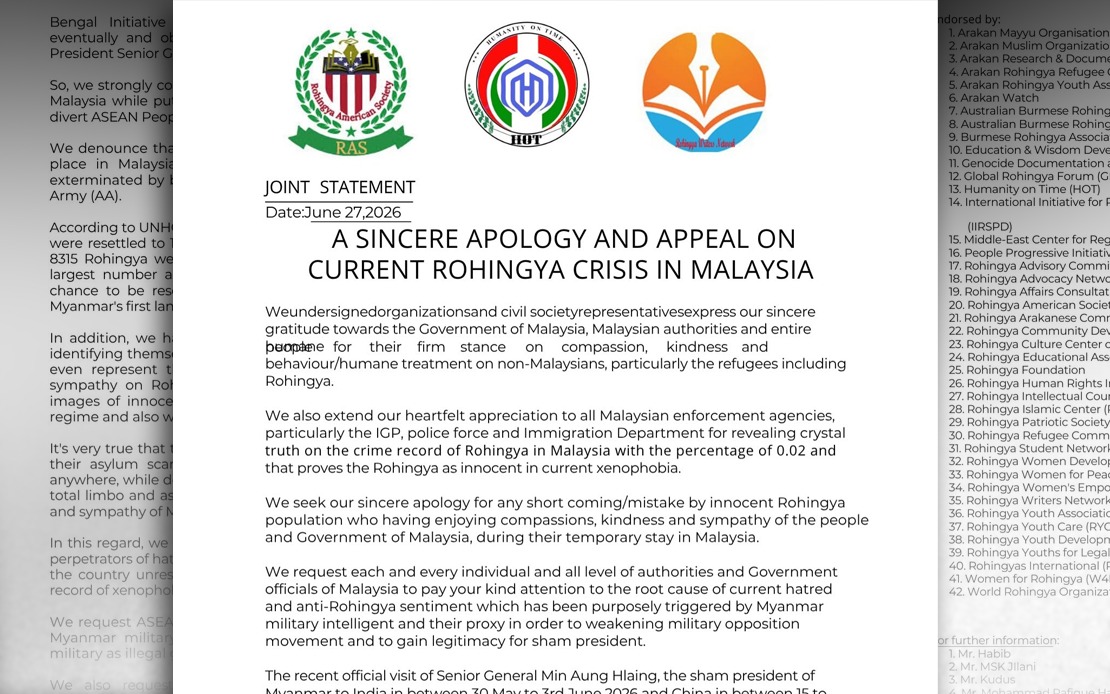
Malaysia's premier humanitarian organisation MAHAR has responded positively to an apology issued by 40 Rohingya non-governmental organisations, treating the gesture as evidence of collective accountability within the refugee support sector. The organisation seized the moment to articulate a broader vision for how refugee aid should operate in the Malaysian context, moving beyond conventional charitable work to encompass deeper integration and mutual responsibility between displaced populations and host communities.
In shifting the conversation around humanitarian assistance, MAHAR emphasised that the scope of refugee support work must extend well beyond the provision of basic essentials. While food and shelter remain critical, the organisation contends that contemporary humanitarian practice should simultaneously include structured programmes teaching refugees about their obligations and expected conduct while residing in Malaysia. This reframing reflects growing recognition that sustainable refugee integration requires two-way engagement rather than one-directional service provision.
The organisation has specifically called upon the 40 Rohingya NGOs to strengthen their role in cultivating respect among refugee populations for Malaysian legal frameworks, cultural practices, and social values. By positioning this advocacy as foundational to improving local-refugee relations, MAHAR has articulated a form of humanitarian work that serves both vulnerable populations and receiving communities. This approach addresses a persistent tension in Malaysian refugee discourse: the need to protect one of the world's largest stateless populations while simultaneously maintaining social cohesion in host communities increasingly strained by the scale of displacement.
Beyond the domestic sphere, MAHAR has urged the coalition of NGOs to amplify international advocacy targeting the systematic persecution of Rohingya in Myanmar. The organisation's reasoning reflects a nuanced understanding that sustainable humanitarian interventions must address underlying causes rather than merely managing symptoms. As long as conditions in Myanmar remain dire, MAHAR implies, the refugee population in Malaysia will continue to expand, placing compounding pressure on local resources and services. This emphasis on root-cause advocacy distinguishes MAHAR's approach from purely palliative responses to displacement.
Jismi Johari, MAHAR's President, has introduced an important safety dimension to the debate. He stressed that genuine humanitarian work must simultaneously prioritise the wellbeing of both refugee populations and local Malaysian communities. This dual-focus framework represents an attempt to move beyond what he views as false binaries between refugee protection and local security—a distinction that matters deeply in Malaysian political discourse where refugee issues have become increasingly contentious at the grassroots level.
Johari acknowledged that certain Malaysians have raised legitimate safety concerns rooted in their direct experiences of incidents involving individuals from refugee communities. Rather than dismissing these concerns as xenophobic or prejudicial, MAHAR's leadership has chosen to validate them as part of authentic community feedback that cannot be ignored. This stance represents a calculated effort to establish MAHAR as a credible interlocutor capable of understanding both refugee vulnerabilities and host-community anxieties.
Simultaneously, Johari cautioned against the dangers of collective stereotyping, emphasising that painting entire communities with the brush of minority misconduct represents a fundamental injustice. He pointed out that deviance exists across all social strata and ethnic groups, implying that scrutiny of refugee communities should not exceed the scrutiny applied to established populations. This argument, while philosophically sound, operates within a contested space where Malaysian public opinion has grown increasingly sceptical of refugee populations following high-profile incidents.
The MAHAR President framed resolution of community tensions as requiring empathy, mutual respect, and constructive dialogue involving all relevant stakeholders. This tripartite framework—emotional intelligence, reciprocal regard, and inclusive deliberation—suggests that sustainable coexistence depends less on top-down policy mandates and more on organic relationship-building between refugees, NGOs, local authorities, and residents. For Malaysian readers, this emphasis on grassroots engagement carries particular significance given the devolved nature of local governance and the influence of community associations in shaping public opinion on refugee issues.
MAHAR has reaffirmed its institutional commitment to humanitarian work grounded in what it terms justice, safety, and human dignity. This three-part formulation attempts to balance the moral imperative to protect vulnerable refugees against the practical necessity of maintaining social order and security within receiving communities. The language choice is deliberate: justice encompasses refugee rights and fair treatment, safety acknowledges legitimate local concerns, and human dignity applies to both populations, rejecting hierarchies of worthiness.
The organisation's intervention arrives at a critical juncture in Malaysia's handling of refugee affairs. With over 180,000 registered Rohingya and hundreds of thousands of other refugees and asylum seekers nationwide, Malaysia hosts one of Asia's largest refugee populations. Tensions between humanitarian obligations and local resource constraints have intensified as informal settlements expand in major urban centres, occasionally sparking neighbourhood conflicts. MAHAR's call for expanded NGO engagement thus addresses not merely philosophical principles but urgent operational realities affecting millions of vulnerable people and hundreds of thousands of Malaysian residents.
The apology from 40 Rohingya NGOs, while significant as a symbolic acknowledgement of accountability, suggests growing awareness within refugee-led organisations that acceptance in Malaysian society requires demonstrated commitment to coexistence rather than simply advocating for refugee interests. MAHAR's response frames this as an opportunity to elevate the entire sector's standards and to model how humanitarian work can serve integration rather than inadvertently reinforcing parallel communities.
Looking forward, MAHAR's framework offers Malaysian policymakers a middle pathway: neither abandoning humanitarian principles nor ignoring legitimate public concerns. By positioning refugee support organisations as crucial mediators capable of fostering mutual understanding, the body has arguably elevated expectations for what constitutes responsible humanitarian practice in the Southeast Asian context. Whether the 40 Rohingya NGOs can operationalise these expectations while managing resource constraints remains an open question with profound implications for Malaysia's approach to regional displacement challenges.

