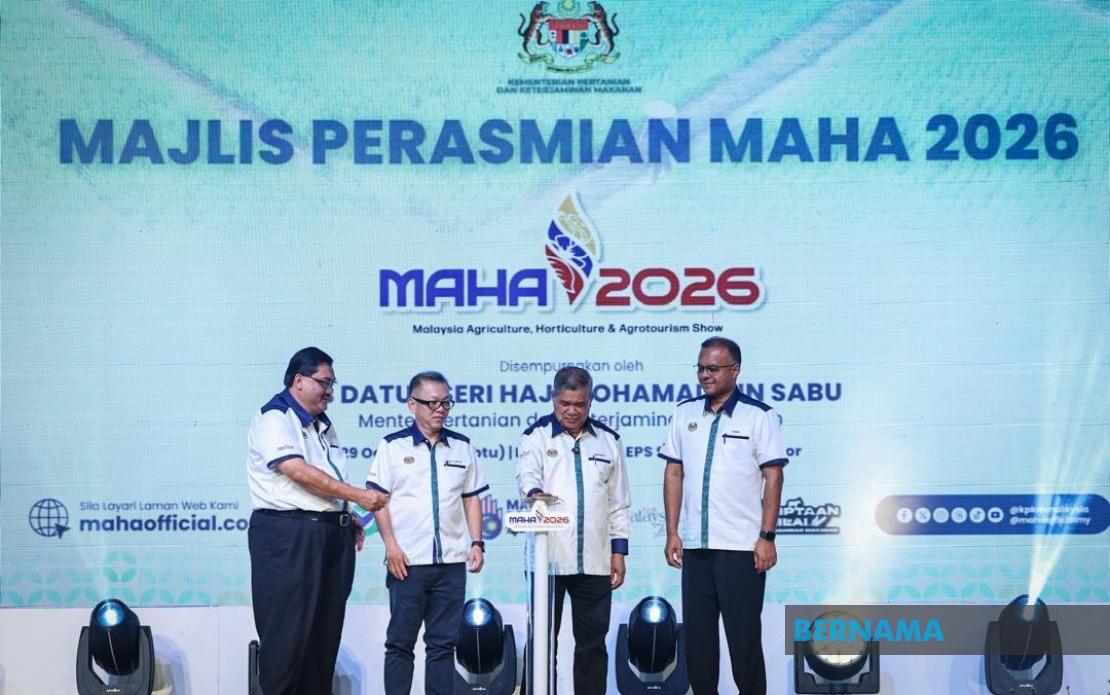
Agriculture and Food Security Minister Datuk Seri Mohamad Sabu has positioned the Malaysia Agriculture, Horticulture and Agrotourism Show 2026 as a watershed moment for transforming the nation's farming landscape through an unwavering commitment to sustainable practices. Speaking at the opening of MAHA 2026 at the Malaysia Agro Exposition Park Serdang on August 29, Mohamad underscored how environmental responsibility and economic viability must advance together as Malaysia confronts the twin challenges of climate change and food security.
The minister's vision extends beyond conventional farming efficiency to encompass a holistic reimagining of how Malaysia produces, processes, and distributes food. By championing sustainable agricultural methods, the government seeks to simultaneously reduce the country's carbon footprint while building resilience in supply chains vulnerable to external shocks. This dual approach addresses mounting concerns among consumers and trading partners about environmental credentials, particularly as international markets increasingly demand proof of sustainable sourcing from agricultural exporters.
Modern sustainable practices showcased at MAHA 2026 reflect diverse innovations now reshaping Asian farming. These include optimising electricity consumption through precision agriculture technologies, implementing circular economy principles in waste and food management systems, phasing out single-use plastics across production and retail phases, regenerative agriculture techniques that restore soil health, and comprehensive recycling protocols that transform agricultural byproducts into valuable inputs. For Malaysian farmers and agribusinesses, adoption of such methods opens pathways to premium market segments where consumers willingly pay price premiums for certified sustainable produce.
Crucially, Mohamad invoked the Green Book Policy, initiated by Malaysia's second Prime Minister Tun Abdul Razak in 1974, as an enduring blueprint for contemporary agricultural strategy. That pioneering framework sought to curb reliance on food imports while addressing cost-of-living pressures through expanded domestic production. Nearly five decades later, as geopolitical uncertainties and climate volatility threaten global supply chains, the policy's core objective—achieving meaningful food self-sufficiency—resonates with renewed urgency for policymakers and farmers alike. The minister's deliberate resurrection of this historical reference signals continuity in strategic thinking whilst signalling adaptation to present-day sustainability imperatives.
The government's modernisation agenda encompasses significant investment across livestock and fisheries sectors, traditionally important to Malaysian rural communities and export earnings. Enhanced fishing vessel technology, upgraded farm facilities, development of high-value aquaculture segments, technological integration in animal feed production, and strengthened disease surveillance protocols collectively represent an ambitious transition toward efficiency and food safety. These infrastructure and systems improvements position Malaysian producers to compete effectively in markets where safety standards and traceability have become non-negotiable prerequisites for market access.
International dimension to MAHA 2026 reflects broader recognition that sustainable agriculture requires cross-border collaboration and knowledge exchange. With delegations from fourteen countries participating, the exposition functions as a diplomatic and commercial platform where governments and private enterprises identify partnership opportunities. Yet Mohamad's caution regarding memoranda of understanding proves instructive: bilateral and multilateral agricultural agreements frequently languish as ceremonial documents unless anchored to concrete implementation frameworks and measurable outcomes. His insistence that cooperation must yield tangible results—increased export volumes, technology transfer, investment flows—elevates expectations beyond symbolic diplomacy.
For Malaysia's emerging agritech sector and smallholder farmers, MAHA 2026 represents a critical inflection point. Startup enterprises and new agricultural businesses require capital injections and market access to scale innovations addressing production constraints. International investors attending the exposition bring not merely financial resources but also technical expertise, distribution networks, and exposure to global best practices. By facilitating connections between domestic entrepreneurs and external capital sources, the government endeavours to democratise access to growth capital whilst ensuring Malaysian enterprises retain ownership and decision-making authority over agricultural innovation.
The scale of MAHA 2026 underscores agriculture's enduring economic and social significance within Malaysia's development trajectory. Hosting approximately two thousand exhibitors and targeting over four million visitors during its ten-day run reflects the sector's capacity to mobilise diverse constituencies—from commercial agribusinesses to consumers seeking locally-produced goods. For regional observers, the exposition benchmarks Malaysia's agricultural ambitions against peer nations also pursuing sustainability certification and market differentiation in increasingly competitive Asian food systems.
Sustainability discourse in Malaysian agriculture carries particular resonance given the sector's land-use footprint and demographic composition. Smallholder farmers, who constitute the farming sector's demographic backbone, often lack technical capacity and capital to independently invest in sustainability infrastructure. Government facilitation through platforms like MAHA 2026—connecting smallholders with technology providers, extension services, and market opportunities—becomes essential for inclusive transition toward sustainable practices. Without deliberate inclusion of marginal producers, sustainability initiatives risk reinforcing existing inequalities whilst concentrating benefits among larger, better-resourced operators.
Deputy Minister Datuk Chan Foong Hin and the Ministry's Secretary-General Datuk Seri Isham Ishak's presence at the opening ceremony signals institutional commitment across the agriculture ministry's hierarchy. Alignment between political leadership and bureaucratic implementation structures proves critical for translating policy pronouncements into sustained operational changes. The multipart sustainability agenda outlined by Mohamad requires coordination across production, processing, marketing, and export functions—demanding coherent institutional architecture and adequate resourcing.
Looking forward, MAHA 2026's success in catalysing genuine agricultural transformation depends partly on how effectively the exposition translates international interest into binding commercial arrangements and investment commitments. The minister's emphasis on moving beyond symbolic gestures toward measurable outcomes suggests the government recognises previous initiatives' limitations in generating lasting change. Whether agritech startups secure significant capital injections, export agreements materialise into substantial order volumes, and smallholder farmers gain meaningful access to sustainability support services will ultimately determine whether MAHA 2026 marks genuine sectoral transition or merely another well-intentioned but ultimately circumscribed policy moment.

