The MADANI Government has reaffirmed its commitment to advancing sustainable and inclusive development across every state in Malaysia, with Pakatan Harapan (PH) leadership stressing that regional progress must benefit all citizens equitably. Datuk Seri Saifuddin Nasution Ismail, the coalition's secretary-general and Home Minister, delivered this message during an engagement in Johor Bahru, underscoring the federal administration's determination to prioritise economic growth that translates into tangible improvements for ordinary Malaysians rather than merely accumulating capital expenditure figures.
Under the stewardship of Prime Minister Datuk Seri Anwar Ibrahim, the government has positioned itself as a champion of multi-faceted development that extends beyond traditional economic metrics. The administration's policy framework emphasises strategic investments in core infrastructure systems, modernised public transportation networks, healthcare accessibility, and resilience-building measures such as flood mitigation. This holistic approach reflects a recognition that sustainable prosperity depends on establishing robust foundations across multiple sectors simultaneously, rather than concentrating resources on isolated flagship projects.
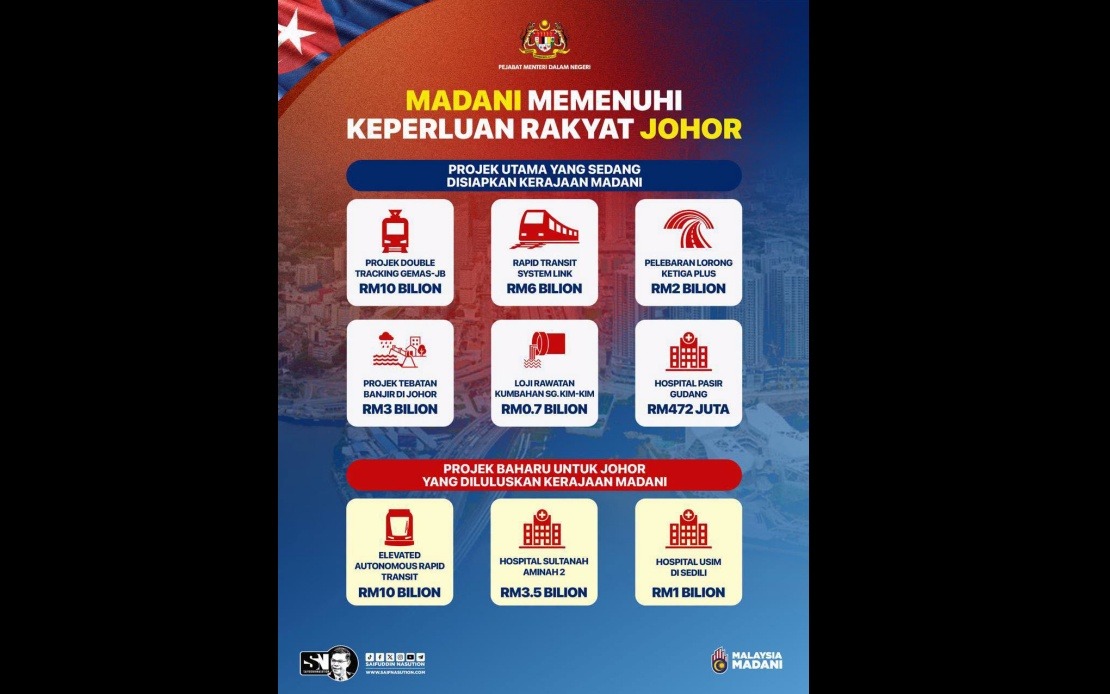
Johor has emerged as a testing ground for this developmental philosophy, with the state currently experiencing accelerated implementation of several transformative initiatives. The Gemas-Johor Bahru Electrified Double Tracking Project represents a significant modernisation of rail connectivity, promising enhanced passenger capacity and operational efficiency along a critical transport corridor. This venture forms part of a broader vision to transform Malaysia's railway infrastructure into a competitive alternative to road transport, particularly across major economic zones. The rail electrification scheme also carries environmental implications, reducing transport-sector emissions as the country pursues decarbonisation targets aligned with international climate commitments.
The Rapid Transit System (RTS) Link project further demonstrates the government's focus on metropolitan mobility challenges. By introducing seamless cross-border public transport connections, the initiative addresses long-standing commuter needs in the Johor Bahru–Singapore corridor, where hundreds of thousands of workers traverse daily. Such infrastructure investments carry implications beyond convenience; they reshape labour market dynamics, reduce congestion-related economic losses, and enhance competitiveness for the region as a logistics and commercial hub. Similarly, the third-lane expansion of the PLUS Highway aims to alleviate bottlenecks on one of Malaysia's most heavily trafficked arterial routes, directly impacting supply-chain efficiency and business operating costs across the southern region.
Parallel to transportation modernisation, the government has prioritised flood mitigation with particular urgency in Johor, a state frequently affected by seasonal inundation. The dedicated Johor flood mitigation project, alongside complementary infrastructure such as the Sungai Kim Kim Sewage Treatment Plant, addresses interconnected urban drainage and environmental challenges. Flooding has historically imposed substantial economic and social costs on affected communities, disrupting commerce, damaging property, and threatening lives. Investment in preventive systems thus functions as both a humanitarian imperative and an economic efficiency measure, protecting existing capital assets and enabling uninterrupted business operations.
Healthcare expansion has also received substantial attention in the government's Johor strategy. The Pasir Gudang Hospital, along with newly approved facilities including Sultanah Aminah Hospital 2 and the USIM Hospital facility in Sedili, represents significant capacity-building in medical services. This expansion responds to demographic pressures and emerging health demands in a state with a substantial and growing population. Enhanced healthcare infrastructure carries multiple returns: improved treatment outcomes reduce indirect productivity losses from prolonged illnesses, bolster public confidence in government services, and reduce medical tourism leakage as citizens access world-class care domestically.
Saifuddin Nasution's articulation of development philosophy emphasises that progress cannot be evaluated solely through budget allocations or project expenditures. Instead, success should be measured through concrete improvements in daily living standards experienced by constituents. This framing addresses a persistent critique of development discourse in Malaysia, where massive infrastructure investments sometimes fail to meaningfully enhance livelihood conditions for ordinary citizens. By explicitly prioritising job creation alongside physical infrastructure, the MADANI Government signals recognition that sustainable development requires employment generation and skills upgrading, not merely construction of assets.
The transportation efficiency gains promised by these initiatives carry particularly significant implications for Malaysian workers and businesses. Reduced commute times translate directly into improved work-life balance and enhanced productivity, while lower congestion generates environmental co-benefits through reduced vehicular emissions. For businesses, infrastructure improvements reduce logistics costs and supply-chain vulnerabilities, enhancing regional competitiveness against other Southeast Asian economic zones competing for manufacturing and commerce investment.
The breadth of Johor-focused initiatives also reflects the state's strategic importance within Malaysia's economic architecture. As the second-largest contributor to national GDP and home to critical petrochemical, port, and semiconductor facilities, development outcomes in Johor carry multiplier effects across the entire economy. Enhanced infrastructure, healthcare, and transportation systems in this region therefore serve not merely local constituencies but strengthen Malaysia's competitive positioning within global supply chains and emerging economic networks.
Looking beyond Johor, the government's enunciation of commitment to all states suggests this developmental framework operates as a national template rather than preferential regional policy. This approach carries implications for federal-state relations and resource allocation debates, as it positions the central government as guarantor of inclusive progress across diverse administrative jurisdictions. For states governed by opposition coalitions, this messaging tests whether the MADANI administration maintains equitable commitment to development delivery or whether political considerations influence infrastructure prioritisation.
The emphasis on sustainable, inclusive development also aligns with Malaysia's international commitments under the United Nations Sustainable Development Goals framework. By foregrounding environmental considerations, healthcare access, and employment creation alongside infrastructure, the government projects an image of development as integrated rather than extractive. This positioning becomes particularly important as Malaysia competes with regional neighbours for foreign direct investment and seeks to attract international capital increasingly conscious of environmental, social, and governance criteria.
Moving forward, the test of MADANI Government commitment will centre on delivery pace and equitable resource distribution. The articulated vision represents an ambitious agenda requiring sustained political will, technical capacity, and inter-agency coordination. Success will depend on whether announced projects reach completion within reasonable timeframes and budgets, whether tangible employment and quality-of-life improvements materialise, and whether development benefits distribute equitably across income groups and geographic areas rather than concentrating among already-privileged constituencies.

