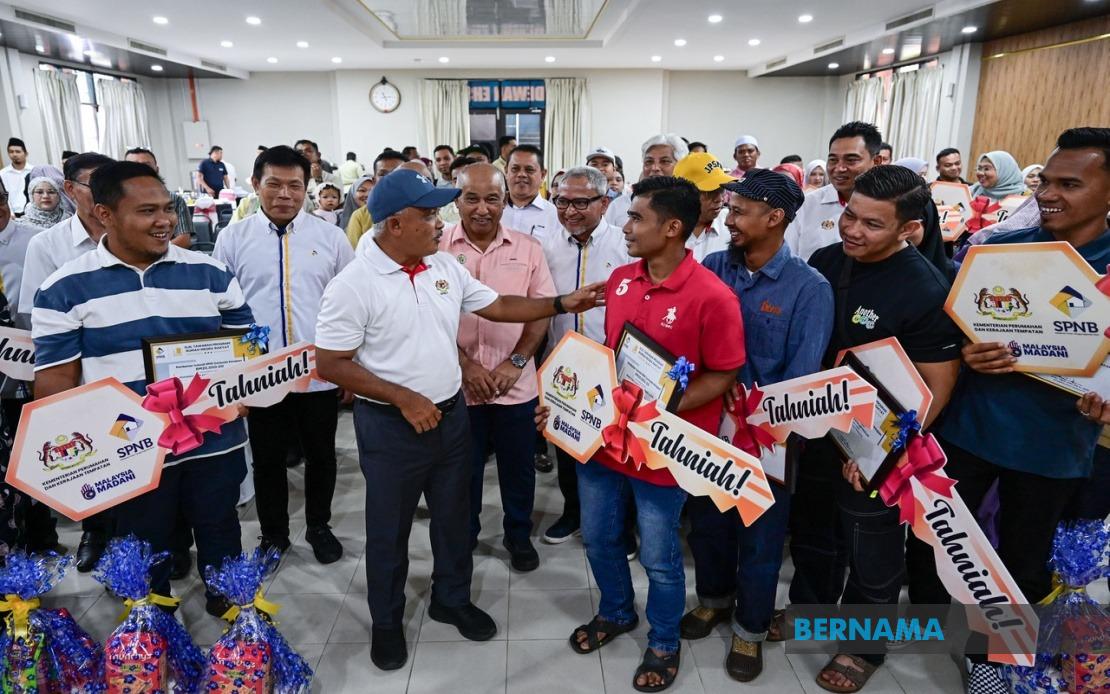
The MADANI Government took a significant step in its housing agenda when fifty families in the Kuala Terengganu and Kuala Nerus constituencies received assistance under the Rumah Mesra Rakyat (RMR) programme during a ceremony held in Kuala Nerus. The presentation, which took place at Dewan Ehsan in Felda Wilayah Timur, comprised thirty completed homes ready for immediate occupation and twenty offer letters granting approval for the construction of new residential units. The Housing and Local Government Ministry (KPKT) secretary-general Datuk Dr M. Noor Azman Taib oversaw the distribution, marking another milestone in the government's commitment to addressing Malaysia's affordable housing challenge.
The RMR initiative, which operates under the National Housing Company (Syarikat Perumahan Negara Berhad or SPNB), targets a specific and often underserved demographic: landowners from lower-income backgrounds who possess property but cannot afford to build or acquire proper housing. This targeted approach distinguishes the programme from conventional subsidised housing schemes, as it recognises that land ownership does not automatically translate to housing security. By providing construction assistance and completed homes to eligible families, the government addresses what many consider a structural gap in Malaysia's housing market, where purchasing power among certain groups remains constrained despite underlying asset ownership.
According to Datuk Dr M. Noor Azman, the RMR programme transcends the simple transaction of handing over house keys. Rather, it functions as a comprehensive mechanism for elevating living standards and fostering economic stability among participating families. The initiative acknowledges that secure, comfortable housing forms the foundation for improved household wellbeing, stronger family structures, and more cohesive communities. This holistic perspective aligns with international development thinking that views housing security as essential infrastructure for breaking cycles of poverty and enabling families to invest in education, health, and other areas critical to social mobility.
The government's ambition for the RMR programme appears substantial. Under Budget 2026, authorities intend to construct six thousand five hundred and forty-five units nationwide, representing a significant expansion of the scheme. Progress to date demonstrates that the government has already implemented nearly three thousand nine hundred units, with two thousand four hundred and seventy-eight completed and transferred to recipients. An additional one thousand four hundred and twenty-two units remain under construction, indicating a robust pipeline of future beneficiaries. This accumulating delivery represents a tangible manifestation of the MADANI Government's stated priorities, though the pace of construction will ultimately determine whether targets translate into actual homes for waiting families.
Terengganu occupies a particularly prominent position within the RMR expansion, with six hundred and eighty units being implemented across the state using a total allocation of RM46.67 million. As of May of the previous year, two hundred and forty-six units had already been completed and distributed to eligible residents, while another one hundred and fifty-four units were actively under construction. This concentration of resources in Terengganu suggests that state-level demand for affordable housing remains high, possibly reflecting demographic patterns, income levels, or previous gaps in housing provision. The investment level per unit—calculated across completed and projected units—provides insight into construction quality standards and the level of government subsidy embedded in the programme.
Within Terengganu, the Kuala Terengganu parliamentary constituency received thirty-four RMR units, with eighteen already completed and handed over to residents and sixteen in active construction. Neighbouring Kuala Nerus, the location of today's distribution ceremony, has seen thirty-two units implemented, comprising twenty-five completed dwellings and seven still under development. Together, these two constituencies account for sixty-six of the state's six hundred and eighty units, suggesting that other parliamentary areas within Terengganu also benefit from the programme's expansion. The staggered completion pattern—with ongoing construction projects running parallel to handovers—indicates that the government is managing a complex portfolio of development sites, each at different stages of completion.
The historical trajectory of the RMR programme offers perspective on its long-term impact. Introduced in 2002, the scheme has benefited more than eighty thousand families across Malaysia over the past two decades. This cumulative figure suggests that the programme, despite operating for more than twenty years, has developed substantial infrastructure, institutional expertise, and community networks that facilitate delivery. The progression from its inception to the current expansion under the MADANI Government indicates sustained political commitment across different administrations, suggesting that affordable housing for landless property owners has achieved cross-party recognition as a legitimate policy concern.
For Malaysian policymakers, the RMR programme highlights an often-overlooked segment of the nation's housing challenge. While much public discourse focuses on first-time homebuyers or young families struggling with property prices in urban centres, the RMR target group—individuals and families with land but without capital for construction—represents a distinct and substantial demographic. In many rural and semi-rural areas, particularly in states like Terengganu, land inheritance patterns and agricultural backgrounds mean many households possess property yet lack the financial resources to develop it into functioning homes. The programme thus addresses a market failure where conventional banking and property development channels prove inaccessible.
The implications for Southeast Asian readers extend beyond Malaysia's borders. Across the region, similar patterns of landlessness amid property ownership persist, particularly in countries with large rural populations and limited formal housing finance infrastructure. Thailand, the Philippines, and Indonesia all confront comparable challenges where traditional homeownership pathways exclude lower-income groups despite underlying asset bases. Malaysia's RMR model, therefore, offers a potential template for neighbouring governments seeking to address affordable housing through targeted intervention directed at property-owning but capital-constrained families. The scheme's two-decade track record provides implementers with a proven framework, though adaptation to local contexts would inevitably prove necessary.
Looking forward, the success of the RMR expansion depends on several factors beyond budgetary allocation. Efficient land identification and validation, transparent recipient selection processes, and quality control in construction remain critical. Supply chain disruptions, labour availability, and cost inflation all pose potential threats to programme timelines and per-unit expenditure. The government's commitment to delivering six thousand five hundred and forty-five units under Budget 2026 represents an ambitious target that will require sustained administrative effort and vigilant oversight. Should the programme successfully meet or approach its targets, it would constitute a meaningful contribution to Malaysia's broader affordable housing agenda, though complementary policies addressing urban housing affordability and financing mechanisms would remain necessary to comprehensively address the nation's housing needs.

