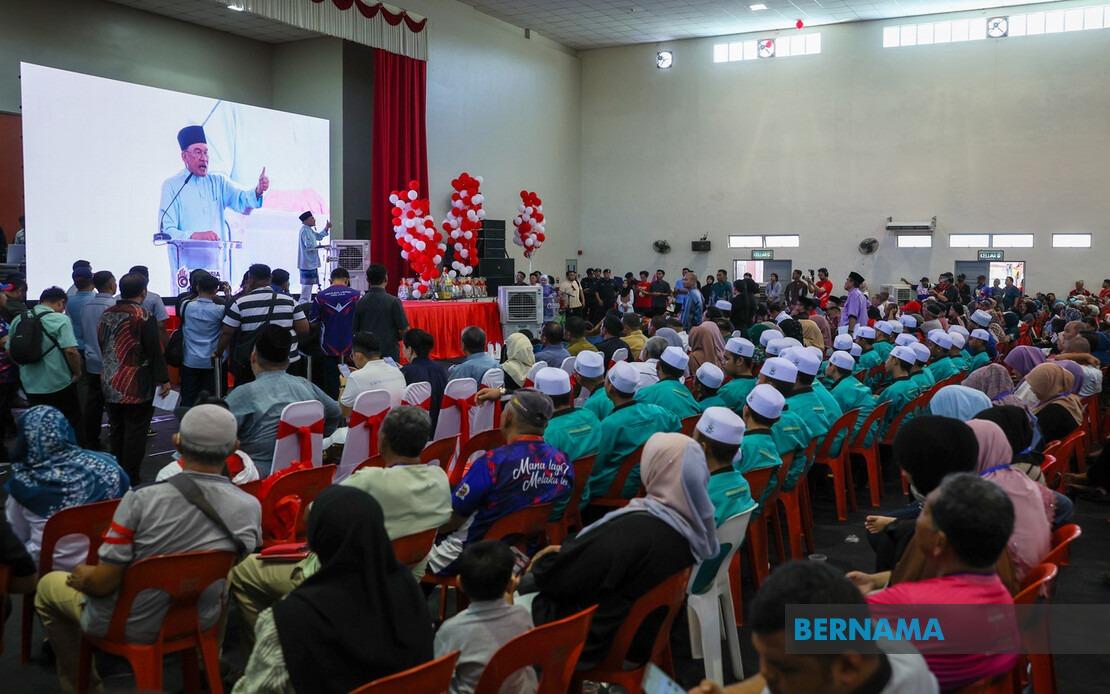
Prime Minister Datuk Seri Anwar Ibrahim has moved to allay concerns about education funding disparities, pledging that the MADANI Government remains dedicated to serving all educational communities fairly without sidelining any particular group. Speaking at the Gelombang MADANI Carnival in Alor Gajah, Anwar emphasised that the administration's recently expanded allocations to Islamic educational institutions represent a correction of historical neglect rather than a shift in priorities that would disadvantage Chinese and Tamil schools. The announcement comes at a significant moment for Malaysia's education policy, as questions about funding equity have periodically surfaced in multiethnic societies where resource allocation carries symbolic weight alongside material implications.
Anwar clarified that the restoration and enhancement of funding for pondok schools and tahfiz institutions addresses a longstanding gap in government support that had persisted across previous administrations. He stressed that many Islamic educational facilities had been systematically overlooked for years, operating without adequate government assistance, and that the current investment represents a belated effort to bring these institutions into line with the quality standards maintained in other education sectors. This contextualisation proves important for understanding the government's approach: rather than portraying additional Islamic education funding as preferential treatment, the Prime Minister framed it as corrective action to establish genuine parity across all educational systems. The narrative also carries significance for Southeast Asian observers monitoring how Malaysia navigates resource allocation in ethnically and religiously diverse societies.
Crucially, Anwar announced that dedicated funding packages for Chinese and Tamil vernacular schools have already been scheduled for public announcement within approximately two weeks, with the revelation planned to occur in Kuala Lumpur. This forward commitment serves multiple functions: it reassures communities reliant on vernacular education that their institutions remain government priorities, it provides a concrete timeline that counters speculation about delayed allocations, and it demonstrates governmental intent to manage multiple education streams through coordinated rather than reactive policy. The measured announcement strategy also reflects awareness that education funding operates as a proxy for broader questions about which communities governments truly prioritise, making transparent communication essential for preserving social cohesion.
The philosophical framework guiding the MADANI Government's education policy extends beyond resource mathematics to encompass a vision of national harmony rooted in mutual recognition and respect. Anwar articulated this through references to Malaysia's proven track record as a plural society where citizens of vastly different backgrounds coexist peacefully, attributing this success to deliberate commitments to inclusive governance and community respect. By positioning education funding within this broader narrative of managed diversity, the government attempts to reframe debates about allocation as technical matters of equity rather than zero-sum competitions between communities. This rhetorical move carries particular relevance given regional patterns in South and Southeast Asia where education policy disputes frequently crystallise deeper anxieties about group representation and state priorities.
Anwar's invocation of the Islamic concept of 'ummatan wasatan' (a balanced community) as articulated in Surah Al-Baqarah, verse 143, provided theological grounding for the government's pluralistic approach. He articulated this concept as encompassing balance across faith, knowledge, character, human relationships, and environmental stewardship, arguing that genuine Islamic practice requires Muslims to serve as moral exemplars through conduct rather than assertion of dominance. The Prime Minister suggested that communities embodying this balance would naturally attract respect and emulation, creating cascading benefits for societal stability and international standing. This theological framing permits the government to address religious constituencies while simultaneously emphasising values—integrity, environmental protection, efficient administration—that transcend sectarian boundaries, thereby constructing a common platform for dialogue across educational and community divides.
The historical backdrop of education funding neglect requires examination to contextualise current policy directions. Anwar identified 2022 as the inflection point marking when the Unity Government commenced reversing patterns of reduced investment in Islamic educational facilities that had characterised preceding years. The government initiated restoration funding in 2023 and expanded allocations further in 2024, signalling a multi-year commitment rather than episodic intervention. This trajectory reveals how political transitions in Malaysia can produce shifts in educational investment priorities, though the current administration appears committed to avoiding the pendulum effect where one community's gains necessitate another's losses. Understanding this timeline proves important for Malaysian readers and regional observers assessing whether the government possesses the political capital and budgetary resources to simultaneously improve Islamic, Chinese, and Tamil educational institutions without creating new disparities.
The practical implementation of these funding commitments materialised during the carnival event, with Anwar announcing RM1.29 million in collective allocations benefiting thirteen Islamic educational institutions across Melaka. Individual grants ranged substantially, from RM250,000 for Madrasah Tahfiz Al-Quran Wal Qiraat Kota Melaka down to RM100,000 for Sekolah Agama Rakyat JAIM Taman Maju, reflecting differentiated needs assessment across institutions of varying scale and capacity. The inclusion of infrastructure upgrades alongside emerging technology integration—specifically AI and computer training—indicates a modernisation agenda extending beyond traditional religious education toward workforce preparation in domains increasingly essential for economic participation. This technological dimension addresses a critical concern that rapid digital advancement could marginalise graduates from institutions not equipped with current technical resources.
The comparative framework Anwar employed, positioning pondok schools as at risk of falling behind Chinese and Tamil schools already well-managed and equipped, articulates a development anxiety prevalent across educational systems in plural societies. The implicit argument suggests that without deliberate corrective investment, institutional divergence widens, creating educational hierarchies that correlate with ethnic and religious identity in ways that undermine national cohesion. This framing appeals particularly to constituencies concerned about their communities' institutional futures while simultaneously asserting that government intervention prevents zero-sum dynamics where one community's educational advancement necessitates another's relative decline. For Malaysian educators and policymakers, this approach represents an attempt to transcend competitive frameworks in favour of parallel improvement trajectories.
The presence of state-level officials including Melaka Chief Minister Datuk Seri Ab Rauf Yusoh and Deputy Higher Education Minister Adam Adli Abdul Halim signified vertical governmental alignment on education equity commitments, extending from federal policy through state implementation structures. The inclusion of the Prime Minister's wife, Datuk Seri Dr Wan Azizah Wan Ismail, carried symbolic significance of family and spousal engagement in governance communication, a contemporary political practice that emphasises inclusive decision-making. These multiple presences collaborated in constructing an image of coordinated, multilevelled government commitment to the articulated education agenda, though the substantive translation of this symbolic alignment into consistent implementation across diverse district administrations remains contingent on ongoing political will and resource adequacy.
The timing of these announcements, occurring at grassroots carnival events rather than through formal policy documents or parliamentary discourse, reflects a deliberate communication strategy targeting community audiences directly rather than channelling messaging through traditional institutional mechanisms. This approach permits the Prime Minister to address multiple constituencies simultaneously—Islamic education advocates receive affirmation of their institutions' priority, while vernacular school communities receive scheduling assurances—while circumventing detailed parliamentary questioning that might expose budgetary tensions or implementation challenges. For Malaysian readers monitoring government education policy, such announcements require supplementary scrutiny regarding actual funding disbursement timelines, institutional capacity for absorbing capital improvements, and whether allocated resources genuinely address identified gaps or represent symbolic gestures without proportionate substantive impact.
Regional implications of Malaysia's education funding approaches deserve attention from observers across Southeast Asia where similar tensions between community educational preferences and state resource allocation capacities exist. Malaysia's institutional experience managing education across multiple ethnic and religious communities offers lessons—both positive and cautionary—regarding whether genuinely equitable funding models can emerge within conditions of finite resources and competing priorities. The MADANI Government's explicit commitment to avoiding marginalisation of any educational stream, combined with structured announcement timelines for vernacular school allocations, suggests an attempt to operationalise inclusive governance beyond rhetorical assertion. However, sustaining this commitment across multiple budget cycles while managing population growth, infrastructure deterioration, and technological transformation of educational requirements remains an ongoing challenge requiring vigilant monitoring and transparent accountability mechanisms.

