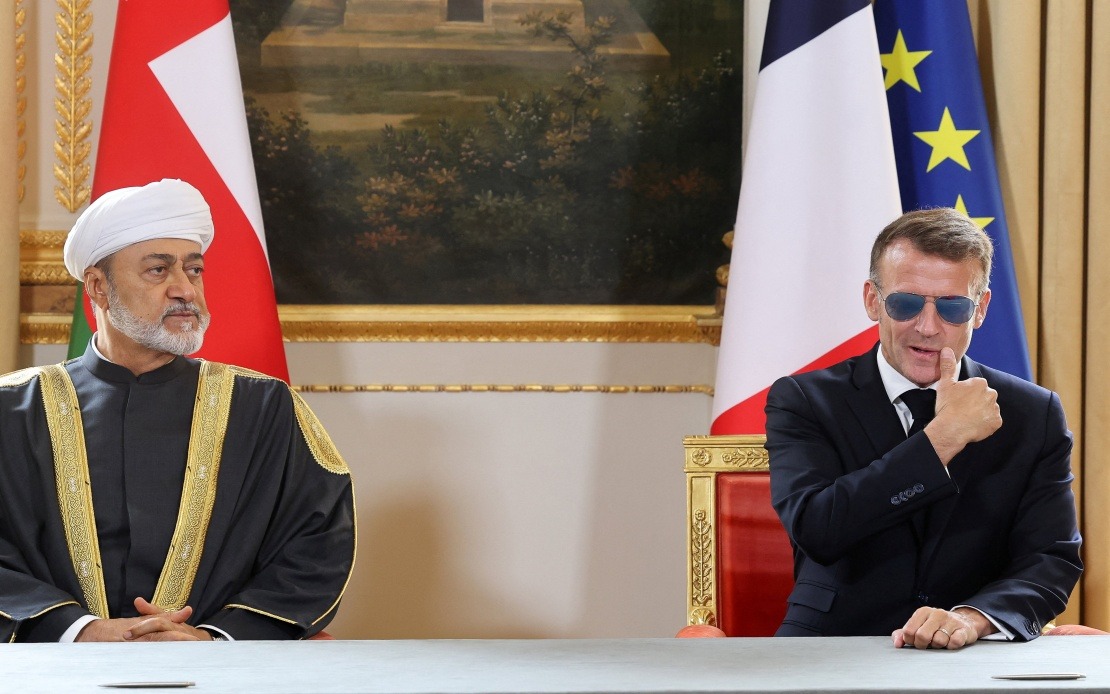
French President Emmanuel Macron greeted the Sultan of Oman while wearing his now-infamous aviator sunglasses on Monday, reigniting curiosity about the eyewear that has periodically thrust itself into international headlines. During the bilateral meeting with Sultan Haitham bin Tariq at the Élysée Palace, Macron maintained the dark spectacles throughout the formal discussions, prompting fresh speculation about the French leader's vision challenges. According to sources close to the president quoted by French media outlets, the accessory was necessitated by an underlying eye condition rather than any fashion statement, though the distinction has done little to quell public interest in the polarising eyewear.
The sunglasses first captured widespread international attention earlier this year when Macron wore them to the World Economic Forum in Davos, an appearance that triggered considerable mockery and commentary across global media platforms. US President Donald Trump seized upon the moment to jest about the French leader's appearance, while within France itself, social media users and commentators drew comparisons between Macron and the fictional secret agent portrayed by Tom Cruise in his film franchise. The lighthearted ridicule underscored how personal fashion choices by world leaders frequently transcend the realm of mere aesthetics, becoming fodder for diplomatic banter and popular culture commentary. The incident demonstrated the manner in which contemporary global politics remains susceptible to moments of levity, even when serious matters of state conduct international business.
Medical advisors to Macron had previously disclosed that he experienced a minor eye inflammation condition in January that necessitated protective eyewear for approximately a fortnight. The recurrence of the issue during his meeting with the Omani Sultan suggests the inflammation may have proven more persistent than initially anticipated, or that Macron remains susceptible to periodic flare-ups that compromise his comfort during extensive public engagements. Such health considerations, while routine among the general population, assume heightened significance when affecting heads of state who maintain demanding schedules of public appearances and international diplomacy. The transparency displayed by French officials in explaining the medical rationale behind the sunglasses reflects a modern approach to presidential health disclosure, contrasting with historical tendencies toward opacity regarding leaders' physical conditions.
The Macron sunglasses phenomenon has generated unexpected commercial consequences that extend well beyond diplomatic circles. Henry Jullien, the French luxury eyewear manufacturer responsible for crafting the aviator-style frames worn by the president, experienced a substantial surge in customer inquiries following his Davos appearance. The company has strategically leveraged the association by continuing to market the specific model using official photographs of Macron, a form of inadvertent celebrity endorsement that demonstrates how global media attention can translate into tangible commercial benefits. The episode illustrates broader truths about consumer behaviour in the digital age, wherein association with prominent public figures—whether intentional or circumstantial—can dramatically amplify demand for previously unremarkable products.
For Malaysian observers and regional Southeast Asian audiences, the incident offers insights into the management of presidential imagery and public perception within established democracies. The French approach of providing straightforward medical explanations for Macron's accessory choice reflects institutional confidence in public communication, a practice that contrasts variably across the region depending on political culture and media environment. The willingness of international media to scrutinise and comment upon such details, while occasionally verging toward triviality, underscores the intensified global connectivity that characterises modern governance. Leaders in Southeast Asia and the broader Indo-Pacific region operate within similarly scrutinised environments, where even minor stylistic choices can generate disproportionate commentary.
The bilateral meeting between France and Oman carries significance beyond the sunglasses spectacle, representing continued French engagement with Gulf states and the broader Middle Eastern region. Oman, under Sultan Haitham bin Tariq's leadership, occupies a distinctive diplomatic position as a nation with historical relationships spanning the Western and Arab worlds. France maintains substantive commercial, cultural, and strategic interests throughout the Middle East and North Africa, and such high-level engagement reflects Paris's commitment to maintaining influence within the region. For Malaysian policymakers observing international relations, the France-Oman interaction demonstrates how established powers remain actively invested in maintaining relationships across diverse geographical and cultural contexts.
The incident encapsulates the reality that contemporary international diplomacy operates simultaneously on multiple registers—the substantive policy discussions between nations occurring beneath a surface layer of public imagery and media interpretation. Macron's sunglasses, however medically justified, become absorbed into the broader narrative surrounding his presidency and France's international presence. The way such moments are reported, commented upon, and ultimately remembered shapes public perception of leaders and their administrations, a phenomenon that modern political operators must navigate with sophistication. The French president's apparent comfort with the situation, evident in his willingness to maintain the eyewear throughout formal proceedings, suggests confidence that the explanation would suffice to defuse any perception of impropriety.
As Macron continues his presidency, the sunglasses may persist as a recurring feature of his public presentation should the underlying eye condition remain unresolved. The medical explanation, while straightforward, will likely not entirely suppress the public and media interest that the distinctive accessory has generated. International leaders operate within fishbowl environments where personal details assume outsized significance, and Macron's experience with his eyewear provides a case study in how modern communications technology amplifies attention to even minor aspects of leaders' physical presentation. For Southeast Asian governments navigating their own media landscapes, the episode illustrates both the challenges and occasional absurdities inherent in contemporary political leadership.

