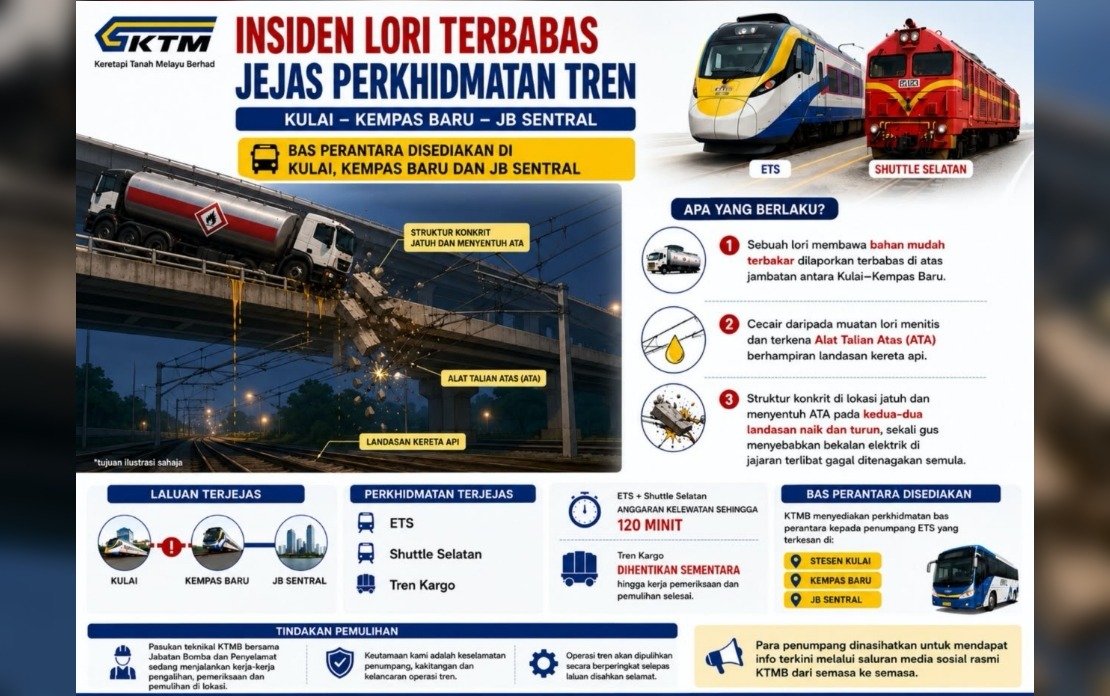
A transportation crisis unfolded in Johor Bahru on August 5 when a lorry transporting flammable liquid veered dangerously close to active railway tracks, causing a power supply failure that cascaded through two critical rail networks serving the southern corridor. The incident brought Electric Train Service (ETS) and Shuttle Selatan operations on the Kulai–Kempas route to a standstill, stranding hundreds of commuters during peak evening hours and exposing the vulnerability of Malaysia's transportation infrastructure to roadside accidents near rail corridors.
Keretapi Tanah Melayu Berhad (KTMB) disclosed the disruption through a Facebook announcement, confirming that the lorry skid had precipitated an electrical outage affecting the entire Kulai–Kempas corridor. The operator immediately initiated emergency protocols, dispatching repair crews to address both the infrastructure damage and the hazardous cargo situation. The incident underscores a recurring problem in Malaysian transportation systems: the proximity of road and rail infrastructure and the inadequacy of buffer zones in some industrial areas where hazardous materials are transported.
The operational impact was substantial and immediate. At 10.37 pm, specific train services were running significantly behind schedule, with ETS9449 delayed by 32 minutes and the more severely affected ETS9533 trailing by 55 minutes. These figures represented only a snapshot of disruptions that extended beyond the initial reporting period, as KTMB cautiously noted that actual delays remained subject to evolving operational conditions. For commuters dependent on these services for their daily commute between Kulai, Kempas Baru, and Johor Bahru Sentral, the uncertainty compounded frustration.
To mitigate passenger inconvenience, KTMB implemented emergency contingency measures that have become standard protocol during rail disruptions. Shuttle bus services were hastily arranged at three key stations—Kulai, Kempas Baru, and JB Sentral—to absorb displaced ETS passengers and maintain some semblance of connectivity. This response reflects lessons learned from previous incidents, though the strain on alternative transport capacity during evening peak hours inevitably meant longer wait times and overcrowding on replacement services.
Shuttle Selatan passengers faced more limited options, with KTMB advising them to seek alternative transport modes entirely rather than offering substitute rail services. This disparity in contingency planning highlights how different rail networks have varying levels of integrated backup systems. Passengers were left to navigate their own solutions through taxis, ride-hailing applications, or private vehicles, effectively shifting the burden of logistics back to already frustrated commuters.
Recognising the impact on passenger finances, KTMB committed to fare adjustments for those affected by the disruption. The specifics of this compensation scheme were not detailed in the initial announcement, but the gesture acknowledged that service failure carries financial consequences beyond mere inconvenience. For regular commuters facing delays of an hour or more, even partial refunds provide minimal solace, yet such measures remain important for maintaining public confidence in national rail operators.
The incident raises important questions about safety protocols and infrastructure separation standards in Malaysia. A lorry carrying hazardous materials should theoretically be routed through designated corridors away from sensitive infrastructure, yet such accidents recur with troubling regularity. The flammable liquid cargo adds another layer of concern, as any ignition or spillage near electrical substations and power distribution systems could have resulted in catastrophic consequences far exceeding service delays.
For Malaysian commuters, particularly those in the Johor region who depend on integrated rail networks, incidents like these illuminate the fragility of transportation systems that have grown increasingly complex without proportional investment in redundancy and safety. The Kulai–Kempas corridor serves not merely as a commuter link but as vital infrastructure for economic activity in Malaysia's southern industrial zone. Extended disruptions can cascade through supply chains and business operations.
KTMB's public communication through social media represented a transparent approach to crisis management, keeping passengers informed of developments and available alternatives. However, the operator's apology for inconvenience, while courteous, cannot fully address the systemic issues that make such incidents possible. Station staff were mobilised to assist stranded passengers, demonstrating that frontline personnel adaptation can partially compensate for infrastructure vulnerabilities.
The broader implications for Malaysian transportation policy merit consideration. As the nation continues expanding its rail network, particularly through initiatives like the Klang Valley Double Track and various express rail projects, incidents such as this serve as sobering reminders that construction and operational safety require constant vigilance. Risk management frameworks must account not only for internal rail operations but for the external environment in which infrastructure exists.

