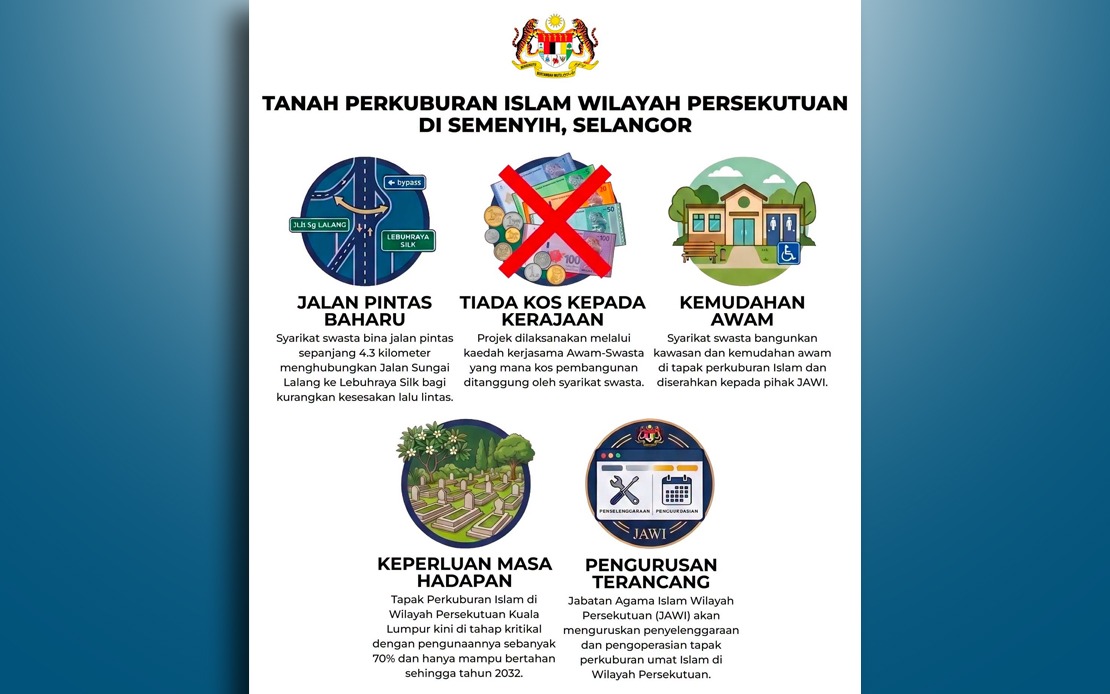
The Federal Government has moved to clarify the timeline and scope of the Hulu Semenyih Muslim Cemetery Development Project following online confusion about the initiative. Minister in the Prime Minister's Department (Federal Territories) Hannah Yeoh explained on Facebook that the 332.6-acre project has been in planning stages since 2005, designed primarily to tackle the acute shortage of Islamic burial grounds affecting residents in Kuala Lumpur while simultaneously addressing traffic management challenges in Selangor.
The urgency underlying the project becomes apparent when examining the occupancy statistics of existing burial facilities. Current Islamic cemeteries across Kuala Lumpur have surpassed 70 per cent capacity, leaving only approximately 29 per cent availability, or roughly 34,496 plots, according to June 2023 data. At current consumption rates, these remaining plots are projected to be exhausted by around 2032, creating a critical gap in essential services for the Muslim community across the federal territory.
Yeoh's clarification addressed widespread social media misinformation about the project's scope and beneficiaries. Beyond serving Kuala Lumpur residents, the facility will allocate 10 per cent of its total burial capacity to surrounding Selangor communities, positioning it as a regional infrastructure asset rather than a purely urban initiative. This approach reflects broader strategic thinking about balancing federal territory requirements with support for adjacent areas experiencing similar demographic pressures.
The development structure employs a public-private partnership model that attempts to transfer financial burden from government to the private sector. The developer will finance all infrastructure costs associated with establishing and preparing 104,470 Muslim burial plots for use. This comprehensive package includes essential facilities such as staff accommodation, a prayer hall (surau), administrative offices, food and beverage facilities, sanitary amenities, security infrastructure, and site preparation works totalling RM93.89 million for the accompanying 4.3-kilometre link road connecting Jalan Sungai Lalang to the SILK Highway.
Critically, the arrangement preserves public ownership and Islamic institutional control over the facility. The Federal Lands Commissioner will retain title to the cemetery land indefinitely, while the Federal Territories Islamic Religious Department (JAWI) maintains exclusive jurisdiction over management, administration, and operational oversight. This structure explicitly prevents private sector management of the burial ground, addressing potential concerns about commercialisation of religious services and maintaining alignment with Islamic principles regarding funeral rites and cemetery administration.
The associated link road represents an important secondary benefit extending beyond cemetery functionality. By providing an alternative 4.3-kilometre route from Jalan Sungai Lalang to the SILK Highway, the infrastructure aims to distribute traffic more evenly across Selangor's road network, potentially reducing congestion on existing routes through Semenyih. Developers will bear the full RM93.89 million cost as a condition imposed by Selangor state authorities, meaning the investment requires no government outlay from the federal budget.
The project has navigated substantial approval requirements before reaching its current stage. According to Yeoh, the cemetery proposal underwent comprehensive technical assessments, underwent Value Management Lab evaluation procedures, and secured explicit approval from both Selangor state government and Federal Government bodies. This multi-layered approval process suggests decision-makers carefully weighed competing interests including environmental impact, traffic implications, local community concerns, and religious facility requirements.
For Malaysian policymakers and residents, the project highlights persistent infrastructure challenges accompanying rapid urbanisation. Despite more than two decades of planning since 2005, demographic growth in Kuala Lumpur has simply outpaced the supply of burial facilities, creating a situation where essential services face capacity exhaustion within a decade. This timeline pressure illustrates how infrastructure planning in fast-growing urban regions must anticipate generational demand shifts, particularly for culturally and religiously significant services.
The Hulu Semenyih initiative also demonstrates emerging approaches to funding essential public infrastructure in Malaysia. By leveraging private sector financing capacity while maintaining public sector control and oversight, the partnership model attempts to address budget constraints without compromising institutional autonomy or public interest protection. As Malaysian cities continue expanding, similar arrangements may become increasingly common for water systems, transportation networks, and other critical services.
Regionally, the project reflects broader Southeast Asian challenges related to cemetery management in densely populated urban areas. Singapore, Indonesia, and Thailand have each grappled with similar burial space constraints as religious and cultural practices interact with limited urban land availability. Malaysia's structured approach using public-private partnerships while preserving religious institutional control may offer relevant lessons for neighbouring countries managing comparable pressures.
The clarification from Yeoh's office underscores how major infrastructure projects require persistent public communication to counter misinformation and build community confidence. Despite being in planning for nearly two decades, the project apparently remained unfamiliar to significant portions of the online public, allowing confusion and speculation to spread across social media platforms. Going forward, government agencies managing long-term infrastructure initiatives may need to invest more heavily in public awareness campaigns during extended planning phases.

