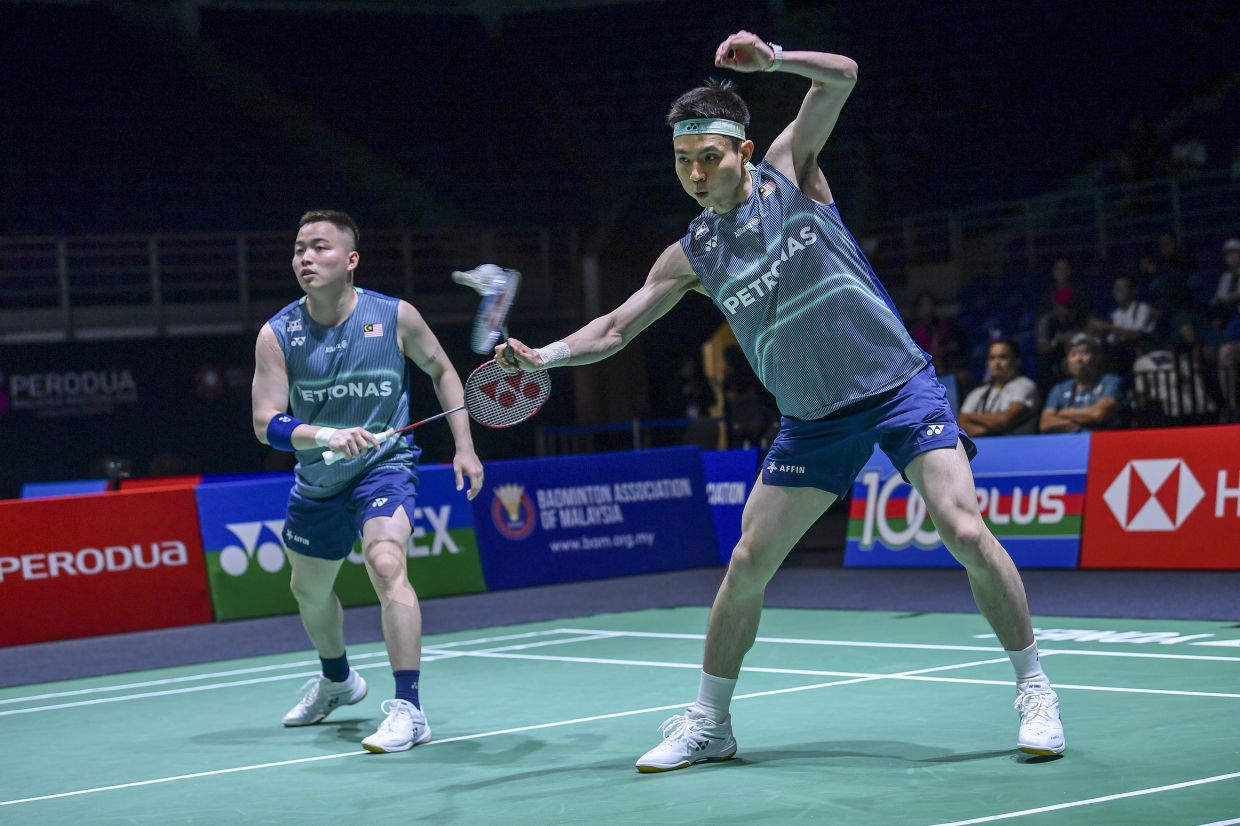
Datuk Seri Lee Chong Wei, the Badminton Association of Malaysia's performance committee chairman, has delivered a firm message to the national badminton contingent: no individual player holds greater importance than the collective team. Speaking to media in Petaling Jaya, Lee responded to recent comments from men's doubles player Soh Wooi Yik, who indicated he and partner Aaron Chia were exploring all available options to maintain their partnership through the 2028 Los Angeles Olympics.
The catalyst for Lee's statement centres on the professional uncertainties facing one of Malaysia's most accomplished mixed doubles combinations. Following their silver medal finish at the World Championships in New Delhi, Aaron Chia and Soh Wooi Yik have publicly expressed their preference to remain as a pair throughout the Olympic cycle. This desire, however, conflicts with BAM's current strategic approach to men's doubles development, which involves systematically trialling alternative pairings to identify the strongest possible combination for Olympic competition.
Lee's remarks underscore a philosophical stance that distinguishes the current BAM administration from its predecessors. He emphasised that while the association maintains an open-door policy for player discussions, management has resolved to avoid being manipulated through ultimatums or threats of departure. The distinction matters significantly in Malaysian sports politics, where athlete retention and player satisfaction have historically influenced federation decision-making. Lee's pronouncement signals a recalibration of that power dynamic, positioning BAM as the ultimate arbiter of sporting strategy rather than as a body reactive to player demands.
Acknowledging the historical relationship between institution and individual, Lee pointed to BAM's foundational role in developing elite players from their formative years. He stressed that players must remember the developmental infrastructure and coaching support that enabled their rise to international prominence. This framing transforms the negotiation from a simple contractual arrangement into a narrative about institutional loyalty and recognition of the association's investment in athlete development. For Malaysian readers familiar with the sports establishment's paternalistic traditions, this represents both continuity and a subtle shift toward institutional assertiveness.
The specific case of Aaron Chia and Soh Wooi Yik illustrates the tension between player aspiration and federation planning. Over the preceding two months, BAM's coaching apparatus had deliberately fractured the successful pairing to assess alternative combinations. Aaron was tested alongside Aaron Tai, with the duo reaching the Taiwan Open final, while Soh Wooi Yik partnered Man Wei Chong and subsequently Aaron Tai, the latter pairing advancing to the Korean Masters final. Such experimentation reflects a systematic approach to Olympic preparation, suggesting BAM views player partnerships as tactical variables rather than fixed arrangements deserving continuity.
Further roster changes loom as the China Masters tournament approaches in September. Aaron Chia will unite with Wei Chong, displacing him from his established partnership with Soh Wooi Yik, who will instead partner Aaron Tai. This continued reshuffling demonstrates BAM's commitment to thorough evaluation of potential Olympic pairings, regardless of player preferences or the success of existing combinations. The strategy assumes that comprehensive testing produces superior outcomes compared to maintaining proven but potentially suboptimal partnerships.
Lee's warning carries material weight beyond rhetorical emphasis. Should Aaron Chia and Soh Wooi Yik elect to pursue independent status outside BAM's framework, they would confront substantial contractual consequences. Both players remain bound to BAM through 2028 under existing contracts, creating potential financial liability if they breach terms. Beyond monetary considerations, the federation retains the authority to restrict their participation in international tournaments, a power that would severely damage their ability to accumulate the ranking points essential for Olympic qualification.
The implications for Malaysian badminton extend beyond this particular partnership dispute. Lee's firm stance reflects growing international competitiveness in badminton, where Olympic medals require ruthless optimisation of team composition. Countries like Indonesia and China have demonstrated willingness to rotate player combinations extensively during Olympic cycles, prioritising performance outcomes over athlete sentiment. BAM's analogous approach signals recognition that sentimental attachments to successful partnerships may not produce optimal results when tested against global competition standards.
For Malaysian sporting governance more broadly, Lee's comments signal a modernisation of federation management philosophy. Rather than accommodating star players' preferences—a pattern that had sometimes constrained organisational strategy—BAM under current leadership articulates a merit-based, strategy-driven approach. This shift aligns with international best practices in Olympic programme management, though it inevitably creates friction with athletes accustomed to greater influence over their competitive circumstances.
The broader context involves Malaysia's aspiration to improve its Olympic badminton medal tally. Men's doubles has historically underperformed relative to the nation's strength in mixed doubles and women's singles, suggesting genuine tactical room for improvement through systematic partnership experimentation. BAM's willingness to test multiple configurations reflects data-driven decision-making rather than institutional whimsy, even if individual players experience such decisions as disruptive.
Lee's message ultimately establishes boundaries for the negotiating space available to elite athletes within Malaysia's badminton ecosystem. Players retain the right to discuss concerns and preferences, but federation leadership has signalled it will not reward departure threats with policy capitulation. This recalibration may produce short-term friction with ambitious players seeking autonomy, but it potentially strengthens BAM's strategic coherence and its ability to implement long-term Olympic preparation programmes unburdened by constant player-driven disruptions to competitive planning.

