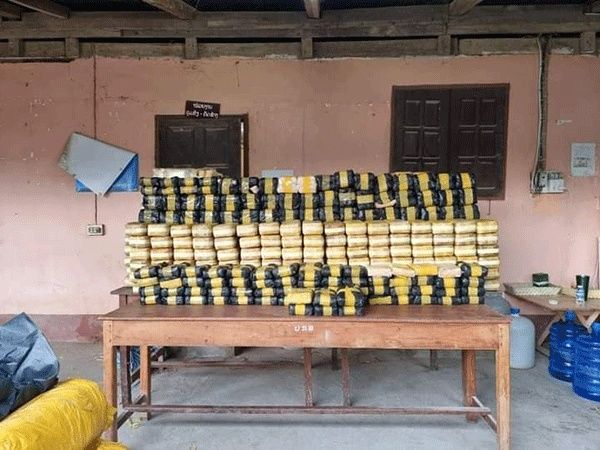
Drug trafficking has become the defining criminal challenge facing authorities in Xaysomboun province, central Laos, with law enforcement agencies confronting a troubling spike in narcotics-related activity that has reshaped the region's security landscape. During the opening six months of this year, drug offences comprised 24 of 54 total criminal cases handled by the Xaysomboun Provincial Public Security Force—a striking proportion that equates to nearly 44 per cent of the province's entire recorded crime burden. The concentration of drug cases underscores a fundamental shift in the types of threats that have come to dominate the work of local police, who now find themselves grappling with systematic trafficking networks rather than dispersed petty crimes.
The scale of the drug problem becomes clearer when examining the progress on these cases. Of the 24 drug-related investigations initiated, only two have been completed and transferred to the Public Prosecutor's Office for potential prosecution, leaving the overwhelming majority still under active investigation. This sluggish case resolution rate reflects the complexity of drug investigations, which frequently involve financial tracking, supplier networks, and international coordination—factors that complicate rapid prosecution. Across all crime categories, the provincial police force managed to settle six cases, concluded four for prosecution, and fully resolved 15 others, leaving 29 cases still in progress. The disparity between the volume of drug cases and their rate of completion illustrates the resource constraints and investigative challenges confronting provincial law enforcement.
The stark crime figures emerged during an official visit to Xaysomboun by Police Lieutenant General Vanthong Kongmany, the nation's Minister of Public Security, on August 7. At a meeting with Police Brigadier General Ouday Insouvanh, head of the provincial security command, the minister received detailed briefings on the first-half performance and the mounting obstacles facing local authorities. Police Brigadier General Ouday outlined efforts to maintain political stability and preserve social order while systematically gathering intelligence and monitoring developments to inform higher-level security decision-making. The minister's direct engagement with provincial leadership reflects the gravity with which Vientiane regards the situation, signalling that drug control remains a paramount national concern requiring coordination between central and local authorities.
During his visit, Police Lieutenant General Vanthong articulated an expansive security agenda extending well beyond narcotics. He called on the Xaysomboun Provincial Public Security Command to intensify operations against smuggling operations, human trafficking networks, theft and burglary, illegal mining activities, and underground gambling—a sprawling portfolio of criminal enterprises that collectively threaten economic development and social stability. The minister's emphasis on evolving criminal methodologies suggests recognition that offenders continuously adapt their techniques to evade detection, necessitating police forces that remain equally flexible and innovative in their responses. This broader directive positions drug enforcement within a comprehensive security framework rather than as an isolated priority, reflecting the interlinked nature of organised crime in the region.
The sustained focus on narcotics control aligns with a deliberate government strategy established five years ago, when the Laotian authorities formally designated drug suppression as a national agenda item. This long-standing commitment has yielded substantial enforcement activity: according to a report delivered by Prime Minister Sonexay Siphandone to the National Assembly last month, nationwide law enforcement agencies processed 1,786 drug-related cases during the first six months of this year alone. These investigations culminated in the apprehension of 4,025 suspects, including 93 foreign nationals, alongside the confiscation of significant drug stockpiles and vehicles implicated in trafficking operations. The national figures contextualise Xaysomboun's experience within a much larger crisis, suggesting that the province's drug problem reflects countrywide trends rather than localised aberrations.
Beyond traditional criminal enforcement, Police Lieutenant General Vanthong instructed provincial authorities to strengthen monitoring of social media platforms and develop capacity to combat emerging cybercrime threats. This directive represents a significant modernisation of security priorities, acknowledging that criminal activity increasingly operates through digital channels rather than exclusively through physical distribution networks. Drug trafficking organisations have adopted encrypted communications, cryptocurrency transactions, and online marketplaces to coordinate operations and reach customers, compelling police forces to develop technical expertise and cyber investigation capabilities. The expansion of security priorities to encompass digital crime reflects Laos's gradual integration into global information networks and the corresponding emergence of technology-enabled criminal threats.
Road safety emerged as an ancillary but substantial concern during the ministerial meeting, with provincial police reporting 60 traffic accidents over the six-month period that resulted in four fatalities, 80 injuries, and damage to 109 vehicles. The accumulated losses from these accidents exceeded 2.56 billion kip, representing considerable economic harm to affected individuals and families. The inclusion of traffic safety within the broader security briefing illustrates how public safety encompasses multiple dimensions beyond organised crime, with vehicular accidents contributing significantly to mortality, morbidity, and property damage. This multifaceted approach to security challenges reflects emerging understanding that comprehensive safety requires integrated responses across diverse threat categories.
Immigration management and tourism oversight constituted additional areas of ministerial scrutiny, reflecting Xaysomboun's role as a tourism destination and border region. During the first six months, provincial security personnel inspected 1,698 tourists, of whom 396 held foreign nationality, indicating substantial cross-border and international visitor activity. The minister stressed the necessity for immigration authorities to exercise professional, systematic oversight calibrated to individual officers' expertise levels, ensuring that foreign national management proceeds according to legal standards rather than arbitrary procedures. This emphasis on professional conduct suggests concerns regarding consistency and potential corruption within immigration enforcement, issues that generate friction between Laos and international partners when compliance with legal procedures is questioned.
Police Lieutenant General Vanthong issued directives extending beyond operational tactics to encompass officer conduct, ideological orientation, and institutional culture. He urged provincial security force leaders to strengthen political and ideological education among personnel, ensuring compliance with Party policies, state laws, and disciplinary requirements governing public security work. The minister called for personnel to acknowledge institutional weaknesses, avoid passive dependence on hierarchical directives, and accept direct responsibility for work outcomes—language suggesting previous problems with accountability and initiative among lower-ranking officers. These personnel-focused directives indicate that effective security enhancement requires cultural and institutional change alongside resource allocation and tactical innovation.
The minister further demanded that investigations, detention procedures, and rehabilitation work maintain strict adherence to legal protocols, addressing potential governance challenges in how security forces exercise power over suspects and detainees. This emphasis on procedural legality may reflect international scrutiny of Laotian law enforcement practices or recognition that legal violations undermine both the legitimacy of prosecutions and public confidence in security institutions. By stressing that detention and rehabilitation must follow established procedures, the minister signalled that security effectiveness depends not solely on apprehension rates but on maintaining institutional credibility and legal legitimacy. The holistic approach—combining operational intensity, technological adaptation, professional conduct standards, and legal compliance—represents an attempt to address drug trafficking through systematic institutional strengthening rather than enforcement surge tactics alone.
The convergence of drug enforcement imperatives, technological adaptation requirements, personnel discipline expectations, and legal compliance standards reflects Xaysomboun's evolution as a security challenge requiring multidimensional state capacity. The province's 44 per cent drug crime rate indicates that conventional enforcement approaches have proven insufficient to contain narcotics activity, necessitating integrated responses encompassing investigation sophistication, officer professionalism, legal rigor, and institutional coordination. For Malaysian and Southeast Asian observers, Xaysomboun's experience demonstrates how drug trafficking networks exploit governance vulnerabilities and institutional constraints in developing regional economies, underscoring the necessity for transnational cooperation and capacity-building initiatives. The Laotian government's comprehensive response—extending from enforcement operations to cultural transformation within security institutions—suggests recognition that sustainable crime control requires sustained institutional investment rather than episodic enforcement campaigns.

