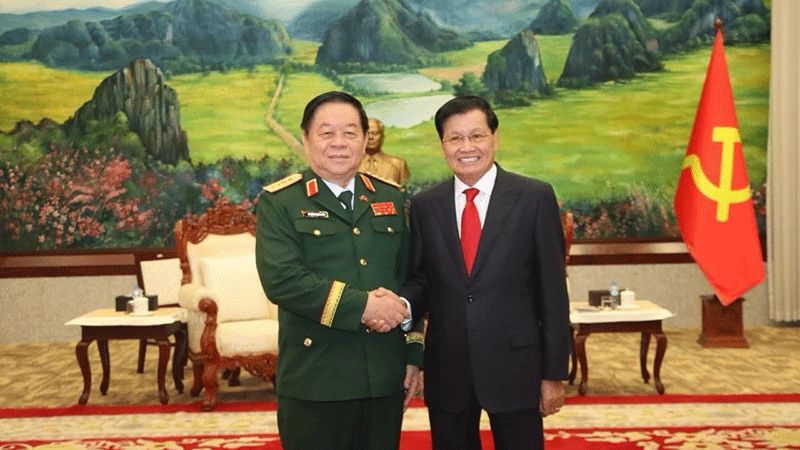
Laos and Vietnam have reaffirmed their commitment to strengthening bilateral defence cooperation following a series of high-level military discussions this week. The visit by General Nguyen Trong Nghia, Chairman of the General Department of Politics of the Vietnam People's Army, from August 5 to 7 has underscored the two nations' determination to fortify the bonds that underpin their strategic relationship in Southeast Asia. President Thongloun Sisoulith, who also serves as Secretary General of the Lao People's Revolutionary Party Central Committee, received the Vietnamese delegation and commended the productive nature of the military-to-military dialogue, signalling the importance both governments place on sustaining their defence partnership amid regional geopolitical shifts.
The visit represents a continuation of decades-long ties between Laos and Vietnam that extend far beyond conventional military cooperation. Both nations share a historical legacy rooted in their revolutionary struggles and ideological alignment, factors that continue to shape their contemporary relationship. For Malaysia and other ASEAN members, the reinforcement of this Laos-Vietnam nexus carries implications for the broader regional balance, particularly given Vietnam's established role as a major Southeast Asian power and Laos's geographic centrality within the mainland region. The emphasis placed by both delegations on a "special relationship" and "strategic cohesion" reflects a partnership that operates at multiple levels simultaneously, integrating political party structures, state institutions, and military organisations into a coordinated framework.
During his courtesy call with President Thongloun, General Nguyen Trong Nghia articulated Vietnam's foundational commitment to preserving and advancing the special bilateral relationship. The President characterised the visit as another significant step in deepening what he termed the "great friendship, special solidarity, comprehensive cooperation and strategic cohesion" between the two parties, states, armies and peoples. This multilayered rhetoric reveals how Laos and Vietnam conceptualise their relationship not merely as a transactional state-to-state arrangement but as an interconnected web of relationships spanning political parties, military institutions, and grassroots populations. For Southeast Asian analysts, this integrated approach contrasts with more compartmentalised partnerships and suggests a durability rooted in institutional depth.
The substantive outcomes of the military talks, conducted between the General Departments of Politics of both armies, focus on practical domains where cooperation can be expanded. These include political education and ideological alignment, military-to-military exchanges that build interpersonal networks among officer corps, enhanced border management capabilities, and personnel training programmes. The attention to border management reflects the realities of geographic proximity—Laos shares a lengthy frontier with Vietnam—and the mutual interest in preventing cross-border complications that could undermine the broader relationship. By institutionalising cooperation in these areas, both nations are creating mechanisms that can absorb potential friction points and channel disagreements through established channels rather than allowing them to escalate.
General Khamlieng Outhakaisone, who holds the dual position of Deputy Prime Minister and Minister of National Defence in Laos, also received General Nguyen Trong Nghia, indicating the civil-military coordination that characterises Lao governance. The two defence officials reiterated their determination to position defence cooperation as a cornerstone of what they term the "Laos-Vietnam comprehensive strategic partnership." This terminology, increasingly common in regional diplomacy, reflects an evolution beyond narrowly conceived security arrangements toward comprehensive frameworks encompassing economic, cultural, and institutional dimensions. For policymakers in Malaysia and across ASEAN, understanding such partnerships is essential to contextualising the strategic landscape and anticipating how regional middle powers may align on questions affecting collective security and economic governance.
Lieutenant General Vongsone Inpanphim, Deputy Minister of National Defence and head of the General Department of Politics of the Lao People's Army, engaged directly with General Nguyen Trong Nghia in substantive military discussions. The two officials agreed to broaden cooperation in party and political work—a formulation that underscores the ideological dimensions of their partnership—while strengthening exchanges between military institutions. Particular emphasis was placed on enhancing border management cooperation and developing educational initiatives aimed at younger generations. This generational focus is strategically significant; by embedding historical narratives about Laos-Vietnam friendship into educational curricula and military training, both nations are attempting to institutionalise their relationship across time, ensuring that future cohorts of officials and civilians internalise the value of the partnership.
The timing and composition of General Nguyen Trong Nghia's delegation merit consideration. As Chairman of the General Department of Politics—essentially the Communist Party's representative within the Vietnamese military apparatus—his position carries weight in both security and ideological spheres. His official visit signals that Vietnam's commitment to Laos transcends narrow military interests and encompasses the political-ideological foundations that both communist-led states consider fundamental to governance and legitimacy. For regional observers monitoring Vietnam's strategic priorities, such high-level visits indicate the continued centrality of Laos within Vietnamese strategic planning, despite Vietnam's expanding global engagement.
The emphasis throughout the meetings on historical friendship and enduring solidarity reflects a diplomatic language designed to project stability and continuity. Both nations invoke their shared revolutionary past as a foundational element legitimising contemporary cooperation, creating a narrative arc that connects historical struggles to present-day partnerships. This rhetorical approach serves multiple purposes: domestically, it reinforces regime narratives about the rightness of current alliances; regionally, it communicates to other ASEAN members that the Laos-Vietnam relationship rests on foundations unlikely to shift; and strategically, it positions both nations as part of a coherent bloc with shared interests and values.
From a Malaysian perspective, the deepening of Laos-Vietnam defence ties reflects broader patterns within Southeast Asia where certain bilateral relationships intensify while others remain more transactional. The emphasis on comprehensive cooperation and strategic cohesion suggests that Laos-Vietnam collaboration may extend into areas touching on regional security architecture, potentially influencing how both nations position themselves on ASEAN-level issues including the South China Sea and economic regionalism. Understanding such bilateral intensifications helps Malaysian analysts anticipate coalition-building dynamics within ASEAN forums and assess how regional consensus on various matters might coalesce or fracture.
Looking forward, the outcomes of these military discussions are likely to manifest in concrete cooperation frameworks over the coming months and years. Border management enhancements could improve security coordination in frontier areas; military exchanges will build networks among officers who may eventually assume senior positions; political education initiatives will shape institutional cultures in both militaries. For neighbouring nations including Thailand and Cambodia, which share borders or significant interactions with both Laos and Vietnam, these developments carry implications for regional stability and the distribution of influence within mainland Southeast Asia. The visit thus represents not merely a ceremonial diplomatic exchange but a substantive effort by both nations to systematically strengthen their strategic partnership across multiple institutional domains.

