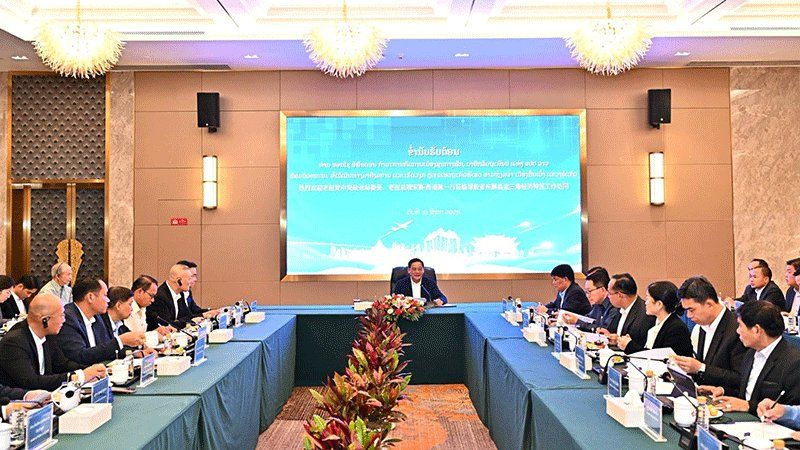
Prime Minister Sonexay Siphandone has intensified pressure for tighter governance and more environmentally responsible expansion of the Golden Triangle Special Economic Zone (GTSEZ), signalling growing official concerns about the pace and quality of development in this strategically important economic hub. During a working visit to the zone on Tuesday, August 18, the Premier emphasised the need for improved oversight mechanisms and better alignment between investment activities and sustainable growth objectives across the 10,000-hectare enclave located in Tonpheung district, Bokeo province.
The zone, which has attracted approximately US$10 billion in cumulative investment since its establishment in 2007, represents a significant pillar of Laos's economic diversification strategy. Straddling the borders of Laos, Myanmar, and Thailand while remaining proximate to China, the Golden Triangle SEZ offers multinational enterprises and regional investors unparalleled access to labour pools and consumer markets spanning the broader Mekong region. The zone's geographical positioning has made it an attractive destination for companies operating across manufacturing, real estate, hospitality, financial services, tourism, and trade sectors.
Yet behind these headline investment figures lies a troubling performance gap that has prompted the Prime Minister's direct intervention. According to official assessments, only 60 per cent of the activities stipulated in investment contracts have materialised over the zone's 19-year operating history. This substantial shortfall indicates chronic underperformance that threatens the zone's potential to function as a genuinely transformative economic engine for northern Laos. The gap between contractual commitments and actual implementation raises questions about investor commitment, project feasibility, and the effectiveness of existing regulatory frameworks in enforcing compliance.
Dr Sonexay's directive to strengthen the zone's institutional architecture reflects recognition that managerial deficiency rather than investment appetite represents the binding constraint on performance. He instructed officials to overhaul the one-stop-service system to improve investor experience and reduce bureaucratic friction, acknowledging that smoother administration could unlock dormant investment potential. Simultaneously, he demanded more rigorous enforcement of the Law on Enterprises and insisted that all commercial transactions—encompassing trade, investment, wage payments, and service provision—flow through the formal Lao banking system rather than informal channels.
The emphasis on financial transparency and banking system integration suggests underlying concerns about illicit capital flows, money laundering, or informal economic activity within the zone. This preoccupation reflects a broader regional challenge facing Southeast Asian special economic zones, where porous regulatory environments and inadequate oversight have sometimes facilitated financial crimes. By mandating banking system integration, the Lao government aims to establish clearer audit trails and reduce opportunities for informal commerce that escapes taxation and regulatory scrutiny.
The Premier also directed authorities to establish more stringent controls over personnel movement across the zone's boundaries and to strengthen the capacity of the zone's Management and Administration Committee. Currently hosting more than 10,000 registered workers alongside 10,000 additional investors, business operators, residents, and tourists, the zone has evolved into a dense population centre requiring sophisticated border and labour management protocols. Cross-border worker flows, particularly from neighbouring Myanmar and Thailand, demand coordinated immigration procedures and bilateral labour agreements that can prevent labour exploitation and irregular employment arrangements.
Dr Sonexay's identification of priority investment sectors—specifically tourism, manufacturing, processing, transportation, education, and public health—suggests a strategic reorientation toward higher-value activities and sectors delivering broader social benefits. Manufacturing and processing operations generate employment and foreign exchange earnings while reducing Laos's manufacturing deficit. Educational and healthcare investments address critical infrastructure gaps across northern Laos and create knowledge spillovers into surrounding communities. Tourism development capitalises on the zone's natural assets and cultural heritage while generating foreign exchange.
The zone's concession agreement framework requires modernisation to align with contemporary legislation and international standards for special economic zones. This institutional renovation signals acknowledgement that governance structures crafted 16 years ago may insufficiently address contemporary regulatory challenges, environmental concerns, and labour standards. Harmonising agreements with evolving national legislation creates clearer expectations and reduces disputes between zone management and investors.
Enhanced regional cooperation mechanisms, particularly expanded airline connectivity and formal worker management arrangements with Myanmar and Thailand, reflect the zone's fundamentally transnational character. The Mekong region's infrastructure limitations have historically constrained the Golden Triangle's accessibility; improved air links would reduce travel times for investors and tourists while facilitating regional business networks. Coordinated worker management protocols would formalise labour movements that currently occur through informal channels, reducing exploitation risks and generating tax revenue.
The presence of over 400 government officials representing multiple sectors demonstrates the zone's governance complexity and the resource investment required to maintain functional administration. This substantial bureaucratic footprint underscores both the zone's importance to national economic strategy and the coordination challenges inherent in managing a densely populated special economic zone spanning three national borders.
Dr Sonexay's intervention reflects broader Southeast Asian trends toward stricter special economic zone governance and environmental accountability. As regions globally face scrutiny over development sustainability and equitable benefit distribution, Lao authorities are signalling commitment to more responsible zone stewardship. For Malaysia and other regional economies competing for similar foreign direct investment flows, the Golden Triangle case illustrates evolving expectations regarding regulatory standards, environmental protection, and community benefit sharing that will increasingly shape investor decisions and regional competitiveness in the coming decade.

