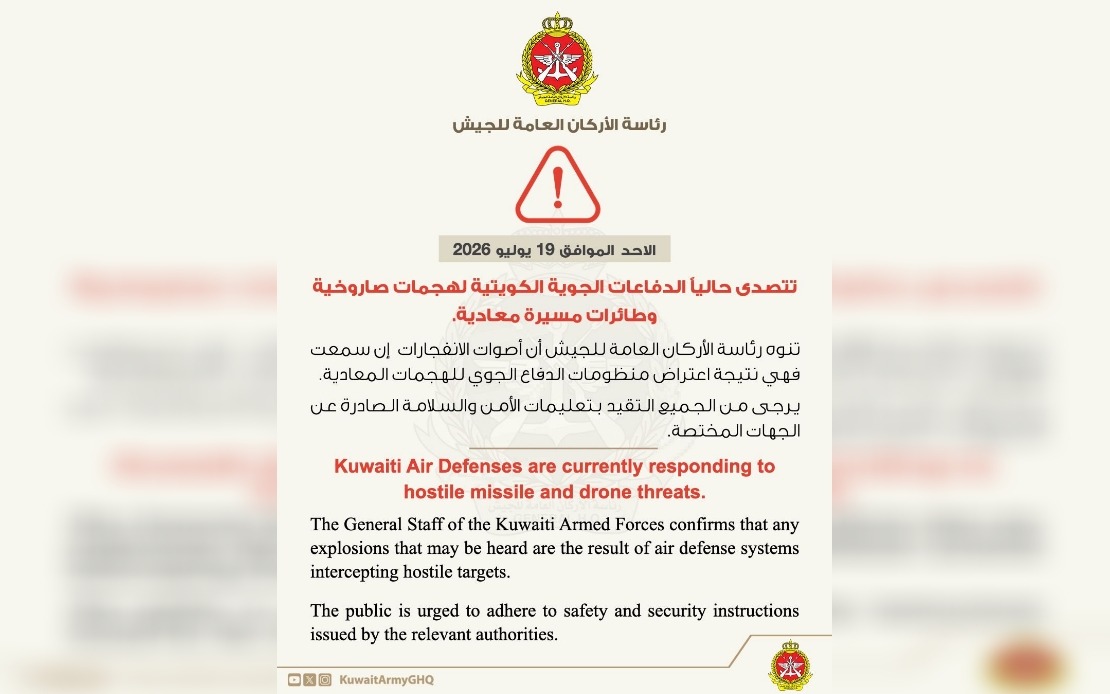
Kuwait's armed forces have been forced to deploy active air defence measures to counter incoming missiles and unmanned aircraft, according to a statement released by the Kuwaiti army on Sunday. The military confirmed that residents may hear explosions in the coming hours, explaining these as the result of defensive systems engaging hostile targets. The announcement reflects the severe deterioration in regional security, with Kuwait now positioned directly in the crossfire of an intensifying conflict between Washington and Tehran that has spiralled across the Middle East.
The escalation marks a critical moment in Gulf security dynamics, as one of the region's most strategically important oil-producing nations finds itself under direct threat from Iranian military action. Kuwait hosts significant American military infrastructure and serves as a crucial hub for US operations throughout the Persian Gulf, making it an inevitable target in the broader Iranian retaliation campaign. For Malaysian readers monitoring regional stability, the implications are substantial—disruptions to Gulf shipping and energy exports from this region carry immediate consequences for Southeast Asia's energy security and maritime trade.
Iran has maintained a sustained campaign of strikes against what it characterises as American military installations across multiple regional countries, with Kuwait bearing particular significance due to its hosting of US forces and facilities. This represents a dramatic shift from the tentative diplomatic overtures made just months earlier, when a Pakistan-brokered memorandum of understanding was signed in June with explicit aims of halting the tit-for-tat military exchanges and establishing a durable peace framework. The rapid unravelling of that agreement underscores the fragility of current diplomatic efforts and the structural tensions that continue driving hostile actions despite formal understandings.
The cycle of retaliation has now expanded into a pattern of successive military operations spanning nearly a week. American forces have conducted waves of strikes on Iranian territory, prompting Tehran to respond with attacks on facilities it alleges serve American military purposes. This reciprocal escalation, occurring across multiple countries within a compressed timeframe, suggests neither party shows signs of de-escalation, despite the existence of negotiated frameworks theoretically designed to prevent such outcomes.
For Kuwait specifically, the situation carries particular urgency given its geographical proximity to Iran and the density of military and civilian infrastructure within its relatively compact borders. The Kuwaiti authorities have issued comprehensive security directives for residents, advising compliance with official guidance during periods of heightened military activity. This precautionary measure reflects realistic concerns about civilian safety amid active air defence operations, where interception attempts themselves can pose risks to populated areas below.
The broader geopolitical context reveals how deeply entrenched the Iran-US confrontation remains despite international mediation efforts. The Pakistan-brokered memorandum represents one of several diplomatic initiatives aimed at tempering regional hostilities, yet its apparent ineffectiveness in preventing the current escalation raises troubling questions about whether fundamental structural conflicts can be resolved through agreements alone when underlying strategic interests remain opposed.
Southeast Asian nations, including Malaysia, maintain significant economic interests throughout the Persian Gulf region. Disruptions to Gulf stability inevitably reverberate through global energy markets and maritime security corridors vital to regional commerce. The current situation thus extends beyond Middle Eastern boundaries, creating ripple effects that influence economic conditions and security considerations across Asia-Pacific shipping lanes and energy supply chains.
Kuwait's activation of air defence systems represents not merely a defensive measure but a signal of the severity that regional tensions have reached. The public acknowledgment of military response, rather than attempting to downplay or obscure such activities, suggests authorities view transparency regarding the threat as preferable to maintaining civilian uncertainty about potential explosions and military activity. This approach prioritises public safety awareness over operational secrecy.
The persistence of Iranian strikes despite diplomatic arrangements suggests that Tehran perceives continued military action as necessary to its strategic objectives, whether as deterrence against further American action or as measured retaliation for perceived provocations. The sustainability of this cycle depends largely on whether either party perceives negotiated outcomes as preferable to continued military posturing, a calculation that remains unclear given recent developments.
For regional observers and international stakeholders monitoring developments, the situation illustrates how quickly security conditions can deteriorate in the Middle East when underlying disputes outweigh diplomatic frameworks. The challenge for Kuwait and other Gulf nations lies in managing immediate security threats while maintaining the possibility of longer-term de-escalation pathways. The coming days will prove crucial in determining whether current military exchanges represent a contained episode or the beginning of a more sustained conflict phase.

