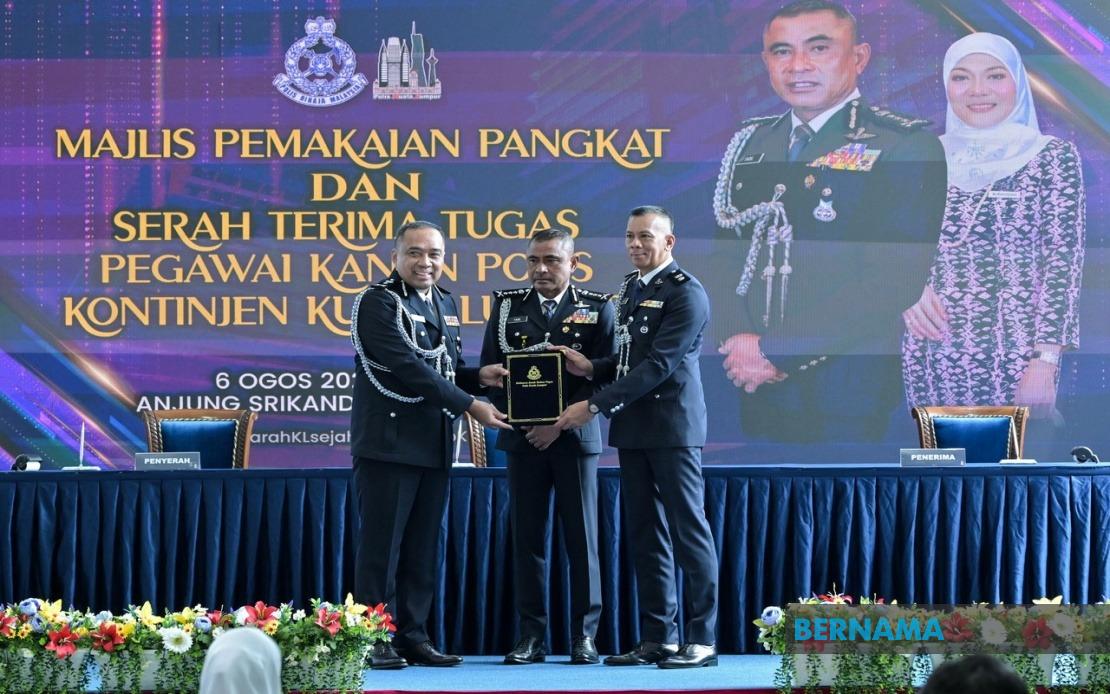
The Kuala Lumpur police contingent formally transitioned six senior leadership positions in a structured handover ceremony, signalling an important moment of organizational renewal within the capital's law enforcement hierarchy. Datuk Fadil Marsus, who leads the Kuala Lumpur police contingent, presided over the ceremony at contingent headquarters, overseeing the transfer of responsibilities across critical investigative and operational departments that form the backbone of the force's crime-fighting capacity.
The reshuffling touched multiple pillars of police operations in the capital. Criminal investigation leadership changed hands as SAC Zulkarnain Samsudin departed his role as CID head, with SAC Sazlee Adam stepping into the position. Parallel to this, the narcotics enforcement chain saw movement, with ACP Kee Hang Kee taking charge of the Narcotics Crime Investigation Department from SAC Haslah Bachok. These two departments represent high-stakes investigative functions where officer experience and institutional knowledge prove invaluable in combating organized crime and drug trafficking networks that transcend city boundaries.
District-level policing, which shapes daily public contact with law enforcement across Kuala Lumpur's diverse communities, also experienced transitions. Supt Nuzulan Mohd Din assumed command of the Dang Wangi district police contingent from SAC Sazlee Adam, while Supt Jasni Zolpa took the helm of Sentul operations, replacing SAC Basri Sagoni. These postings carry particular significance in metropolitan policing, as district chiefs serve as direct links between neighborhood-level security concerns and higher command decision-making.
The intelligence and operations functions within the police apparatus underwent corresponding changes. SAC Kamaruzaman Md Alib relinquished his position as Special Branch deputy chief overseeing intelligence and operations, with ACP Saefuddin @ Mohd Fitri Abdul Rahman assuming the role. Additionally, SAC Zulkarnain Samsudin handed over the CID deputy chief portfolio for intelligence and operations to Supt Ong Seng Keong. These intelligence positions carry distinctive importance in contemporary policing, where coordination between crime investigation and strategic intelligence gathering increasingly determines operational success against sophisticated criminal enterprises.
The presence of Datuk Mohd Azani Omar, the Kuala Lumpur deputy police chief, at the ceremony underscored the importance accorded to the transition. Such formal protocols reflect institutional emphasis on structured succession planning—a practice that mitigates knowledge loss when experienced officers move to different assignments or retirement.
Fadil articulated a clear organizational philosophy in his remarks, emphasizing that promotions transcend mere recognition of individual performance. He framed advancement as institutional acknowledgment of escalating responsibility and elevated trust, qualities requiring sustained demonstration of integrity, professional competence, and genuine commitment to public service. This messaging carries particular relevance in the Malaysian context, where public confidence in law enforcement remains contingent upon visible adherence to ethical standards and transparent governance.
The police chief positioned the handover ceremony as symbolic of institutional continuity within the Royal Malaysia Police hierarchy. Rather than treating leadership transitions as disruptive moments, he characterized them as fundamental organizational processes enabling the force to evolve through fresh perspectives and innovative methodologies. This conceptual framing addresses a persistent challenge in large security agencies: balancing the institutional knowledge embedded in experienced personnel against the need for organizational renewal and adaptation to emerging threats.
Fadil's address specifically highlighted the escalating complexity of contemporary security challenges confronting the capital. He called upon all Kuala Lumpur police personnel to strengthen commitment across multiple operational domains: intensive crime suppression, combating substance abuse, refining investigative methodologies, maintaining operational readiness, and cultivating community partnerships. This multifaceted directive reflects evolving policing priorities that extend beyond traditional reactive law enforcement toward preventive and community-engaged approaches.
For Malaysian stakeholders monitoring police effectiveness, these leadership transitions carry broader implications. The reshuffle affects departments directly responsible for homicide investigation, organized crime detection, drug trafficking interdiction, and intelligence gathering—functions that materially impact public safety perceptions and actual crime statistics reported in urban centers. The appointment of officers to these sensitive positions reflects command confidence in their capability to manage complex investigations and intelligence operations under pressure.
The restructuring also occurs within a broader context of police modernization efforts across Southeast Asia. Malaysian law enforcement agencies increasingly adopt international best practices in investigative techniques, intelligence integration, and community policing models. Leadership transitions provide natural junctures for implementing new protocols and strategic directions, as incoming officers bring different operational philosophies and tactical approaches informed by their career experiences.
Significantly, the ceremony demonstrates institutional mechanisms for managing organizational change in ways that emphasize stability and continuity rather than disruptive upheaval. For a law enforcement agency operating within a complex urban environment, maintaining operational capability during leadership transitions requires deliberate attention to handover procedures, documentation transfer, and institutional memory preservation—elements evident in the formal ceremony structure.
The timing of this restructuring, conducted within the established police hierarchy rather than through external political intervention, reflects Malaysia's institutional approach to law enforcement leadership management. The involvement of senior command officers and emphasis on procedural formality suggest adherence to police regulations governing promotion and transfer processes, factors that contribute to perceived legitimacy of organizational changes within the force.
Moving forward, the effectiveness of these appointments will be measured against crime prevention outcomes, investigative success rates, and public perception of police responsiveness in Kuala Lumpur. These new leaders inherit departments facing persistent challenges ranging from violent crime in certain districts to sophisticated drug smuggling operations. Their success in addressing these challenges will substantially influence public confidence in the capital's law enforcement capacity during the coming operational period.

