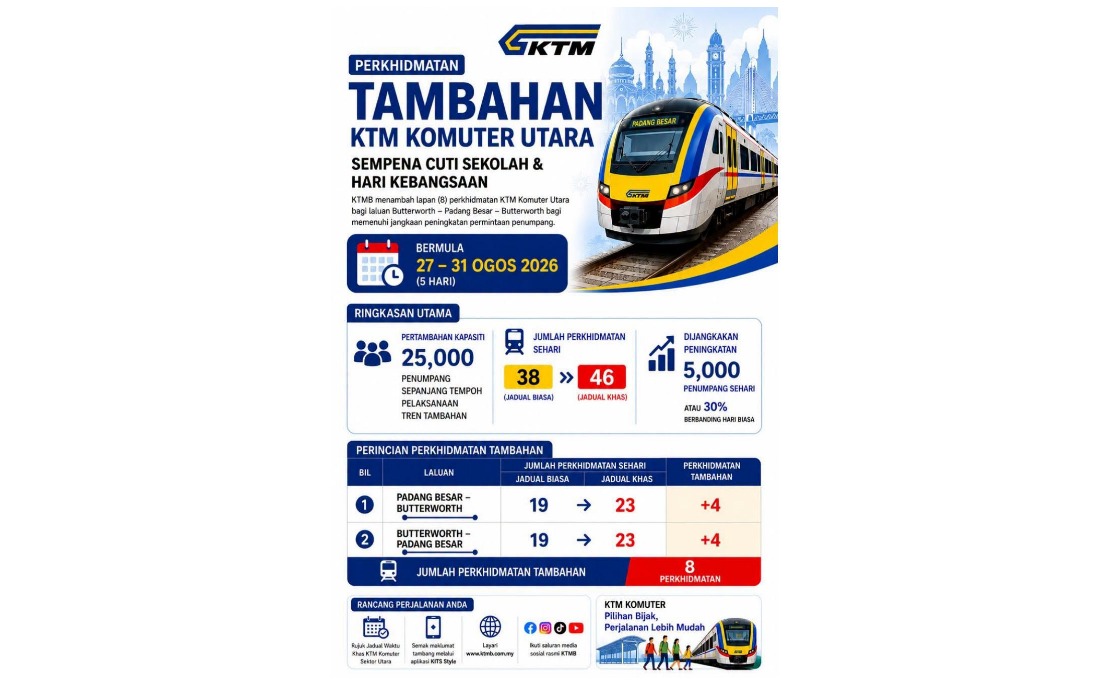
Keretapi Tanah Melayu Berhad (KTMB) is responding to anticipated travel demand during Malaysia's school holidays and National Day celebrations by rolling out eight supplementary train services on its busy northern corridor. The expansion, scheduled to run from Thursday through Monday of the final week of August, targets the high-traffic Butterworth-Padang Besar route connecting Penang, Kedah and Perlis—three states that typically see elevated passenger volumes when schools close.
The temporary scheduling boost represents a tactical approach to capacity planning, transforming daily service frequency on this corridor from 38 to 46 trains. KTMB anticipates passenger numbers will rise by approximately 30 per cent compared with ordinary weekdays, a substantial uptick that would overwhelm conventional timetables. The eight extra services translate into four additional departures each direction, with northbound trains from Padang Besar to Butterworth increasing from 19 to 23 daily, while southbound services from Butterworth to Padang Besar similarly expand to 23 trains per day.
Capacity projections indicate the additional rolling stock can absorb roughly 5,000 extra travellers daily throughout the five-day implementation window, yielding a total additional carrying capacity of 25,000 passengers across the entire period. For commuters and holiday-makers accustomed to crowded platforms and standing-room-only conditions during peak travel seasons, this intervention offers measurable relief. The move underscores KTMB's recognition that Malaysia's northern states function as an integrated regional transport network, with school holidays triggering cross-state movement that strains conventional service schedules.
This expansion initiative reflects broader strategic priorities within Malaysia's public transport ecosystem. As authorities nationwide emphasise modal shift away from private vehicles toward mass transit, managing capacity during predictable demand surges has become critical. The Komuter Utara system already serves as a vital lifeline for daily commuters between these northern states; augmenting capacity during peak periods demonstrates commitment to reliability that might encourage mode switching among occasional travellers.
The timing proves particularly significant given Malaysia's National Day celebrations on August 31, which coincides with the school holiday window. Public holidays typically trigger discretionary travel—visits to relatives, short breaks, and regional exploration—layering additional pressure atop the baseline holiday commute. KTMB's proactive scheduling acknowledges this compound demand scenario rather than treating school closures and national celebrations as separate phenomena.
Operationally, implementing the KTM Komuter Northern Sector Special Timetable during these specific dates requires coordination across multiple departments: crew scheduling, maintenance cycles, ticketing systems, and station operations. The announcement emphasises advance journey planning, directing passengers toward the KITS Style mobile application, KTMB's official website, and social media channels for timetable information. This multi-channel communication strategy reflects modern transport operator practice, recognising that journey planners use diverse platforms to access schedule data.
For regional analysis, this expansion carries implications beyond immediate passenger convenience. The northern corridor connecting Penang, Kedah and Perlis represents Malaysia's primary surface transport spine linking the peninsula to Thailand. Enhanced capacity on this route supports economic integration within the region, facilitating workforce mobility, tourism movement, and commercial transport. During holiday periods, this becomes especially pronounced as leisure travellers traverse state boundaries, while cross-border workers exploit extended breaks to visit home communities in southern Thailand.
The 21 per cent increase in daily service capacity (from 38 to 46 trains) demonstrates that KTMB possesses operational flexibility within its existing fleet. This suggests the constraint during normal periods reflects scheduling philosophy or resource allocation rather than absolute equipment limitations. Whether KTMB maintains permanent deployment at this expanded level, or reverts to baseline timetables once holidays conclude, will signal management priorities regarding standard-period service adequacy versus cost management.
Practical challenges accompany such temporary expansions. Station infrastructure, parking facilities, and feeder bus coordination must scale to accommodate enhanced volumes. The Butterworth and Padang Besar terminals, already handling complex passenger flows, face intensified operational demands. Staff fatigue and scheduling complexity increase when railways operate beyond designed frequencies, potentially affecting service quality even as absolute capacity expands.
For Malaysian commuters, particularly students and working-age adults traversing these northern states regularly, the timing provides tangible benefit. However, the temporary nature underscores fundamental questions about whether baseline Komuter Utara scheduling adequately serves this corridor's potential. Sustainable transport development typically requires permanent capacity increases aligned with population trends and economic growth, rather than periodic supplements during predictable surge periods.
KTMB's announcement positions the rail operator as responsive to passenger needs, a positioning that supports broader government objectives around public transport promotion. Whether this five-day expansion represents genuine capacity constraint management or clever public relations timing around National Day celebrations remains an analytical question. Nonetheless, the 25,000 additional passenger-journeys facilitated during this period constitute real transport provision that likely influences mode choice behaviour among participants experiencing improved service availability during this high-demand window.

