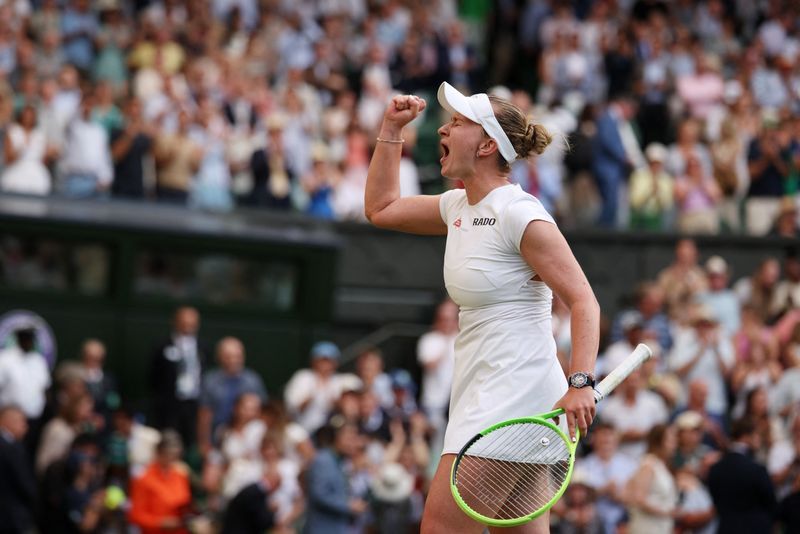
Barbora Krejcikova demonstrated the resilience expected of a former Wimbledon champion on Wednesday, overcoming a set deficit to eliminate fifth seed Mirra Andreeva from the tournament at the All England Club. The Czech player's 4-6 7-5 6-4 victory on Centre Court showcased her ability to recover from difficult moments, a hallmark of her multiple Grand Slam campaigns across singles and doubles disciplines.
The match presented a fascinating generational clash between the 2024 Wimbledon champion and the 19-year-old Russian prodigy, who recently captured her maiden major title at the French Open just weeks earlier. Andreeva's breakthrough success in Paris had positioned her as one of tennis's most promising emerging talents, and her fifth seeding at Wimbledon reflected the circuit's confidence in her ability to compete at the sport's highest level. Against this backdrop, Krejcikova's presence on the opposite side of the net carried particular significance, representing the established guard against the new wave of youth threatening to reshape women's tennis hierarchy.
Krejcikova opened the encounter with considerable attacking intent, establishing a 3-0 lead that suggested a dominant performance might unfold. However, the Czech competitor's intensity dipped precisely when momentum seemed irreversible, allowing Andreeva to claw back into the opening set. The Russian youngster capitalized on this lapse to claim the set 6-4, a reversal that underscored her competitive maturity despite her age and relatively limited Grand Slam experience. For many observers, this initial set loss raised questions about whether Krejcikova could maintain her composure against an opponent increasingly confident in high-pressure situations.
The second set became the turning point where Krejcikova's Grand Slam pedigree became evident. Rather than allowing frustration to mount, she systematically elevated her game and forced Andreeva into increasingly defensive positions. By securing a 7-5 outcome, Krejcikova levelled the match and reset the psychological balance, demonstrating that experience and tactical flexibility remain formidable advantages even against talent-laden competitors. This set proved critical in redirecting the narrative and established conditions favouring the Czech player heading into the decider.
The final set witnessed Andreeva's frustrations visibly intensify as Krejcikova's relentless pressure continued. During this fraught conclusion, Andreeva's emotions boiled over as she confronted the accumulated disappointment of losing control of the match's trajectory. Notably, the Russian saved six match points during the decider, a testament to her fighting spirit and refusal to concede without exhausting all possibilities. Yet despite these desperate efforts, Krejcikova's superior court positioning and shot selection ultimately prevailed, allowing her to secure the match and claim only her second victory in five encounters with the teenage sensation.
Post-match, Krejcikova reflected on the competitive intensity that characterized their meeting, acknowledging Andreeva's exceptional qualities while celebrating her own performance. She emphasized that their history of closely contested matches elevated the significance of victory, suggesting that beating such a formidable opponent while competing at Wimbledon held special meaning. Her reference to competing on Centre Court as the world's premier tennis venue highlighted the emotional resonance of performing at this iconic venue for established champions seeking to maintain their status.
The victory positions Krejcikova for a third-round encounter with fellow Czech player Nikola Bartunkova, setting up an intriguing all-Czech matchup. This pairing raises interesting dynamics regarding player nationality, as two competitors from the same country advance deeper into the tournament's latter stages. Meanwhile, Andreeva faced the difficult process of processing a defeat that might have felt avoidable given her accumulation of match-point opportunities. Her visible frustration—expressed through racket disposal—reflected the emotional toll of narrowly missing chances to progress further in a Grand Slam tournament where she recently proved her credentials as a major-championship competitor.
From a regional perspective, this match illustrates patterns observable across professional tennis globally. While Southeast Asia has produced fewer players competing regularly at Grand Slam venues compared to established tennis nations, the tournament's competitive intensity and the standards required for success remain consistent across all playing regions. Krejcikova's patient approach to overcoming a younger opponent—combining defensive stability with selective aggression—mirrors principles that apply regardless of geographic origin or career stage.
Andreeva's rapid rise from relative obscurity to major-championship winner represents one of tennis's most remarkable recent narratives. Her performance at this year's Wimbledon, despite the second-round exit, demonstrated that maintaining the intensity required to compete effectively at multiple Grand Slams consecutively presents genuine challenges even for talented young competitors. Krejcikova's experience navigating these demands over a longer career ultimately provided the decisive advantage in a match that provided compelling evidence of why grand championships remain won by those combining talent with the intangible resilience developed through repeated high-stakes competition.
The outcome reinforces Krejcikova's credentials as a serious contender for further glory at the All England Club, where her previous championship success established her among the venue's accomplished modern champions. As the tournament progresses, her trajectory through the remaining rounds will indicate whether the Czech player can sustain the level demonstrated against Andreeva and mount another serious challenge for the title that has eluded her since her triumphant 2024 campaign.

