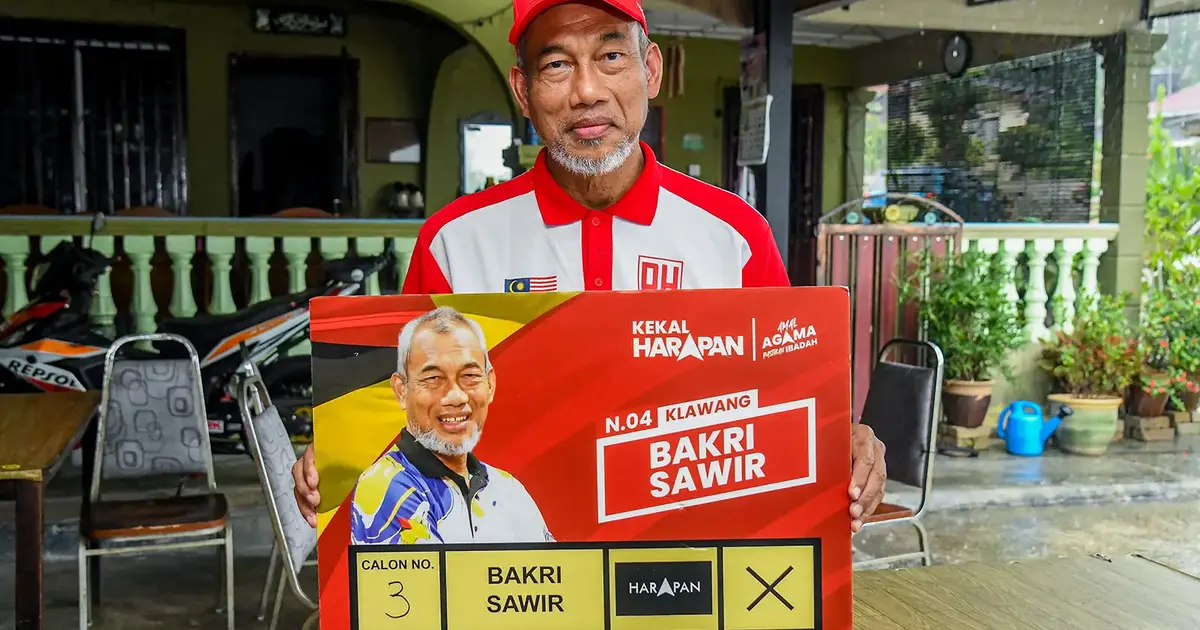
Pakatan Harapan's two-term Klawang assemblyman Bakri Sawir has expressed confidence that he can retain his seat in the face of the latest political alliance between Barisan Nasional and Perikatan Nasional, drawing on his experience of electoral victory without Umno backing during the 2023 state elections in Selangor.
The incumbent's bullish stance comes as political coalitions continue to reshape Malaysia's electoral landscape, with the BN-PN partnership presenting fresh challenges to opposition-held constituencies. For Selangor, where Klawang is located, such alignments carry particular significance given the state's role as a political bellwether and its economic importance to the broader region.
Sawir's confidence appears rooted in tangible proof of concept. During the 2023 Selangor state assembly elections, the Klawang seat changed hands dramatically, with the Pakatan Harapan candidate emerging victorious despite what Sawir characterises as abandonment by Umno—traditionally the dominant player in rural Selangor constituencies. This victory, achieved without the organisational machinery or resources that Umno typically deploys, now serves as his template for the upcoming contest.
The relationship between Pakatan Harapan and Umno remains fractious across much of Selangor, notwithstanding broader power-sharing arrangements at federal and state levels. Rural constituencies like Klawang, historically Umno strongholds, have proven susceptible to opposition inroads when Umno's support fractures or when the incumbent has built sufficient grassroots credibility. Understanding these micro-dynamics within larger political blocs has become essential for opposition strategists.
The formation of the BN-PN pact introduces a complicating variable that Sawir and his party must navigate carefully. Such coalitions typically aim to maximise seat consolidation by preventing three-cornered contests, which can fragment the vote and benefit neither alliance partner. However, the precise terms of the BN-PN agreement—particularly regarding seat allocation in Selangor—remain subject to negotiation and interpretation. For constituencies like Klawang where an incumbent opposition member holds sway, the dynamics become more complex.
Sawir's invocation of his 2023 performance reflects a broader pattern visible across Malaysian politics: the increasing fragmentation of support bases and the declining ability of any single party to claim monolithic support within constituencies. Klawang's electorate, particularly in its more urbanised precincts, has demonstrated willingness to vote for candidates perceived as effective and locally responsive, regardless of traditional party allegiances. This shift suggests that ground-level competence and constituent service may increasingly outweigh coalition arithmetic in determining electoral outcomes.
From a regional perspective, the resilience of Pakatan Harapan candidates in Selangor despite BN's superior financial and organisational resources carries implications for opposition politics across Southeast Asia. Malaysia's relatively mature electoral system allows for genuine power rotation at state and federal levels, a rarity in the region. The outcome of contests like Klawang will contribute to the broader narrative about the sustainability of multi-party competition and whether established incumbents can survive determined challenges from renewed coalition arrangements.
The political economy of rural Selangor constituencies also warrants examination. Klawang, while developing, retains characteristics of constituencies where personal relationships, infrastructure delivery, and direct engagement with constituents matter considerably. An incumbent who has spent two terms building such networks enters the next contest with advantages that cannot be easily offset by high-level coalition agreements struck at state or federal levels. This reality suggests that Sawir's confidence, while perhaps appearing audacious, may reflect a rational assessment of the local political terrain.
However, Sawir's strategy faces real risks. The BN-PN alliance brings together significant organisational capacity and financial resources that exceed what opposition parties can typically mobilise in rural areas. If the coalition partners successfully suppress internal competition and present a unified candidate, they create a concentrated opposition to Pakatan Harapan that may prove difficult to overcome. Umno, despite any grievances, remains a formidable electoral machine when it functions as designed.
The timing of Sawir's public expression of confidence also merits attention. Political candidates often use media statements to signal resolve to their own party apparatus, to energise local supporters, and to establish psychological advantage before campaigns formally commence. His assertion that he conquered Umno's dominance once before serves all these purposes simultaneously, framing the coming contest not as an anomaly but as the continuation of a new political reality in Klawang.
For Malaysian voters and observers, the Klawang seat will serve as a useful barometer for testing several hypotheses about contemporary electoral behaviour: whether coalitions formed at state and federal levels meaningfully shape outcomes at the assembly level; whether incumbent advantage can withstand coordinated opposition from larger alliances; and whether constituencies are gradually becoming more personalistic in their voting patterns or whether larger party and coalition dynamics remain determinative. The answers will carry significance well beyond Selangor's borders.

