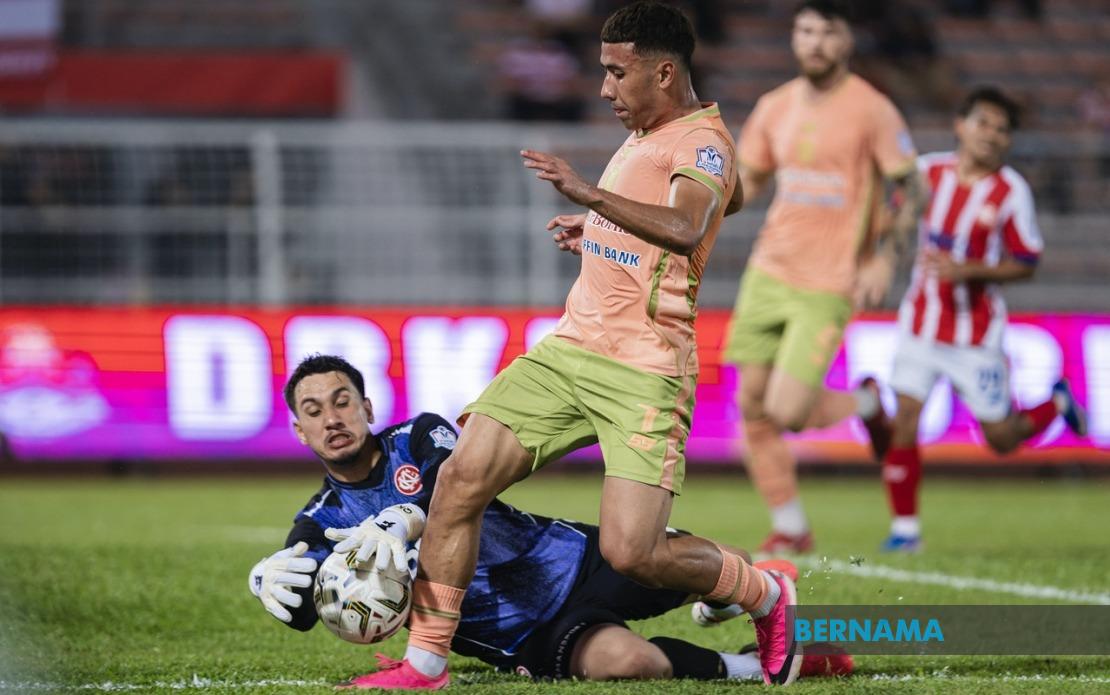
Kuala Lumpur City FC confronted an administrative and health crisis of historic proportions when they took to the Kuala Lumpur Football Stadium pitch in Cheras to face Kuching City FC in their 2026-2027 Super League opener, arriving with skeletal numbers that would have seemed unimaginable in professional football—just ten players and a single substitute on the bench. The resulting 0-6 hammering marked not merely a heavy defeat but a watershed moment that coach Datuk Dollah Salleh described as entirely without precedent across his two decades-plus in the dugout.
The catastrophe unfolded against a backdrop of compounding administrative and medical complications. Thirteen players and two staff members had contracted influenza during the run-up to the match, while persistent registration difficulties left the club unable to field a competitive squad. Dollah's distress was palpable when discussing the sequence of events, revealing that the unusual circumstances had preoccupied him to the point where colleagues around him noticed his unease. For a coach accustomed to navigating the complexities of managing Malaysia's national team and professional club operations, this situation represented genuinely uncharted territory.
The match itself became an exercise in damage limitation from the outset. Despite facing a 10-against-10 scenario after Kuching City captain James Okwuosa received a red card in the 44th minute, KL City's exhausted players deteriorated progressively through the second half. Having given maximum effort during the first period when they were already outnumbered in practical terms, the squad simply lacked the physical reserves to maintain defensive shape. Dollah's tactical adjustment—instructing his depleted unit to focus on preventing further goals rather than attempting to create chances—reflected the grim reality of his options rather than strategic preference.
The coach's empathy for his players was evident in his post-match reflections. He acknowledged that under such dire circumstances, pointing fingers at individual performances would be both unfair and counterproductive. Instead, he praised their resilience in circumstances that would have broken most squads mentally, noting that the magnitude of the defeat was almost inevitable given the constraints. His 23 years of coaching experience, spanning multiple clubs and the national programme, had equipped him for tactical challenges and personnel management but not for fielding matches with fewer than half a standard starting eleven available.
KL City's decision to proceed with the fixture rather than attempt to postpone or withdraw carried significant strategic weight. The alternative of failing to field a team would have triggered far more severe consequences than a single heavy loss, potentially jeopardizing the club's standing within the Malaysian Football League structure and their participation rights throughout the season. This calculation forced Dollah and the club's hierarchy to accept the humiliating scoreline as the lesser evil, a pragmatic choice that nonetheless carried reputational costs.
The broader context of KL City's institutional troubles extends beyond this single catastrophic match. The club had already suffered through a 3-0 forfeiture loss the previous Saturday against Negeri Sembilan FC at Stadium Tuanku Abdul Rahman in Paroi, when they proved unable to register sufficient players to even field a team. The Malaysian Football League responded by awarding Negeri Sembilan a victory by default while imposing a RM50,000 fine on KL City, compounding the administrative and financial pressures bearing down on the organization.
A critical development emerged in the aftermath of the Kuching City debacle, offering a glimmer of hope for the club's immediate future. Dollah confirmed that FIFA had lifted the international transfer ban that had previously restricted KL City's capacity to register new players. The club president's announcement of this clearance suggests that at least one major obstacle to squad reconstruction has been removed, though the damage from two calamitous opening fixtures cannot be erased from the record.
The lifting of the FIFA transfer restriction represents a turning point in KL City's ability to function as a competitive entity. Without this constraint, the club can now actively pursue player registrations and potentially bolster their diminished squad ahead of their scheduled fixture against DPMM FC at home this Saturday. Dollah expressed cautious optimism that this administrative hurdle could no longer serve as an excuse for future underperformance, suggesting the team will look to rebound decisively.
The institutional failures that permitted this crisis to develop raise uncomfortable questions about Malaysian club governance and administrative oversight. That a professional Super League club could enter the season with unresolved registration issues and insufficient contingency planning for health crises suggests systemic vulnerabilities in how clubs prepare for competition. The flu outbreak affecting 13 players and two officials points to potential lapses in medical protocols or facility management that more rigorous oversight might have mitigated.
For Malaysian football enthusiasts, the KL City saga illustrates the fragility of club administration even at the professional level. Dollah's long track record and experience proved insufficient to overcome fundamental organizational breakdowns beyond his direct control as head coach. The incident underscores that technical excellence and tactical acumen cannot substitute for robust administrative infrastructure and contingency planning.
Looking ahead, KL City's ability to recover from this humbling start will likely depend on how efficiently they capitalize on the FIFA clearance to strengthen their squad. The remaining fixtures will reveal whether the club can stabilize its operations and transform a disastrous opening into a learning experience rather than a season-defining trajectory. For Dollah, his reputation as a capable coach remains intact, though the extraordinary circumstances surrounding these early-season matches have tested his resilience in ways his decorated career had never previously demanded.

