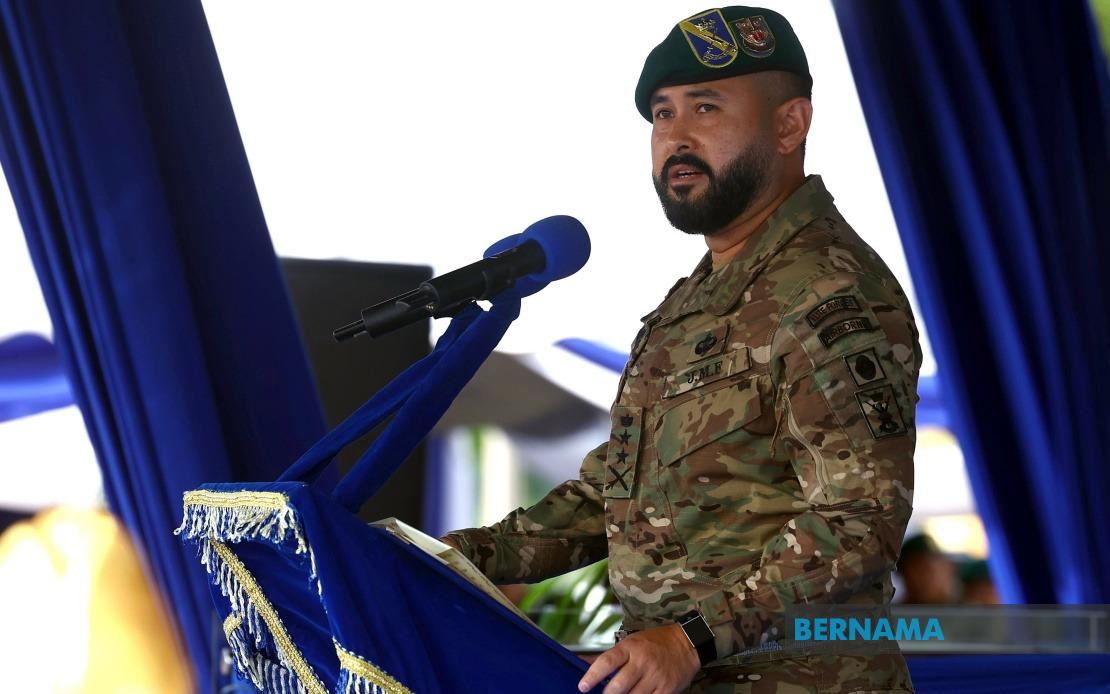
The Regent of Johor, Tunku Mahkota Ismail, has issued a forceful reminder that all parties involved in developing Malaysia's elite Regimen Gerak Khas (RGK) commando unit must strictly adhere to plans and strategies already sanctioned by His Majesty Sultan Ibrahim, King of Malaysia, warning that deviations to serve narrow interests would undermine the unit's operational integrity. Speaking at a ceremonial parade marking the RGK's 61st anniversary in Mersing on August 20, the Regent emphasised that every development initiative concerning the special forces unit requires explicit royal approval, given the King's formal role as Colonel Commandant of the regiment, and must be executed with unwavering commitment to national security and sovereignty.
The Regent's intervention touches on a sensitive issue within Malaysia's military establishment: the tension between long-term strategic planning and bureaucratic or political pressures that sometimes derail institutional commitments. His Royal Highness employed a Malay proverb—"harapkan pagar, pagar makan padi" (trusting the protector only to have them steal what they guard)—to illustrate how previously sound plans risk being compromised when decision-makers prioritise personal or factional advantage over the greater strategic good. The bluntness of his language suggests growing frustration with what he perceives as institutional drift within the defence structure, a concern that carries particular weight given his proximity to the throne and influence over military matters in Johor.
Beyond the immediate question of RGK planning, the Regent levelled broader criticism at the Ministry of Defence hierarchy, signalling awareness of what he described as systemic problems requiring urgent intervention. He pointedly referenced knowledge of who controls the position of Secretary-General at the Ministry of Defence, pledging to address what he termed a "cancer" within the Malaysian Armed Forces—language suggesting he views certain governance practices as fundamentally corrosive to institutional health. This frank acknowledgment that senior civilian and military leadership faces scrutiny indicates that concerns about transparency and merit-based advancement extend to the highest levels of Malaysia's defence establishment.
The Regent articulated an ambitious operational vision for the RGK, stressing that the unit cannot rest on its current capabilities given rapidly shifting security dynamics across the Indo-Pacific region. The contested waters of the South China Sea, combined with intensifying great-power competition in Southeast Asia, have created an environment where defensive readiness must continuously evolve. He insisted that the top brass of the Ministry of Defence, the Malaysian Armed Forces, and the Malaysian Army bear collective responsibility for ensuring the RGK maintains world-class standards across equipment, weaponry, mobility, technology, support infrastructure, and operational assets. His message conveyed that complacency represents an unaffordable luxury in an increasingly unstable strategic environment.
Procurement and capability development emerge as particularly contentious issues in the Regent's assessment. He called for government authorities to implement development and acquisition processes guided strictly by operational capability, technical quality, and value for money—rather than other considerations that might lurk beneath the surface of bureaucratic decision-making. Every RGK project under the 13th Malaysia Plan deserves accelerated treatment and must factor in contemporary technological innovations, fiscal prudence, and alignment with both immediate and anticipated future operational requirements. This emphasis on procurement discipline reflects international best practice, but in the Malaysian context, it implicitly challenges any tendency toward patronage networks or inflated project costs that sometimes characterise defence spending.
The Regent devoted particular attention to personnel management, flagging the danger that favouritism or merit-blind career planning poses to military effectiveness. He warned that allowing personal interests, factional considerations, or non-transparent advancement systems to influence how servicemen and women progress through the ranks undermines organisational performance and erodes the institutional coherence necessary for elite units. Such remarks resonate beyond the RGK, touching on broader governance issues within the civil and military services where political connections or informal networks occasionally override qualifications and track records. For Malaysian defence personnel, the message signals that standards of meritocracy are expected to tighten.
The Regent's insistence on maintaining the highest welfare and career development standards for RGK personnel must be understood within the context of elite military unit dynamics worldwide. Commando and special operations forces depend on cohesion, trust, and the confidence that advancement reflects demonstrated capability rather than hidden political leverage. When a senior royal figure publicly demands transparency in personnel management, he effectively grants cover to whistleblowers or reformers within the institution who might otherwise fear retaliation for exposing irregularities. This dynamic can catalyse meaningful institutional change, particularly when the authority figure commands both symbolic weight and genuine operational influence.
The geographic and geopolitical backdrop to these remarks deserves emphasis for Malaysian and broader regional audiences. The RGK operates in a neighbourhood increasingly characterised by military modernisation, naval competition, and uncertainty about which powers will dominate key sea lanes and strategic chokepoints. Singapore, Indonesia, Thailand, and Vietnam have all invested substantially in special forces capabilities and advanced defence technologies. Malaysia's own defence modernisation efforts have been uneven, with some projects delivering results while others have languished. The Regent's warnings about maintaining the RGK at peak readiness reflect anxiety that Malaysia risks falling behind regional peers if institutional dysfunction prevents optimal deployment of available resources.
The Regent's reference to the Commando Soldier's Oath and the expectation that RGK personnel sustain exceptional levels of skill, physical resilience, mental toughness, integrity, and loyalty to the Crown and nation points toward a philosophical grounding for military professionalism. He portrayed the RGK as the "tip of the spear" in confronting security threats—language emphasising both operational importance and the unit's relatively small size and technical specialisation. This framing justifies his demand for elevated standards across all dimensions, from equipment procurement to personnel conduct. It also implicitly positions the RGK as a strategic asset requiring protection from the kind of institutional decay he evidently fears.
For Malaysian defence watchers and policymakers, the Regent's intervention carries multiple implications. It signals that there are competing visions for how the RGK should evolve, and that at least one influential stakeholder believes certain commitments have been compromised by what he views as illegitimate interference. His emphasis on adhering to royal approval for major decisions establishes a constitutional and hierarchical framework within which future debates must proceed. It also suggests that institutional reform may be forthcoming, particularly if the Regent follows through on his pledge to address governance lapses within the defence ministry. For personnel within the RGK and the wider armed forces, the message conveys both high expectations and an indication that performance standards and institutional integrity now carry elevated scrutiny from quarters with substantial authority.

