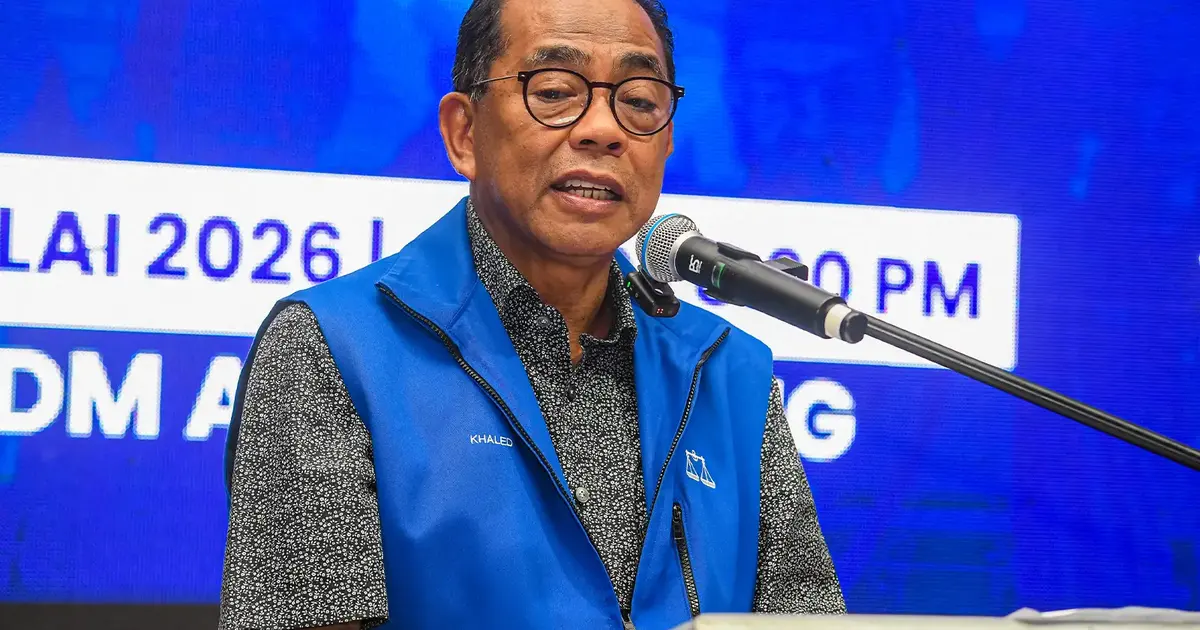
Umno vice-president Khaled Nordin has intensified calls for voters in Negeri Sembilan to deliver a sweeping rejection of Bersatu in the forthcoming state election, drawing parallels with the party's decisive defeat in Johor and warning against allowing it any parliamentary foothold as the country heads toward the next general election cycle.
Khaled's campaign messaging reflects growing concern within Umno's leadership that Bersatu, despite its recent electoral setbacks, retains sufficient organizational capacity and political backing to become a spoiler in crucial state contests. The emphasis on a "complete" rejection suggests Umno views any Bersatu seats in Negeri Sembilan as strategically problematic, potentially fragmenting the opposition vote or complicating post-election coalition arithmetic. This calculus becomes more urgent given that general election GE16 will take place within the next three years, leaving limited time to consolidate voter preference before the national ballot.
The Johor precedent looms large in this messaging. Bersatu's poor performance in that state election demonstrated that voters could be mobilized against the party when coalition partners prioritized that outcome. Khaled's invocation of that result is designed to create momentum and psychological advantage in Negeri Sembilan, suggesting that Bersatu's national decline is irreversible and that backing the party represents a wasted vote. Such rhetoric can prove potent in influencing swing voters who fear squandering their ballot on a failing political entity.
Negeri Sembilan occupies a particularly sensitive position in Malaysian electoral geography. The state's relatively compact voter base and competitive political dynamics mean that a few thousand votes can determine seat outcomes. Unlike larger states where Bersatu might hope to win isolated seats despite organizational weakness, Negeri Sembilan's concentrated electorate offers less room for the party to establish even nominal representation. Khaled's push for a complete whitewash therefore reflects both strategic calculation and realistic assessment of the electoral terrain.
Bersatu's broader decline stems from multiple factors: internal leadership instability, erosion of Malay-Muslim voter trust following the party's evolving political alliances, and perceived abandonment of core constituencies. The party's presence in the Pakatan Harapan coalition, combined with its controversial history and uncertain future direction, has left many traditional supporters uncertain about its fundamental purpose and values. In this context, Khaled's call resonates with voters already ambivalent about Bersatu's continued relevance.
The timing of Khaled's intervention carries weight as well. With Negeri Sembilan elections approaching, Umno operates under imperative to consolidate its voter base and prevent defections to other coalition partners. By positioning Bersatu rejection as a central campaign plank, Khaled shifts focus away from potential intra-coalition tensions and channels voter sentiment toward a common external target. This strategy can improve Umno's bargaining position within its broader electoral coalition while energizing its grassroots machinery.
For Bersatu, the challenge extends beyond Negeri Sembilan's borders. A second major electoral defeat within months of Johor would critically damage the party's credibility and accelerate internal hemorrhaging. Defections to stronger coalition partners would likely accelerate, and the party might struggle to retain leadership talent and organizational capacity. The psychological impact on party members and grassroots activists would be severe, potentially triggering existential questions about whether continued political existence remains viable or worthwhile.
The emphasis on preventing Bersatu from gaining "any footing" ahead of GE16 reveals Umno's longer-term strategic preoccupation. With four to five years separating the Negeri Sembilan election from the general election, Umno leadership clearly fears that allowing Bersatu even symbolic victories would allow the party time to reorganize, recruit new supporters, and position itself as a fresh political entity untethered to recent failures. A clean slate in Negeri Sembilan eliminates that possibility and constrains Bersatu's options for rehabilitation.
Regional implications deserve consideration as well. Negeri Sembilan sits between Kuala Lumpur and other central states that will be pivotal in GE16 calculations. A decisive Umno-led coalition performance in the state election would strengthen the coalition's momentum and credibility in surrounding areas, potentially influencing voting behavior in federal territories and other nearby states. Conversely, any Bersatu gains could be weaponized by political opponents as evidence of coalition fragmentation or voter discontent.
Khaled's messaging also reflects broader Umno calculations about coalition architecture post-GE15. By emphasizing complete Bersatu elimination, Umno arguably seeks to strengthen its own position relative to other coalition partners and create conditions where Umno leads a reconstituted coalition less dependent on troublesome political entities. This internal positioning battle within the broader governing coalition often plays out through rhetoric targeting common external opponents.
Voters in Negeri Sembilan face Khaled's call within a context of Malaysia's evolving political landscape, where electoral outcomes carry consequences extending far beyond individual state contests. The battle over Bersatu's political survival unfolds against questions about which coalitions will govern after GE16, how Malay-Muslim politics will reorganize, and whether Malaysia's political system can achieve greater stability after years of dramatic realignments.
The outcome in Negeri Sembilan will ultimately reflect broader voter assessments about Bersatu's future value and the coalition's strategic direction. Khaled's forceful framing seeks to collapse that choice into a simple proposition: reject Bersatu entirely, or risk its consolidation as a persistent political force complicating the path to GE16 and beyond.

