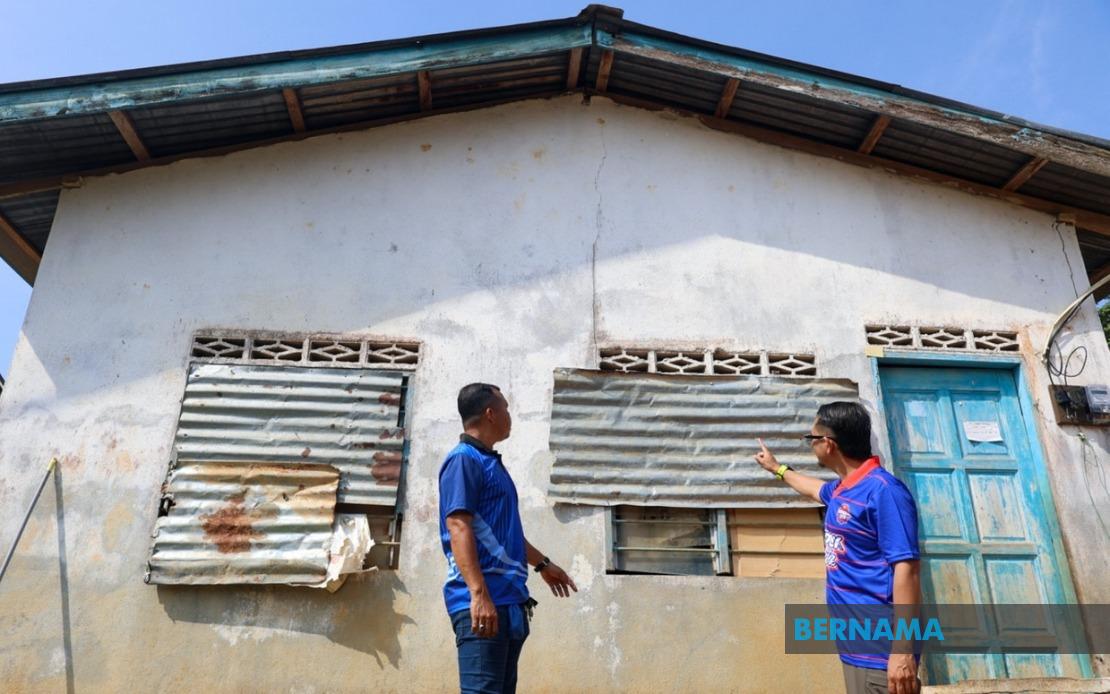
Kelantan's government has mapped a comprehensive development agenda for over 1,500 indigenous residents scattered across two remote forest communities, signalling renewed commitment to addressing longstanding infrastructure deficits in the state's interior regions. The Nenggiri Assemblyman Mohd Azmawi Fikri Abdul Ghani announced the five-point priority framework following recent ground assessments of conditions in the Pasik Resettlement Scheme (RPS) and Kampung Kuala Wok, where approximately 1,524 Orang Asli households struggle with basic services and safety risks that have accumulated over years of relative neglect.
The identification of these priority areas emerged from field visits conducted on August 3 and 4, providing state officials with a direct understanding of how geography and resource scarcity compound the challenges facing these communities. The assemblyman reported that housing conditions constitute the most urgent concern, with numerous dwellings deteriorating beyond safe habitation standards. Roof leakage, structural weakness, and electrical hazards pose immediate health and safety risks, particularly for families with children and elderly members. Beyond repairs, residents have petitioned for new housing construction to accommodate demographic growth, especially young couples establishing independent households—a natural consequence of population increase that resettlement schemes have historically underestimated.
Wildlife conflict represents another dimension of hardship that distinguishes these settlements from more accessible rural areas. Since 2022, wild elephant incursions have escalated in frequency and intensity, disrupting agricultural activities, threatening livestock, and creating psychological stress among residents who must navigate daily routines under constant vigilance. This years-long crisis has deterred productive land use and constrained livelihood options, effectively confining communities to subsistence patterns and welfare dependency. The government's acknowledgment of this issue signals recognition that conventional development approaches must incorporate wildlife mitigation strategies specific to frontier territories where human expansion meets intact forest ecosystems.
Electricity access, though basic infrastructure in most Malaysian contexts, remains irregular and inadequate in these isolated pockets. The absence of reliable power constrains educational opportunities, healthcare delivery, and economic activity, perpetuating disadvantage across multiple domains. When combined with the 200-kilometre round-trip journey required from Gua Musang—necessitating four-wheel-drive vehicles and consuming days for essential transactions—the practical barriers to participating in the broader economy become formidable. This geographic isolation has transformed what should be solvable infrastructure problems into persistent poverty traps.
The Essential Goods Distribution Programme and Jualan Rahmah initiative represent welfare mechanisms attempting to compensate for market access limitations, yet their current design does not fully address local realities. Mohd Azmawi Fikri indicated that the government is seriously considering expanding the Essential Goods Distribution Programme to include RON95 petrol, a measure that acknowledges the critical fuel needs of remote communities where the nearest petrol station lies approximately 50 kilometres distant. Without subsidized fuel access, transportation costs escalate dramatically, rendering market participation uneconomical for small-scale producers and forcing residents to accept unfavourable terms from travelling merchants.
The involvement of the Department of Orang Asli Development (JAKOA) in addressing housing construction demonstrates commitment to working within institutional frameworks, though such coordination often moves slowly. JAKOA's track record with resettlement schemes has been uneven, and successful implementation will require sustained political pressure and dedicated funding allocation beyond routine budgetary processes. The state government's decision to formally table housing proposals for inter-agency discussion marks a procedural advancement, yet skepticism regarding execution timelines remains warranted given historical delays in similar initiatives across Malaysia.
These priority needs cluster into recognizable development challenges that extend across Malaysia's indigenous populations but manifest with particular severity in peninsular interior zones. Unlike urban or suburban Orang Asli communities with established advocacy networks, residents of RPS Pasik and Kampung Kuala Wok possess limited platforms for articulating grievances or mobilizing resources independently. Their recent visibility in state-level discourse owes largely to individual initiatives by local representatives rather than institutionalized mechanisms for indigenous participation in development planning.
The frequency of the Essential Goods Distribution Programme emerged as a secondary concern in the assemblyman's comments, though the source material indicates authorities are studying proposals to enhance distribution cycles. More regular supply runs would reduce dependency on bulk purchasing behaviour and hoarding, improve dietary diversity, and lower the effective cost of market goods for households constrained by storage and preservation capacity. Yet logistical improvements alone cannot substitute for more fundamental economic transformation that would enable communities to generate sustainable incomes rather than remain perpetual welfare recipients.
For Malaysian policymakers and Southeast Asian observers, the Kelantan experience underscores tensions between resettlement models and genuine development. Moving indigenous populations from customary lands into planned schemes has seldom delivered intended benefits without sustained complementary investment in markets, services, and livelihood opportunities. The five-priority framework announced by Nenggiri represents incremental progress, but implementation gaps—between policy pronouncements and on-ground resource allocation—will ultimately determine whether these initiatives constitute meaningful transformation or further cycles of unfulfilled promises. Close monitoring of actual implementation timelines and budget commitments will reveal the sincerity of state commitment to this vulnerable population.

