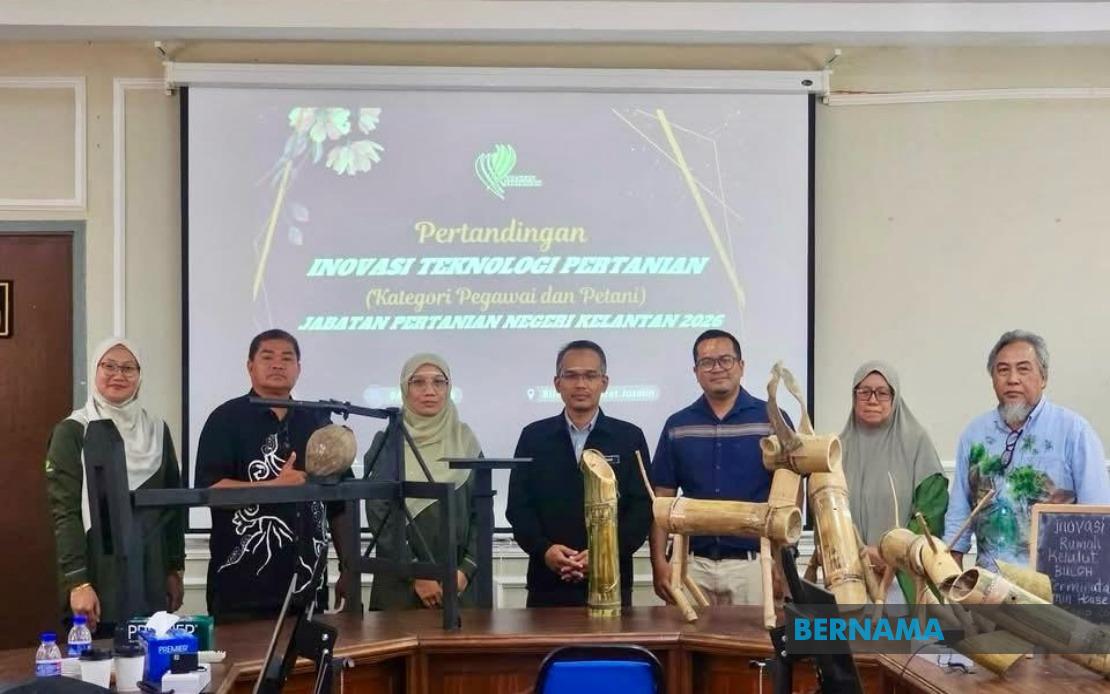
An agricultural innovation developed by Kelantan plantation entrepreneur Che Adnan Che Kadir, 56, has earned state-level recognition and opened doors to nationwide expansion, with agricultural experts now seeing potential for the device to be repurposed for durian processing. The four-star rated coconut dehusking machine, which recently won the farmer category award at the Kelantan Department of Agriculture's 2026 Agricultural Technology Innovation Competition, represents a tangible example of how farm-level problem-solving can scale into broader commercial solutions for Southeast Asia's agricultural sector.
Che Adnan developed the portable 3.5-kilogramme device initially to address the labour-intensive and injury-prone nature of traditional coconut dehusking on his six-hectare property in Kampung Chetok, Pasir Mas. The invention dramatically reduces processing time, cutting the standard two to three minutes required for manual husking down to approximately one minute, with particularly skilled operators capable of completing the task in just forty to forty-five seconds. This efficiency gain carries significant implications not only for individual farmers seeking to reduce labour costs but also for commercial agricultural operations looking to improve throughput and worker safety across the industry.
The judging panel, comprised of representatives from the Kelantan Department of Agriculture, the Malaysian Agricultural Research and Development Institute (MARDI), and regional polytechnics, recognised the device's broader applicability beyond coconuts. After evaluating the machine's design and functionality, the judges suggested that the underlying mechanism could be adapted for processing other fruits, with durians and areca nuts specifically flagged as candidates for further development. Durians emerged as the priority focus area because their notoriously thick and fibrous husks demand considerable skill, strength, and precision to open safely—characteristics that align perfectly with the capabilities of an automated dehusking system.
For Malaysian readers, the durian adaptation holds particular significance given the nation's status as a global durian powerhouse and the ongoing challenges faced by processors seeking to balance quality preservation with operational efficiency. The labour-intensive nature of durian processing remains a bottleneck in the supply chain, particularly as demand from international markets continues to grow. An innovation that could standardise and accelerate this process while reducing worker injury risk would represent a meaningful advancement for the domestic industry, potentially strengthening Malaysia's competitive position in premium durian export markets.
Che Adnan expressed genuine surprise at the trajectory his farm-level innovation has taken. What began as a practical solution to overcome personal operational challenges has now attracted official recognition and institutional support, positioning him as a potential representative for Kelantan at National Innovation Week in Putrajaya, scheduled for late September. This pathway from local invention to national platform exemplifies how Malaysia's agricultural innovation ecosystem is designed to nurture entrepreneurial farmers and scale successful solutions.
To progress toward national-level competition, Che Adnan acknowledges that substantial refinement work lies ahead. The judges provided specific recommendations for design improvements, and securing an innovation grant would prove essential to implementing these modifications and conducting the market research necessary to understand industry requirements regarding production capacity, durability, and cost-effectiveness. The national innovation grant, valued at RM10,000, would provide crucial funding to bridge the gap between prototype and market-ready product.
The adaptation of existing technology for new applications represents a pragmatic approach to innovation, particularly relevant for agricultural economies where resources for fundamental research and development may be constrained. By leveraging the validated mechanical principles already embedded in the coconut dehusking device, Che Adnan and his potential collaborators at MARDI could accelerate the development timeline for a durian-specific solution compared to designing something entirely from scratch. This methodological approach also increases the likelihood of successful commercialisation, as the underlying technology has already demonstrated practical viability.
The broader context for this innovation includes persistent labour shortages across Malaysia's agricultural sector, driven by demographic shifts, rural-to-urban migration, and changing preferences among younger generations regarding farm work. Technological solutions that reduce manual labour while maintaining or improving product quality become increasingly valuable as wage pressures mount and worker availability tightens. An automated durian dehusking system would directly address these systemic challenges while potentially opening export market opportunities for Malaysian durian processors who can offer consistency and food safety assurances.
Che Adnan's journey also highlights the importance of institutional support structures in nurturing agricultural innovation. The Kelantan Department of Agriculture's willingness to facilitate his participation in the state competition, combined with the involvement of established research bodies like MARDI, created the conditions under which a farm-level invention could gain traction and attract serious consideration for scaling. These collaborative frameworks between government agencies, research institutions, and entrepreneurial farmers represent a policy strength that Southeast Asian nations continue to strengthen.
Looking ahead, the commercialisation of a durian-adapted version of this technology could have ripple effects across Malaysia's agricultural supply chain. Beyond the processing efficiency gains, a locally developed solution would reduce dependency on imported equipment and potentially create opportunities for related manufacturing, spare parts supply, and technical servicing industries. For a nation seeking to build greater self-sufficiency and value-addition within its agricultural sector, such developments carry strategic importance.
Che Adnan's ambition to see his innovation both refined and brought to market reflects the mindset increasingly evident among progressive Malaysian farmers who view technological adoption not as a threat but as essential to remaining competitive. His willingness to iterate on his design based on expert feedback and his recognition of the need for grant funding to move from prototype to production demonstrates a realistic understanding of commercialisation requirements. As he prepares to represent Kelantan at the national level, his innovation stands as a concrete example of how homegrown agricultural solutions can address genuine industry pain points.

