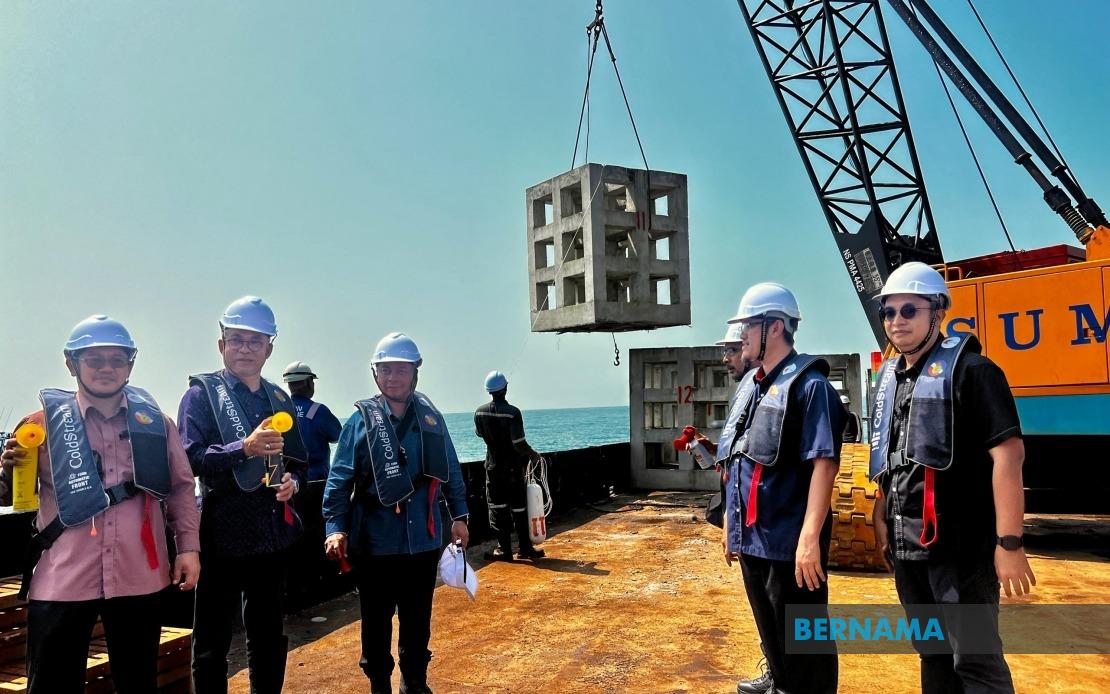
The Kelantan Fisheries Department has taken a significant step in marine conservation by deploying 30 artificial reef structures off the Tok Bali Jetty, positioning them approximately 4.6 nautical miles from shore. This initiative represents the first phase of a broader effort to safeguard the state's fishing communities while simultaneously rehabilitating coastal marine ecosystems. The deployment, funded through contributions specifically allocated by Sultan Muhammad V for fisheries conservation, underscores royal commitment to protecting the livelihoods of Kelantan's fishing sector, which remains economically vital to the state's coastal communities.
Artificial reefs serve a dual purpose that extends beyond conventional environmental management. Department director Ismail Ibrahim explained that these submerged structures function as physical barriers to industrial fishing operations, their design causing fishing equipment to become ensnared when large commercial vessels attempt to operate in shallow coastal waters. This mechanical deterrent effectively establishes a protective zone for small-scale traditional fishermen who depend entirely on these grounds for their income and survival. The strategy represents an innovative approach to resource management, using environmental modification to enforce spatial boundaries without requiring constant surveillance or enforcement interventions.
The ecological rationale behind the programme centres on fish reproduction and population dynamics. When juvenile fish migrate to these artificial habitats during spawning seasons, they gain protection from predators and access to abundant food sources, dramatically improving survival rates. The structures provide surfaces where marine organisms colonize and attach, creating complex microhabitats that mimic natural reef environments. Within months, these areas develop into thriving ecosystem nodes, attracting commercially important species such as grouper, snapper, and various other finfish that form the backbone of regional seafood supplies.
Kelantan's investment in this technology reflects a decade-long commitment to marine conservation infrastructure. Since 2007, the Fisheries Department has systematically deployed approximately 400 artificial reefs across four distinct locations within state waters, demonstrating sustained institutional focus on this approach. The current year alone has witnessed an additional 72 units scheduled for phased deployment, signalling accelerated expansion of the programme. This consistent investment pattern suggests departmental confidence in the methodology's effectiveness and recognition of its importance in addressing mounting pressures on natural fish stocks from industrial overharvesting.
The timeline for observable impact requires patience and environmental understanding. Ismail noted that meaningful improvements in fish breeding and biomass typically emerge after a minimum of six months, though actual outcomes depend on complex factors including water temperature, current patterns, sediment composition, and seasonal ecological cycles. This extended gestation period reflects the reality that marine ecosystem recovery cannot be rushed through policy directive alone; natural processes operate according to biological and physical laws that demand respect and adaptive management. Malaysian fisheries managers must therefore communicate clearly with fishing communities about realistic expectations, preventing disappointment that could undermine public support for conservation initiatives.
Maintenance and active management distinguish this programme from passive conservation efforts. The Kelantan Fisheries Department conducts regular monitoring expeditions and cleaning operations targeting the reef structures, removing accumulated ropes, abandoned fishing nets, and other anthropogenic debris that could compromise ecological function. These interventions prevent the artificial reefs from transforming into traps that inadvertently harm marine life. The commitment to ongoing stewardship demonstrates that deployment represents merely the beginning of a long-term management relationship rather than a one-time intervention, a distinction that separates successful programmes from those that deteriorate through neglect.
For Malaysia's broader fisheries sector, Kelantan's approach offers important lessons relevant to other coastal states facing similar pressures. Perak, Selangor, and Johor have experienced comparable conflicts between industrial and artisanal fishing communities, with small-scale operators increasingly marginalized by factory ships and mechanized trawlers. The artificial reef model provides a template for protecting traditional fishing grounds without requiring expensive enforcement infrastructure or contentious policy conflicts. The moderate cost relative to alternative conservation approaches makes this strategy particularly attractive for resource-constrained state governments seeking to balance economic development with social equity and environmental sustainability.
The programme's implications extend to Malaysia's food security architecture. By enhancing fish stocks in waters accessible to small-scale fishermen, Kelantan effectively increases protein availability for lower-income populations dependent on affordable local seafood. Industrial fishing operations typically export premium catches to international markets, concentrating economic benefits among large operators and corporate shareholders. Supporting artisanal fishing through habitat rehabilitation redirects marine resources toward domestic food chains and community nutrition, contributing to broader development objectives beyond narrow economic metrics. This distributional dimension reflects recognition that fisheries management involves inherently political choices about who benefits from natural resources.
Regional cooperation represents an emerging frontier for reef-based conservation strategies. Fish stocks migrate across territorial boundaries, particularly during monsoon seasons when currents shift and breeding cycles align across the East Coast. Coordinated deployment of artificial reefs by Kelantan, Terengganu, and Pahang could amplify conservation benefits through ecosystem-scale effects that exceed what individual states can achieve independently. ASEAN frameworks and bilateral maritime agreements could facilitate such coordination, creating transnational marine protected zones that recognize ecological realities transcending administrative boundaries. Malaysia's experience with regional fisheries management mechanisms could provide institutional models applicable throughout Southeast Asia, where coastal poverty and marine resource depletion create similar pressures.
Sustainability questions inevitably arise regarding long-term viability of this approach. Artificial reefs function effectively only where underlying ecological conditions support fish populations and where human fishing pressure remains within regenerative capacity. If Kelantan's industrial fishing fleet simultaneously expands its capacity or regional overfishing intensifies, reef benefits could prove temporary and insufficient. The department must therefore integrate this initiative within comprehensive fisheries management frameworks that address fleet size, catch quotas, and seasonal closures. Artificial reefs represent one tool within a broader toolkit that should include demand-side interventions such as consumer education, export regulations, and supply chain transparency.
Looking forward, Kelantan's expansion trajectory suggests confidence that the methodology warrants scaling. The state's stated intention to increase artificial reef deployment across its waters indicates commitment extending beyond pilot phases into normalized practice. Success will ultimately depend on whether fish stocks actually recover measurably over the next several years, a question that can only be answered through rigorous scientific monitoring and transparent reporting. Malaysian fisheries scientists should establish rigorous baseline assessments and ongoing data collection to generate robust evidence regarding programme effectiveness, ensuring that policy decisions rest on empirical foundations rather than optimistic assumptions. Such evidence would strengthen Malaysia's capacity to design evidence-based fisheries policies across all regions.

