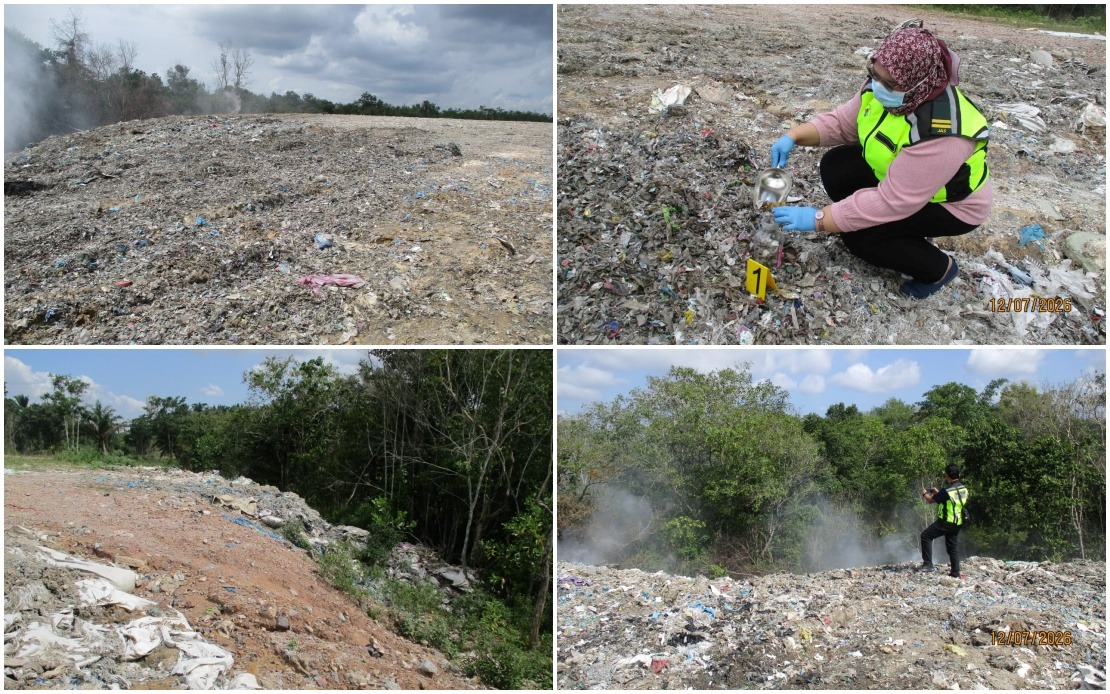
Environmental authorities in Kedah have uncovered a significant violation involving the illegal disposal and incineration of household refuse in the Bukit Banyan locality near Sungai Petani. The discovery followed a formal investigation triggered by resident complaints about acrid smoke permeating the neighbourhood, prompting the state Department of Environment to visit the site on July 14 and document what they found.
The unauthorised waste facility sprawls across roughly 250 square metres of cleared land and contains substantial quantities of domestic refuse. According to Sharifah Zakiah Syed Sahab, the department's director, smoke detected at the scene originated from uncontrolled burning practices conducted by individuals attempting to salvage valuable metallic components from discarded items. This extraction method—heating and burning waste to recover recyclable metals—is a widespread informal practice across parts of Southeast Asia, offering quick monetary returns but creating severe air and soil contamination.
The investigation revealed that the operation lacked any formal authorisation from the Environment Director-General, a mandatory requirement for all solid waste handling facilities in Malaysia. The breach represents a fundamental violation of environmental governance frameworks established under national legislation. The contractors allegedly managing the site had been collecting domestic refuse from industrial locations within the district and depositing it at this unregulated location rather than transporting it to approved disposal facilities.
Kedah's Department of Environment has collected physical samples from the contaminated site and forwarded them to the Department of Chemistry for comprehensive laboratory analysis. These tests will quantify the extent of soil and environmental damage and identify specific contaminants released through the burning process. Such analysis typically reveals heavy metals, persistent organic pollutants, and particulate matter that pose direct risks to nearby residents and broader ecosystem health.
The identified violations fall under two separate legislative provisions within the Environmental Quality Act 1974. The first charge concerns Section 29A(1), which addresses the unauthorised practice of open burning on any parcel of property. The second charge invokes Section 34A(6), targeting the establishment and operation of a solid waste landfill facility without proper governmental sanction. The layering of multiple charges reflects the severity of the infringement and suggests prosecutors intend to pursue a robust legal response.
Managing waste disposal represents an escalating challenge throughout Malaysia and the broader Southeast Asian region, as rapid urbanisation and industrial expansion generate ever-larger quantities of refuse. Informal dumping and unregulated burning often occur when proper collection and treatment infrastructure proves inadequate or economically inaccessible to certain communities and businesses. The Bukit Banyan incident underscores how gaps in formal waste management systems create openings for environmentally destructive practices to flourish unchecked.
The state Department of Environment has now escalated the matter to the Solid Waste and Public Cleansing Management Corporation, commonly referred to as SWCorp. This national agency holds statutory responsibility for enforcing compliance with waste management standards and monitoring licenced operators across Malaysia. SWCorp's involvement signals that this case will receive systematic follow-up and that enforcement mechanisms will be activated to prevent similar operations from recurring in the district.
The emergence of such illegal facilities reflects broader structural issues within Malaysia's waste sector. Contractors tasked with collecting refuse from industrial zones sometimes operate with minimal oversight, and economic pressures may incentivise cutting corners by diverting waste to unregulated sites rather than incurring formal disposal fees. Meanwhile, opportunities to extract recoverable materials attract informal workers seeking livelihoods, even when methods create substantial public health and environmental costs that extend far beyond individual economic gain.
For residents in affected areas, the discovery raises immediate health concerns. Open burning of heterogeneous household and industrial waste releases a complex mixture of toxic compounds into the air, including dioxins, furans, and heavy metal vapours. People living in proximity to such sites face elevated risks of respiratory disease, cardiovascular complications, and other chronic health conditions. The case therefore carries implications that reach well beyond environmental regulation into occupational health and community welfare.
The Kedah incident also highlights the importance of public vigilance and environmental reporting. The investigation began only after community members lodged formal complaints about visible smoke and odour pollution. This pattern demonstrates that regulatory agencies often depend on tip-offs from alert residents to identify violations occurring on private land or in peripheral locations. Strengthening mechanisms for public environmental reporting, coupled with responsive government investigation capacity, remains essential for maintaining compliance across dispersed waste handling activities.
Moving forward, authorities may leverage this case to deter similar operations by pursuing penalties and pursuing prosecutions under the relevant statutes. The involvement of SWCorp should lead to enhanced monitoring of waste contractors operating in the district and potentially stricter licensing conditions for those engaged in refuse collection. Kedah's Department of Environment may also use the incident to conduct broader public awareness campaigns emphasising the severe consequences of illegal dumping and open burning, targeting both contractors and residents who might otherwise consider such practices viable alternatives to regulated disposal.

