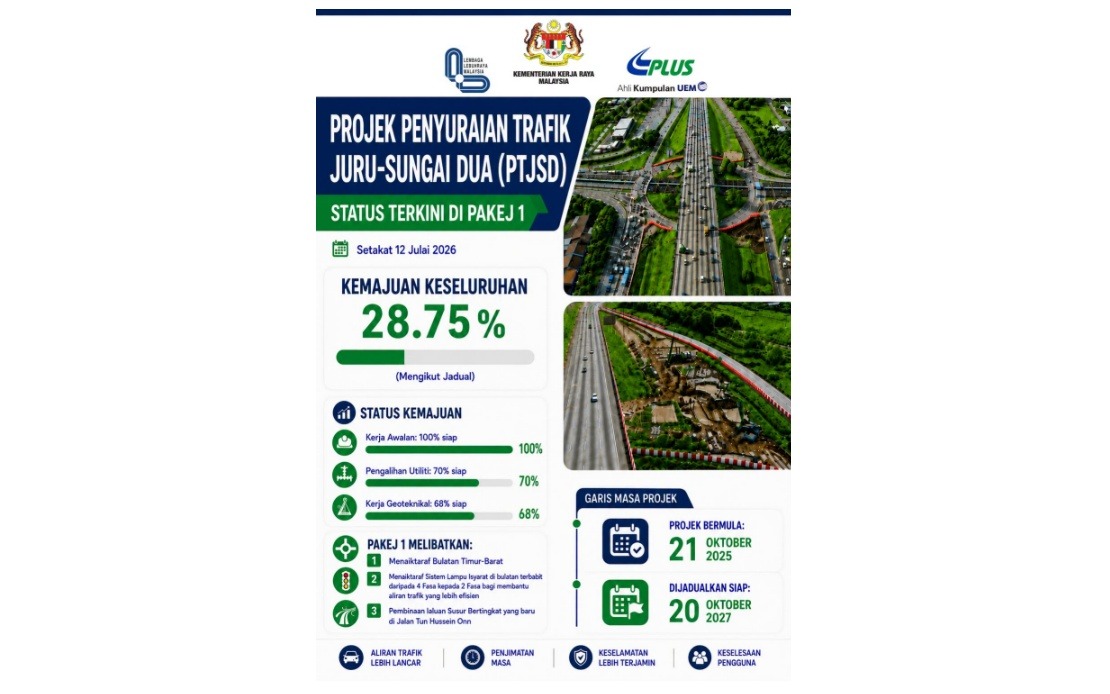
The Juru-Sungai Dua Traffic Dispersal Project (PTJSD) continues its measured advance through northern Penang, with PLUS Malaysia Berhad confirming that Package 1 had reached 28.75 per cent completion as of July 12, maintaining the accelerated timeline that will bring the RM3 billion infrastructure initiative to fruition by October 2027. This steady progression across the mammoth undertaking underscores the operational efficiency of a project designed to fundamentally reshape traffic patterns along one of Malaysia's most congested peninsular corridors.
The preliminary construction phases have already been fully concluded, marking a critical milestone that allows the project to advance into its more intensive stages without the logistical complications that often plague major infrastructure works. The utility relocation work, which involves the complex coordination of rerouting water, electrical, telecommunications, and other essential services across the sprawling 17.3-kilometre corridor, has reached 70 per cent completion. Simultaneously, the geotechnical investigations and stabilisation work have progressed to 68 per cent, indicating that engineers have substantially completed the groundwork necessary for foundation and structural design finalisation across the route.
Package 1 specifically encompasses three interconnected improvements intended to untangle the notorious bottleneck at the East-West Roundabout and surrounding arterial routes. The centrepiece involves upgrading the roundabout itself, coupled with enhanced traffic signal coordination designed to optimise vehicular throughput during periods of peak demand. Additionally, the project includes construction of a new elevated slip road along Jalan Tun Hussein Onn, a critical intervention that will physically separate conflicting traffic flows and eliminate the dangerous merging conditions that currently plague this intersection. These complementary improvements reflect a sophisticated understanding of how localised infrastructure investment can cascade into broader network efficiency gains.
The PTJSD addresses chronic congestion that has long plagued the Juru–Sungai Dua corridor, a vital artery linking Penang with the states of Kedah, Perlis, and surrounding northern regions. This route experiences exceptional demand from commercial vehicles, tourist traffic, and daily commuters crossing between peninsular provinces, creating conditions where journey times regularly exceed one hour during peak periods. The new dedicated Juru-Sungai Dua route being constructed as part of this project is projected to reduce such transit times dramatically to merely 20 minutes during equivalent traffic conditions, representing a transformative improvement to regional mobility and economic connectivity.
The scope of potential beneficiaries is substantial and economically significant. Approximately 200,000 daily users of this corridor stand to gain improved travel reliability and reduced transportation costs. These users span commercial operators dependent on predictable transit times for just-in-time logistics, travellers between provincial centres, cross-border traffic, and daily commuters whose working lives depend on reasonable journey times. For Malaysian businesses, particularly those in manufacturing and trade operations distributed across northern peninsula states, the time savings translate directly into operational cost reductions and enhanced competitiveness.
The project trajectory across South, Central, and North Seberang Perai districts demonstrates how infrastructure planning operates at the metropolitan scale, requiring coordination across multiple administrative jurisdictions. This approach necessitates alignment between local government authorities, state-level planning bodies, and federal highway management entities. The involvement of the Ministry of Works and the Malaysian Highways Authority reflects the seniority of institutional commitment required when undertaking projects of this magnitude and regional importance. Such coordination mechanisms, when functioning effectively, can serve as models for similar cross-jurisdictional infrastructure initiatives elsewhere in Malaysia.
The traffic modelling underlying the PTJSD projections suggests that approximately 30 per cent of existing corridor traffic will migrate to the new dedicated Juru-Sungai Dua route once it becomes operational. This shift, if realised, would substantially alleviate pressure on existing parallel routes while generating the dramatic time savings promised in the project documentation. However, the actual distribution of traffic once the new route opens may depend on toll structures, driver familiarity with alternative pathways, and the operational characteristics of feeder roads connecting to the new infrastructure. Monitoring actual traffic patterns post-completion will prove essential for validating the project's assumptions and informing future infrastructure investments in similarly congested corridors.
The October 2027 completion target provides Malaysian stakeholders with a defined timeframe against which to measure progress, though infrastructure projects of this complexity frequently encounter unforeseen challenges that necessitate schedule adjustments. Weather disruptions, supply chain complications, or unexpected subsurface conditions could potentially impact the timeline. Nevertheless, the project's current adherence to schedule, evidenced by the achievement of preliminary work completion and substantial advancement in utility relocation and geotechnical investigations, suggests that project management capabilities remain adequate to the undertaking's demands.
From a regional economic perspective, the PTJSD represents strategic infrastructure investment in an area of demonstrated commercial vitality. The Juru-Sungai Dua corridor's historical congestion has already imposed quantifiable economic penalties on businesses operating across northern peninsula jurisdictions through lost productivity, increased transportation costs, and deferred investment in regions perceived as difficult to access. By reducing these friction costs, the completed project should stimulate business expansion, facilitate labour market integration across provincial boundaries, and enhance Malaysia's overall logistical competitiveness relative to regional competitors. The magnitude of this investment reflects official recognition that traffic congestion in northern peninsula represents a genuine impediment to economic development warranting mobilisation of substantial public resources.

