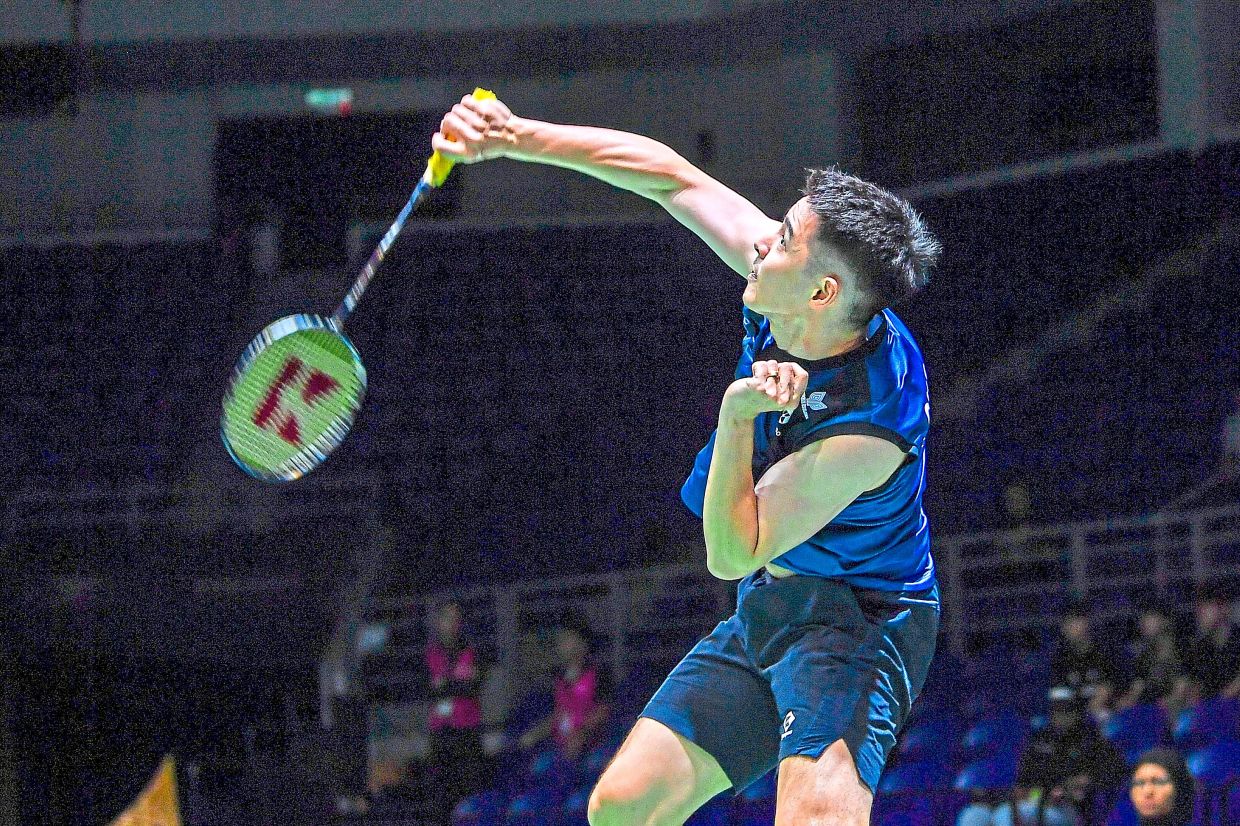
Cheam June Wei's unlikely journey at the Korean Masters took another impressive turn on Friday when the independent Malaysian shuttler dispatched Taiwan's seventh seed Su Li-yang in a closely contested quarter-final at the Asan Yi Sun-sin Gymnasium. The 23-21, 10-21, 21-18 victory marked yet another scalp for June Wei, who entered the tournament without the backing of a major federation or sponsorship structure—a significant disadvantage in professional badminton where resources often determine competitive capacity. His performance underscored the unpredictable nature of individual sport, where tactical acumen and mental fortitude can occasionally overcome conventional hierarchies.
The match itself reflected the grinding character of men's singles badminton at the elite level, with neither player able to establish clear dominance across all three games. June Wei's ability to recover from the second-set reversal and secure victory in the decider demonstrated the psychological resilience required to compete against seeded opponents. His post-match commentary revealed a player content to embrace uncertainty rather than burden himself with expectations. By focusing on point-by-point execution rather than fixating on the broader implications of facing a seeded opponent, June Wei adopted the mental framework that often separates consistent performers from one-tournament wonders in professional sports.
June Wei's ascent through the Korean Masters draw reflected a series of impressive victories that gradually built momentum. His opening-round upset of world number 29 Jason Teh suggested that the independent shuttler possessed the tactical tools to trouble higher-ranked adversaries, a characteristic not always evident in lower-ranked players who often lack the experience of competing regularly against elite opposition. His subsequent second-round triumph over China's world number 49 Dong Tianyao further validated his credentials, indicating that his quarter-final appearance represented genuine competitive achievement rather than fortunate bracket positioning.
The men's doubles competition proved more straightforward for Malaysian representation. The pairing of Man Wei Chong and Soh Wooi Yik dispatched India's Krishna Prasad Garaga and Pruthvi Krishnamurthy Roy with commanding efficiency, posting a convincing 21-7, 21-8 scoreline that suggested superior court positioning and coordinated attacking play. Such dominant performances in doubles often reflect the importance of synchronised movement and understanding between partners—elements that months of training develop into automatic responses during high-pressure competition.
The all-Malaysian quarter-final between two domestic doubles pairings delivered further positive news for Malaysian badminton representation at the tournament. Tee Kai Wun and Yap Roy King proved too strong for Aaron Chia and Aaron Tai, winning 21-12, 21-15 in a match that highlighted internal competition within Malaysia's badminton ecosystem. Rather than depleting the national badminton talent pool, such intra-Malaysian clashes at international tournaments often strengthen the competitive environment by maintaining high training standards and forcing continuous tactical refinement among players competing for limited spots in major competitions.
The mixed doubles category, however, presented a notably different narrative for Malaysian participants. All three Malaysian mixed doubles combinations faltered in the quarter-final stage, suggesting either weaker relative performance in this particular discipline or the depth of competition available in mixed doubles at tournaments of the Korean Masters' calibre. Jimmy Wong and Cheng Su Yin fell to South Korea's second-seeded Kim Jae-hyeon and Jang Ha-jeong, dropping their match 17-21, 18-21 in a contest that likely saw the higher-ranked Korean pairing control the tempo and dictate court positioning.
The exits of Loo Bing Kun with Noraqilah Maisarah Ramdan and Chen Tang Jie with Clarissa San against China's Gao Jiaxuan and Wu Mengying and Japan's Haruki Kawabe and Kokona Ishikawa respectively underscored how mixed doubles success at international tournaments often depends on specific strategic advantages that particular nations have cultivated. China's mixed doubles programme, for instance, has historically emphasised certain technical approaches that have proven consistently effective, while Japanese mixed doubles represents a different tactical philosophy. Malaysian pairs faced opponents whose mixed doubles systems have been honed through years of systematic development, a competitive factor that individual Malaysian pairings must overcome through innovation or superior execution.
June Wei's remarkable progress at the Korean Masters occurs within the broader context of Malaysian badminton's recent international performance. The sport remains a significant dimension of Malaysia's sporting identity, with historical success at major tournaments creating ongoing expectations for medal performances. Individual players operating independently of major badminton structures represent an increasingly important but sometimes overlooked segment of the sport, as they navigate the financial and logistical challenges of competing without institutional support while attempting to match the preparation standards of state-backed athletes from larger badminton nations.
The semi-final appearance for June Wei guarantees him valuable ranking points and prize money, both critical for independent athletes sustaining competitive careers in badminton. More broadly, his performance illustrates how tournament success at this level sometimes reflects intangible competitive qualities—adaptability, mental resilience, tactical flexibility—that statistical rankings may incompletely capture. For Malaysian badminton followers, June Wei's run provides an encouraging narrative about the depth of talent within the country and the possibility of achieving international success through pathways outside traditional institutional structures.

