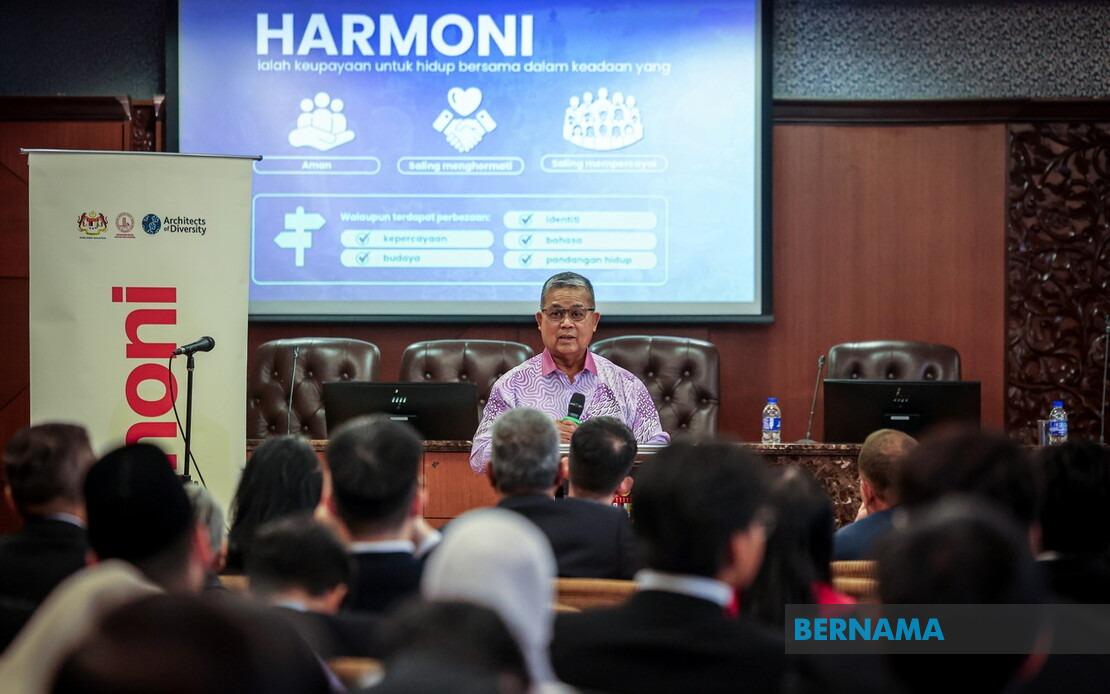
The Department of National Unity and National Integration (JPNIN) has embarked on an ambitious research project to construct a Community Tension Index, a quantitative framework designed to assess the state of social cohesion across Malaysia while simultaneously tracking emerging flashpoints related to matters of race, religion and royalty. This index represents a methodological shift toward data-driven governance in the sensitive domain of interethnic and interfaith relations, allowing policymakers to identify deteriorating community relationships before they escalate into broader conflict.
Minister of National Unity Datuk Aaron Ago Dagang articulated the strategic importance of this initiative at the 2026 Harmony Symposium held at Parliament, explaining that the index findings would furnish government decision-makers with reliable intelligence for crafting preemptive interventions and managing contentious issues within Malaysia's pluralistic landscape. Rather than responding reactively to crises, the ministry aims to establish early warning mechanisms that can flag areas of growing tension before social fractures become entrenched or ignite into larger disturbances affecting national stability.
The timing of this initiative reflects a fundamental shift in how threats to national cohesion manifest themselves. While historical communal tensions often crystallised around physical public spaces and mass gatherings, contemporary challenges increasingly originate from digital platforms where algorithmic curation creates what researchers term "filter bubbles" and "echo chambers." These technological phenomena inadvertently reinforce existing beliefs and isolate users from contrary perspectives, narrowing intellectual space for constructive dialogue and deepening misunderstanding between different communities.
Data released by JPNIN underscores the scale of this digital challenge. Between January 2025 and January 2026, the Malaysian Communications and Multimedia Commission (MCMC) executed enforcement actions resulting in the removal of 1,493 pieces of online content that touched upon religion, royalty, or racial matters in potentially inflammatory ways. This volume suggests that digital platforms have become significant vectors for divisive messaging, with content creators either deliberately inflaming sensitivities or carelessly promoting material likely to alienate communities and erode social trust.
The algorithmic architecture of social media platforms compounds these problems. Content feeds prioritise engagement metrics rather than accuracy or social benefit, meaning controversial or emotionally charged material—particularly content touching on sensitive 3R issues—receives disproportionate algorithmic amplification. Users dwelling within homogeneous information ecosystems consequently develop increasingly polarised worldviews, convinced of narratives that may lack empirical foundation or nuance. This environment rewards inflammatory rhetoric while penalising measured discourse, inverting the conditions necessary for healthy pluralistic society.
Beyond the quantitative measurement tool, JPNIN is simultaneously advancing plans for institutional infrastructure to address these challenges. The ministry has engaged extensive stakeholder consultations regarding a proposed National Harmony Commission (SKN), which would function as a dedicated governmental body oriented toward prevention, mediation, and constructive conflict resolution. Rather than punitive measures alone, this commission would emphasise early intervention and dialogue-based approaches to disputes that threaten national harmony, investigating incidents with systematic attention to their root causes and community impact.
The proposed commission's preventive mandate reflects sophisticated understanding of conflict dynamics. Research in peace-building and community relations consistently demonstrates that early intervention—addressing tensions when they remain nascent rather than after they crystallise—proves substantially more effective than post-facto management of established disputes. A dedicated institutional mechanism focused explicitly on harmony preservation could potentially intervene at crucial junctures, facilitating dialogue between affected communities and helping disputants recognise their shared interests in maintaining national stability.
For Malaysian society, this two-pronged approach—combining empirical measurement through the Community Tension Index with institutional mediation capability through the proposed SKN—represents a modernised governance framework for managing diversity. Rather than suppressing discussion of sensitive matters, these mechanisms facilitate better understanding of underlying tensions and more sophisticated policy responses. The emphasis on early intervention and dialogue aligns with best practices in interethnic relations management globally, where societies that institutionalise dialogue and preventive mechanisms demonstrate greater long-term stability than those relying primarily on legal prohibitions.
The initiative also carries implications for Malaysia's regional role. As Southeast Asia grapples with rising digital polarisation affecting multiple societies, Malaysia's experience in developing measurement and mediation tools could inform regional approaches to preserving pluralism in increasingly fragmented information ecosystems. The success or failure of these initiatives will likely influence how neighbouring nations conceptualise national unity strategies in their own diverse contexts.
Implementing the Community Tension Index effectively will require substantial methodological rigour. Index construction demands careful selection of indicators that capture genuine community sentiment rather than mere digital noise, rigorous data collection procedures, and transparent analysis methodology that commands credibility across Malaysia's different communities. Any perception that the index measures selectively or serves partisan agendas would undermine its utility and erode trust in JPNIN's role as an honest broker of national harmony.
Equally important will be ensuring the National Harmony Commission operates with genuine independence and impartiality. Such bodies risk becoming tools for suppressing legitimate grievances if perceived as instruments of political power rather than neutral mediators. Building public confidence in the commission's fairness—particularly among minority communities historically vulnerable to majority-driven policies—will require transparent procedures, diverse membership, and demonstrated willingness to challenge all parties equally when they contribute to communal tensions.
The success of these initiatives ultimately depends on complementary efforts to strengthen digital literacy and promote responsible online behaviour across Malaysian society. Technology alone cannot solve problems rooted in human psychology and social dynamics. Educational campaigns explaining algorithmic effects, promoting critical consumption of online information, and encouraging diverse perspective-seeking would amplify the positive effects of institutional measures while addressing demand-side drivers of polarisation.
As Malaysia navigates increasingly complex challenges to national unity in the digital age, these initiatives represent serious attempts to develop sophisticated governance tools appropriate to contemporary realities. Whether they succeed will depend on implementation rigour, genuine commitment to dialogue across communities, and willingness to adapt strategies based on emerging evidence about what actually preserves and strengthens social cohesion in plural societies.

