Johor's leadership has undergone a significant restructuring as Menteri Besar Datuk Onn Hafiz Ghazi recalibrated his State Executive Council, signalling both continuity and renewal in the state's administrative direction. The reshuffle, which saw six assemblymen retain their portfolios alongside four newly appointed officials, represents the administration's attempt to balance institutional memory with fresh perspectives as it navigates the challenges ahead for Malaysia's southern gateway.
Onn Hafiz framed the organisational change as a deliberate strategy to sustain momentum while injecting new energy into Johor's governance structures. In his public statement, the Menteri Besar emphasised that the reshuffling was neither a rejection of previous work nor a wholesale abandonment of established approaches, but rather an evolutionary step designed to maintain the state's trajectory towards greater development and prosperity. This positioning suggests a government mindful of the political sensitivities inherent in removing sitting exco members—a move that could otherwise be read as criticism of their tenure.
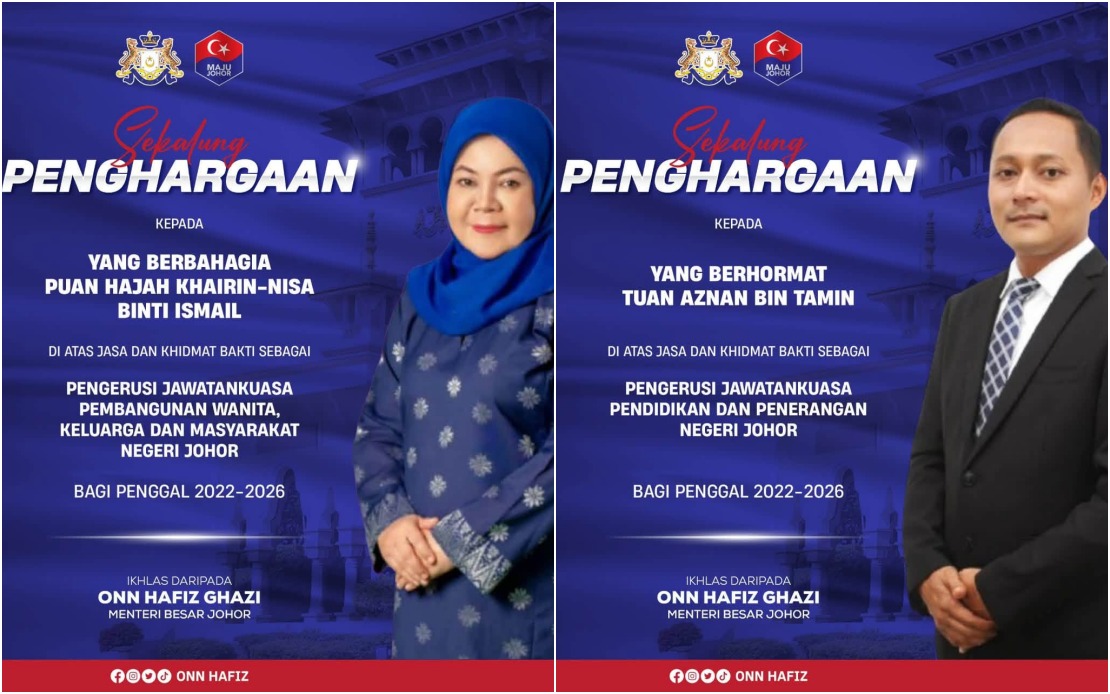
Four former exco members from the 2022-2026 term—Datuk Zahari Sarip, K. Raven Kumar, Aznan Tamin, and Khairin-Nisa Ismail—departed their positions following the restructuring. Rather than characterising this transition as a demotion or failure, Onn Hafiz publicly acknowledged their contributions to the state's administration, emphasising that their sacrifices, dedication, and intellectual capital had been instrumental in achieving government objectives during their term. This diplomatic approach serves multiple purposes: it avoids public acrimony, preserves relationships within the ruling coalition, and maintains the morale of the broader political establishment that depends on such transitions proceeding without rancour.
The philosophical underpinning of the reshuffle, as articulated by the Menteri Besar, rests on the principle that leadership responsibility extends beyond individual portfolio holders. Onn Hafiz suggested that experience, wisdom, and commitment to public service represent transferable assets that departing exco members retain regardless of their formal positions. This framing allows the administration to benefit from the continued engagement of outgoing officials in different capacities—whether in backbench legislative work, party committees, or other institutional roles—without the formal power and resources attached to executive positions.
The ceremonial dimension of the reshuffle underscored its importance within Johor's political calendar. All ten exco members were sworn in before the Tunku Mahkota Ismail at Istana Bukit Serene, the official residence of the Regent, during a formal appointment and oath-taking ceremony. This formal ritual legitimises the new structure within the state's constitutional framework and signals that the change has proceeded with proper institutional protocols. For observers in other Malaysian states, such ceremonies serve as visible markers of governmental continuity despite leadership changes—a reassurance to investors, civil servants, and the general public that institutional mechanisms remain intact even as personnel shift.
The balance between continuity and change—six retained and four new faces—reflects a pragmatic approach to administrative reform. Retaining six assemblymen preserves departmental expertise, maintains institutional relationships with federal agencies and commercial partners, and avoids the disruption that wholesale replacement would entail. Simultaneously, introducing four newcomers enables the injection of fresh policy ideas, expands representation across different assemblies or demographic groups, and creates advancement opportunities that help maintain party cohesion by rewarding backbenchers with enhanced responsibilities.
For Johor specifically, the reshuffle occurs within the context of the state's economic significance to the broader Malaysian economy. As a major industrial, agricultural, and commercial hub, Johor's administrative effectiveness directly impacts regional development and federal revenue. The exco's portfolios typically encompass critical areas such as local government, infrastructure, commerce, and public health—domains where continuity of policy implementation and relationship management remain crucial for sustained performance.
The timing and composition of the reshuffle also merit consideration within the broader landscape of Malaysian federalism. Johor, governed by Barisan Nasional, maintains particular importance given its size, electoral weight, and strategic position adjacent to Singapore. Changes in the state's administrative apparatus often receive attention from federal authorities, investors, and neighbouring jurisdictions, making transparent communication about the rationale for restructuring an important element of political and economic management.
Onn Hafiz's emphasis on the collective achievements of his administration, rather than personalised accomplishments, suggests an attempt to institutionalise governance rather than personalise it. By crediting the former exco members' contributions to broader state outcomes, he positions the government's success as a product of systemic effort rather than individual genius. This approach theoretically insulates the administration from the perception that particular individuals are irreplaceable or that their departure threatens continued progress—a valuable political message in an era of coalition politics where members move between roles frequently.
Moving forward, the reshuffle presents both opportunities and risks. The retained members bring proven track records but face the challenge of mentoring and integrating new colleagues quickly to minimise the learning curve. The four new appointees must rapidly master their portfolios while building the relationships necessary for effective implementation of state policies. For Malaysian observers, Johor's administrative transition serves as a case study in how state governments navigate the perennial tension between stability and renewal—a challenge all administrations face when balancing the preservation of effective institutions with the need to demonstrate progress and responsiveness to changing circumstances.

