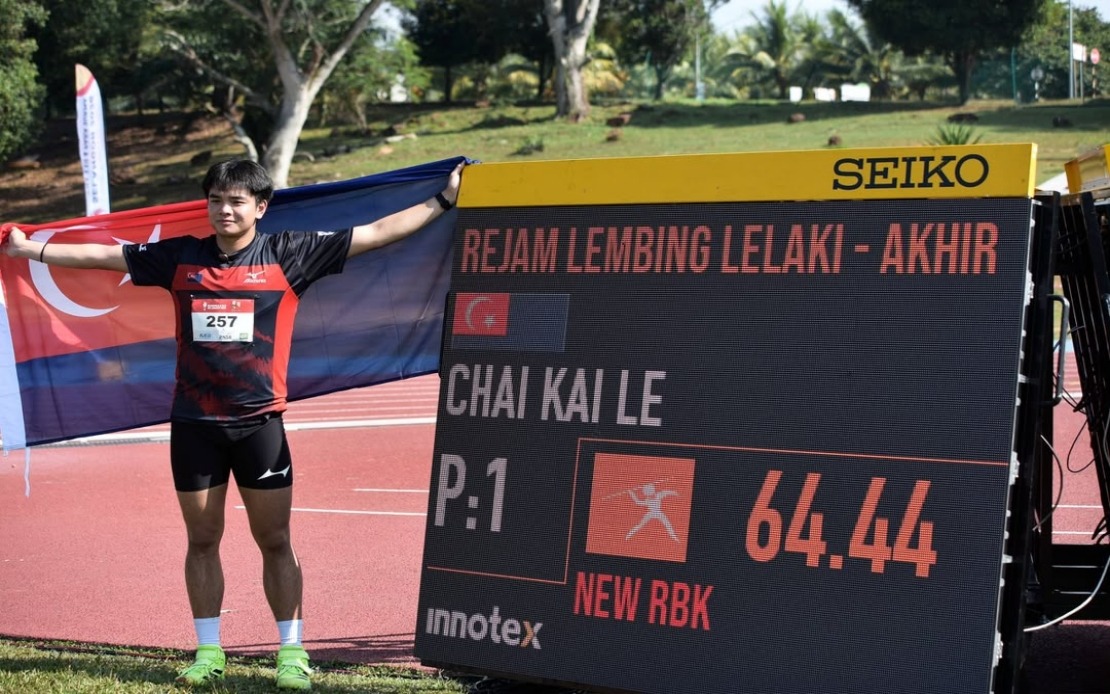
Chai Kai Le of Johor etched his name into Malaysia Games history on August 17 when the 18-year-old javelin thrower launched the spear 64.44 metres at the Universiti Putra Malaysia Sports Centre in Serdang, smashing a record that had stood untouched for more than a quarter-century. The previous SUKMA mark of 62.33 metres, set by Sarawak's Kho Mei Kuan during the 2000 Games in Penang, had long been a benchmark for Malaysian throwing talent, and Kai Le's decisive performance in the second round signalled the emergence of a generational talent in field athletics.
The significance of Kai Le's achievement extends beyond the gold medal itself. The teenager's assault on the record represents a meaningful progression in Malaysian athletics, a sport where regional competitiveness remains fierce and national standards must continually improve to maintain relevance on the Southeast Asian stage. His throw came during the Selangor 2026 edition of SUKMA, where athletes from across the nation converge to showcase their capabilities and stake claims for spots in broader international competitions. For a young athlete to produce a performance of this calibre signals both personal development and the potential depth emerging within Johor's athletics programme.
During his post-competition remarks to journalists, Kai Le demonstrated the mental discipline expected of serious track-and-field competitors. He revealed that breaking the Games record had featured prominently in his strategic objectives as he prepared for this edition of SUKMA over a two-year period. Such extended preparation cycles are increasingly common among Malaysian athletes targeting specific championships, reflecting a more professionalised approach to sports development within the country. His satisfaction with the outcome underscored his confidence heading into the competition, though he acknowledged that execution had not been flawless throughout the day.
Kai Le's physical resilience would be tested during his competitive effort. Following his record-breaking second throw, he experienced a technical miscalculation that triggered lower back discomfort, a concern that forced him to adopt a more conservative approach in his remaining attempts. Rather than pursuing further distance and risking exacerbation of the injury, he prioritised damage control and injury prevention—a pragmatic decision that speaks to his maturity and understanding of long-term athlete management. This calculated approach, while perhaps costing him additional metres, protected his capacity to compete in future competitions and represented sound thinking from both the athlete and his support team.
The national context surrounding Kai Le's achievement gains additional weight when considering his existing credentials. The Johor athlete already holds the national under-20 record with a throw of 65.65 metres, meaning his Games-record throw of 64.44 metres, though impressive at the SUKMA level, falls slightly short of his personal capabilities. This gap suggests considerable room for continued improvement, a prospect that should concern other javelin competitors while encouraging Malaysian athletics administrators who see potential for future progression in this discipline.
The men's javelin podium reflected strong Johor dominance, with the state claiming two medals. Penang's Tan Chun Wei captured the silver medal with a throw of 60.43 metres, a respectable performance that nevertheless fell considerably short of Kai Le's winning distance. The bronze medal went to Kai Le's Johor teammate Mohd Noor Iman Norman, who recorded 59.04 metres. The distribution of medals suggested clear separation in ability among the competitors, with Kai Le operating at a noticeably elevated level compared to his rivals.
Alongside the javelin triumph, another significant athletics victory emerged from the track events. Mohammad Aiman Haikal Sahrudin of Penang claimed gold in the men's 10,000 metres race walk, an event requiring exceptional endurance and technical precision as athletes maintain the strict walk-pattern requirements while covering the gruelling distance. Sahrudin's winning time of 47 minutes 28.84 seconds positioned him ahead of Kelantan's Ahmad Farish Irfan Ahmad Fahmi, who finished second in 47 minutes 37.17 seconds. The bronze medal went to Khor Jing Hong of the Federal Territories, who clocked 47 minutes 49.27 seconds in a competitive field.
Sahrudin's victory held particular resonance for the Penang walker, as it marked improvement from his previous SUKMA showing. At the preceding Games held in Sarawak, Sahrudin had finished second in the same 10,000 metres race walk event, meaning this Selangor edition represented redemption and progression. The 18-year-old athlete, hailing from Kampung Tanah Liat in Penang, represents the next generation of Malaysian race walkers, a discipline that requires dedicated training and represents an underexploited talent pool within the country's athletics system.
Sahrudin's competitive horizons extend beyond SUKMA towards the regional and potentially international stage. Following his gold-medal performance in Selangor, he articulated ambitions to break into Malaysia's national senior squad and qualify for the 2027 SEA Games, the biennial regional championship that serves as a crucial benchmarking competition for Southeast Asian athletes. Notably, the 10,000 metres race walk does not feature on the SEA Games programme, requiring Sahrudin to pivot his focus towards the 20,000 metres distance, an event that will also be contested at the current SUKMA edition. This strategic shift in distances underscores how athletes must navigate varying competition calendars and adapt their preparations accordingly.
The performances at SUKMA 2026 in Selangor carry broader implications for Malaysian athletics development. Young talents like Kai Le and Sahrudin represent investments in human sporting potential, and their achievements at the Games level provide validation that systematic training and structured competition can produce competitive athletes capable of breaking long-standing records. However, the gap between SUKMA records and international standards remains substantial, suggesting that while these achievements merit celebration, Malaysian athletics must continue developing pathways that nurture talents beyond the domestic Games stage.
For Malaysian sports observers and administrators, the achievements of Kai Le, Sahrudin, and other competitors at SUKMA 2026 signal that the talent pipeline remains active and capable of producing fresh records. The two-year preparation cycle Kai Le described aligns with international best practices in athletic development, suggesting that Malaysian programmes are adopting more professional methodologies. Yet sustaining this momentum requires continued investment in coaching, facilities, and support systems that enable young athletes to progress from domestic success towards regional and international prominence. The journey from SUKMA record-holder to established international competitor remains challenging for Malaysian athletes, and whether Kai Le, Sahrudin, and their peers can bridge that gap will ultimately determine the true significance of their current achievements.

