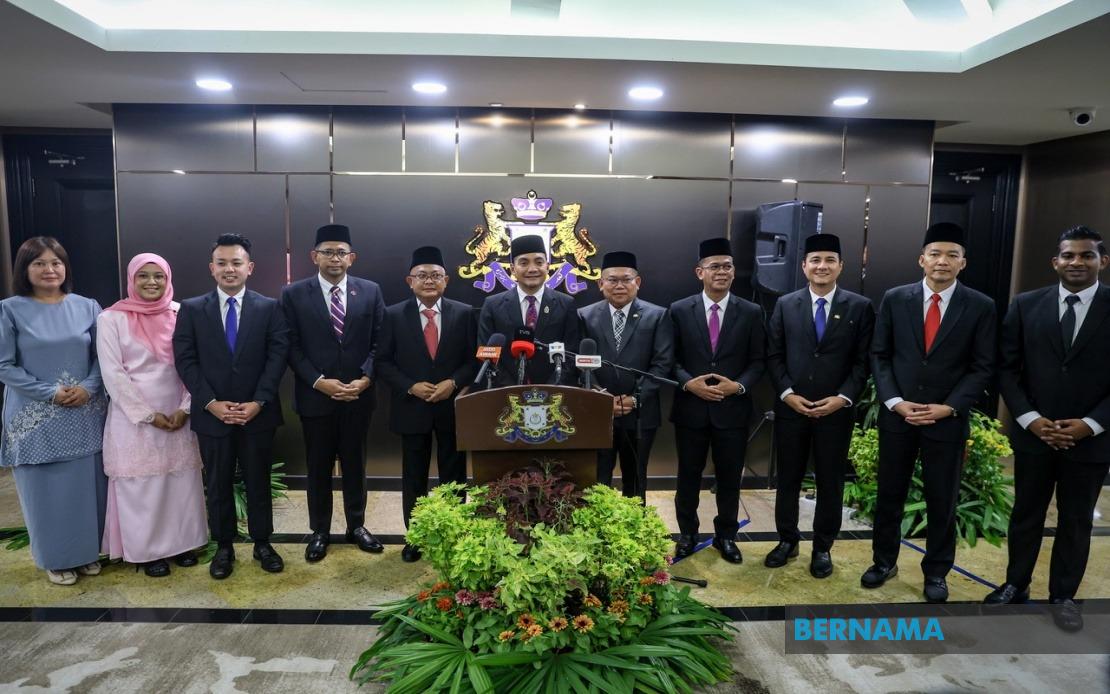
Johor's administration has taken a structural step to reinforce its governance framework by appointing 10 deputy chairmen to the State Executive Council committees. The announcement, made by Menteri Besar Datuk Onn Hafiz Ghazi at a special press conference in Kota Iskandar on July 22, signals the state government's intention to deepen its bench strength as it pursues an ambitious development roadmap extending to the end of this decade.
The creation of these deputy positions reflects a recognition within Johor's leadership that the scope and complexity of state administration have outgrown the existing institutional structure. With the state pursuing simultaneous transformation across economic, social, and infrastructure domains, distributing committee responsibilities among a larger leadership cohort is intended to prevent bottlenecks and ensure that each policy pillar receives adequate oversight and momentum. The appointments have already secured formal endorsement from Tunku Mahkota Ismail, the Regent of Johor, underscoring their constitutional propriety and alignment with the state's established governance protocols.
The timing of these appointments cannot be divorced from Johor's broader strategic aspirations. The state has committed itself to reaching developed-state status by 2030 under the 'Maju Johor 2030' framework, a comprehensive blueprint that encompasses economic diversification, infrastructure modernisation, and human capital development. Alongside this sits the Johor Economic Transformation Plan (JETP), a sector-specific initiative aimed at rebalancing the state economy away from traditional dependencies and towards high-value industries. These interlinked roadmaps are not peripheral exercises but rather constitute the state's primary policy scaffolding for the remainder of this decade, making the need for robust administrative machinery self-evident.
Onn Hafiz's remarks at the announcement emphasised that the deputy committee chairmen are not being appointed to redundant or ceremonial positions but rather are expected to function as operationally engaged administrators. Their mandate extends across three dimensions: bolstering the government's capacity to execute complex initiatives, accelerating the resolution of constituent grievances and logistical bottlenecks, and ensuring that development policies are implemented not merely in form but with genuine effectiveness and distributional fairness. The Menteri Besar specifically stressed that development policies must be rolled out equitably and inclusively across all districts, a signalling of intent that resource allocation and opportunity distribution should not concentrate in already-prosperous areas.
The functional architecture that Onn Hafiz outlined for these deputy positions involves close collaboration between the new deputy chairmen and their principal committee counterparts, coupled with systematic engagement with relevant state agencies and departments. Rather than operating in isolation, the deputy structure is designed to facilitate coordination between the political leadership tier and the bureaucratic apparatus responsible for ground-level execution. This approach acknowledges a persistent governance challenge in Malaysian states: the gap between policy formulation and field implementation, where delays, miscommunication, or institutional silos can substantially attenuate the intended impact of well-designed initiatives.
From a broader Malaysian governance perspective, Johor's move merits attention as a case study in institutional adaptation. The state has positioned itself as a laboratory for administrative innovation within the Malaysian federation, and this restructuring contributes to that positioning. Unlike some states where committee structures have remained largely static for years, Johor's willingness to revisit and strengthen its administrative architecture suggests a results-oriented approach and a recognition that governance machinery requires periodic recalibration to match evolving responsibilities.
The appointment also carries implications for the political balance within Johor's state government. The distribution of deputy committee positions can serve to accommodate ambitious figures within the ruling coalition, provide representation across different constituencies or party factions, and signal the leadership's confidence in rising talent. In a state with significant political dynamism—evidenced by recent electoral shifts and intra-coalition dynamics—these appointments may function partly as reassurance to key stakeholders within the governing coalition that their voices and interests are being structurally represented within the decision-making apparatus.
For Malaysian observers, the Johor appointments underscore a larger strategic conversation about how regional states are positioning themselves in Malaysia's federal architecture. Johor, as the nation's southern economic powerhouse and a state with historically significant political weight, has been increasingly assertive in articulating its own development vision independent of federal initiatives. The 'Maju Johor 2030' framework is explicitly framed in the state government's language and priorities, and the institutional investments being made—such as these committee restructurings—are tangible commitments to realising that vision through strengthened state capacity rather than relying principally on federal support or directives.
The Southeast Asian context also warrants consideration. Economic competition across the region is intensifying, with multiple states and provinces in Thailand, Indonesia, and Vietnam pursuing parallel development acceleration strategies. Johor's structured approach to administrative strengthening reflects an understanding that delivering measurable economic and social progress requires not merely political will but also functional administrative systems capable of coordinating large-scale, multi-sectoral transformation. By appointing deputy committee chairmen with explicit operational responsibilities, Johor is attempting to embed a culture of accountability and performance measurement within its governance structure.
The success of these appointments will ultimately be measured not by the formal announcements made but by tangible outcomes: whether project implementation timelines are genuinely compressed, whether public complaints are resolved more expeditiously, and whether the benefits of state development policies actually reach constituencies across Johor's geography rather than concentrating in traditional centres of economic activity. Onn Hafiz's reference to teamwork across the state administration suggests an awareness that formal structures alone are insufficient; the culture of collaboration, performance orientation, and constituent responsiveness must accompany organisational restructuring.
For Malaysian constituencies watching Johor's evolution, these appointments represent a small but meaningful element within a larger institutional narrative. The state is signalling that it takes its development commitments seriously enough to invest in strengthening the machinery through which those commitments are executed. Whether this structural enhancement yields the intended acceleration of service delivery and policy implementation will provide important evidence about the efficacy of governance reforms in the Malaysian context.

