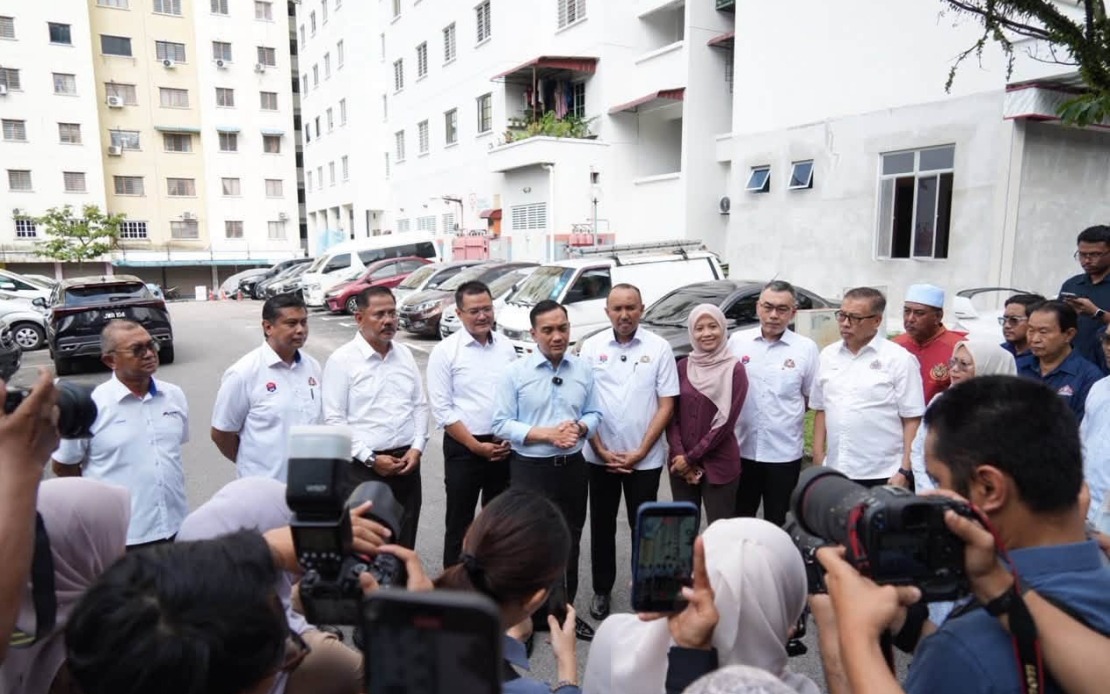
The Johor state government has embarked on an ambitious RM50 million repainting initiative targeting low-cost housing, low-medium-cost residential properties, and public housing estates throughout the state. The programme represents a substantial commitment to upgrading living standards for working-class and lower-income households across Malaysia's southernmost state. The undertaking will encompass 170 housing blocks spread across 26 strategic locations, translating to improvements affecting nearly 46,772 residents whose homes are due for renovation.
Datuk Mohd Jafni Md Shukor, who chairs the Johor State Housing and Local Government Committee, emphasised that the initiative extends beyond mere visual enhancement. During an inspection at Desa Muafakat Apartments alongside Johor Menteri Besar Datuk Onn Hafiz Ghazi, he articulated the deeper significance of maintaining residential environments in good repair. The repainting programme, he explained, contributes to fostering a sense of belonging among residents and signals institutional commitment to their welfare. Such interventions create psychological and social benefits that ripple through communities, strengthening neighbourhood cohesion and demonstrating responsive governance.
The scale of this undertaking involves coordination across multiple state entities and local authorities. Implementation will be spearheaded by the Johor State Housing Development Corporation (PKPJ) working alongside the Local Government Division within the Johor State Secretary's Office. Supporting the effort are four major municipal councils: the Johor Bahru City Council (MBJB), Iskandar Puteri City Council (MBIP), Pasir Gudang City Council (MBPG), and the Kulai Municipal Council (MPKu). This distributed governance model allows customisation to local conditions whilst maintaining overarching quality standards across disparate communities.
The programme addresses a persistent challenge in Southeast Asian urban development: maintaining the fabric of affordable housing stocks that accommodate rapid urbanisation. Malaysia's public and low-cost housing schemes, whilst crucial for social stability, often face deferred maintenance issues due to budgetary constraints and the sheer volume of units requiring upkeep. Johor's allocation demonstrates recognition that preventive maintenance and aesthetic investment can extend asset lifecycles and prevent more expensive interventions later.
Beyond the primary repainting work, the inspection visit revealed broader infrastructure concerns within some housing complexes. Officials were briefed on slope subsidence adjacent to parking facilities at Desa Muafakat Apartments and damage affecting internal road networks. These concurrent issues highlight the interconnected nature of maintenance requirements in aging residential complexes. Addressing painting whilst simultaneously identifying structural and drainage problems allows for more holistic remediation strategies that prevent cascading failures.
Quality assurance has been positioned as central to project success. Datuk Mohd Jafni stressed that all contractors and implementing agencies must adhere to rigorous workmanship, safety, and cleanliness standards throughout execution. The directive reflects frustration commonly experienced in Malaysian infrastructure programmes where projects deliver initial visual improvements but deteriorate rapidly due to substandard materials or inadequate execution. By front-loading quality expectations, the state government aims to ensure that the RM50 million investment produces durable improvements rather than temporary cosmetic fixes.
The repainting drive also coincided with developmental activity at Desa Muafakat, where construction of Tabika KEMAS Bangsa Johor is underway. This institutional facility will provide early childhood education and care services for residents, complementing the housing improvements with support infrastructure. Such integrated approaches to community development address multiple dimensions of resident welfare simultaneously rather than treating housing, education, and social services as separate policy domains.
For Malaysian housing policy observers, this initiative illustrates evolving state-level approaches to managing urban welfare. As federal resources remain stretched, regional governments increasingly pursue targeted interventions addressing specific constituencies. Johor's programme appeals to middle and working-class voters through tangible improvements to their immediate living environments. The emphasis on lower-income households reflects political acknowledgment that affordable housing residents constitute an economically important and politically attentive demographic group.
The RM50 million commitment also reflects broader Southeast Asian urbanisation patterns. Malaysia's rapid economic growth and rural-to-urban migration have created substantial populations dependent on subsidised housing. Unlike developed markets where affordable housing stock remains static, Malaysian states must continually manage expanding low-cost housing inventories whilst maintaining existing units. Johor, as the nation's second-largest state economy and home to significant numbers of industrial workers and service sector employees, faces particularly acute housing maintenance demands.
Implementation timelines and completion dates were not specified in the official announcement, leaving questions about project duration and phasing. Given the geographic dispersion across 26 locations and involvement of multiple municipal councils, the programme will likely proceed in coordinated phases rather than simultaneous execution. Such scheduling complexity requires robust project management to maintain quality whilst ensuring progress across diverse sites.
The initiative also carries political dimension worth noting. Housing quality and governance responsiveness rank among primary concerns for urban Malaysian households. By visibly improving residential environments, the Johor administration strengthens its mandate among constituencies dependent on public and low-cost housing. The programme thus functions simultaneously as welfare provision and political messaging, signalling that state resources flow toward majority populations rather than narrowly benefiting elites.
For neighbouring states and federal policymakers, Johor's repainting programme offers a replicable model for addressing maintenance backlogs in affordable housing stocks. The modular approach involving multiple local authorities could be adapted elsewhere in Malaysia. Success or setbacks in Johor will likely influence housing maintenance strategies across other states confronting similar challenges of aging affordable housing infrastructure requiring systematic rehabilitation.

