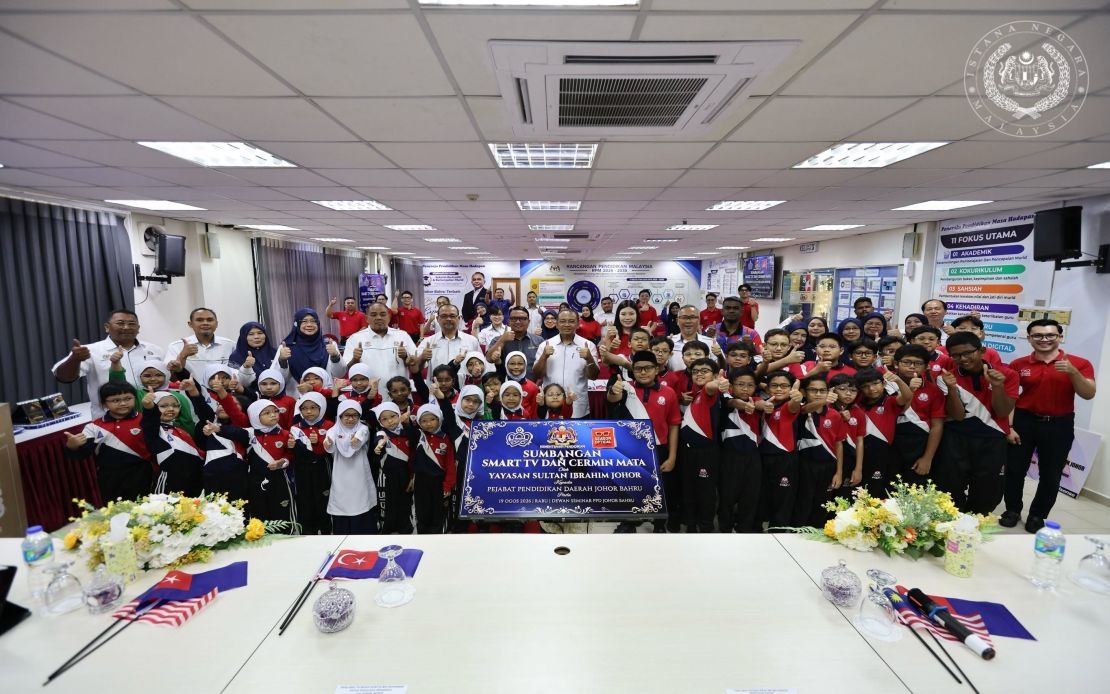
The Yayasan Sultan Ibrahim Johor (YSIJ) has reinforced its commitment to educational advancement and student wellbeing across the state by distributing substantial learning resources to the Johor Bahru District Education Office. The initiative encompasses 10 large-format smart televisions designated for classroom use alongside 2,000 pairs of spectacles earmarked for economically disadvantaged pupils across 20 educational institutions. This dual-track approach addresses two distinct barriers to student success: access to modern educational technology and the removal of vision-related obstacles that can impede academic performance among lower-income families.
The 75-inch smart televisions represent a strategic investment in pedagogical modernisation, enabling educators to integrate digital content and interactive learning tools into their teaching methodologies. In Malaysia's increasingly technology-driven education landscape, the availability of high-quality display systems in classrooms facilitates richer multimedia instruction and can help narrow achievement gaps between well-resourced and under-resourced schools. For Johor Bahru institutions, where student populations exhibit considerable socioeconomic diversity, such equipment creates more equitable learning environments and prepares students for digital literacy expectations in higher education and employment sectors.
The spectacles distribution programme demonstrates particular sensitivity to the intersectionality of poverty and educational disadvantage. Uncorrected vision problems remain a common but frequently overlooked impediment to learning, disproportionately affecting B40 students whose families may lack resources for regular eye examinations and prescription eyewear. By partnering with Season Optical, YSIJ has leveraged private sector expertise to scale this intervention across a meaningful portion of Johor Bahru's school system, suggesting a model of public-private collaboration that could inform broader welfare initiatives throughout Malaysia.
A notable innovation in the programme's design is the incorporation of Columba Vision Screener technology, an eye-scanning device donated by His Majesty Sultan Ibrahim, King of Malaysia. This automated screening apparatus represents a significant operational advancement, capable of identifying vision deficiencies in approximately ten seconds per individual. The efficiency gains from this technology extend beyond mere time savings; they enable schools with limited healthcare infrastructure to conduct comprehensive vision assessments without requiring specialised medical personnel, thereby democratising access to preliminary eye health screening across the student population.
The quality specifications of the distributed spectacles—emphasising durability and suitability for student environments—suggest careful consideration of practical factors that influence whether assistive devices are actually utilised by their intended recipients. Students are more likely to wear prescribed eyewear consistently when frames fit comfortably, resist breakage from typical school activities, and conform to peer aesthetic preferences. By prioritising robust construction and contemporary styling alongside optical functionality, the programme maximises the probability that recipients will adopt and maintain regular spectacle usage, thereby translating the intervention into sustained academic benefits.
The handover ceremony, conducted at Johor Bahru's District Education Office, witnessed participation from YSIJ management, state education authorities, and commercial partners. This formal structure underscores the programme's legitimacy and integration within official educational governance structures. The involvement of Shah Reza Md Kanafe as YSIJ senior manager, alongside education officials including Johor Bahru PPD chief officer Adnan Samsudin and Johor Education Department representatives, reflects institutional coordination that extends beyond charitable distribution toward embedded systemic support for student outcomes.
For Malaysian policymakers observing education equity challenges, this intervention offers instructive lessons about targeting and implementation. The concentration of resources within the Johor Bahru district, rather than diffusion across the entire state, allows for measurable impact assessment and potential scaling based on demonstrated effectiveness. Similarly, the explicit focus on B40 students—those in the bottom 40 percent of household income distribution—aligns the programme with national poverty reduction objectives and Treasury-prioritised welfare allocations.
The partnership dynamic between YSIJ, Season Optical, and government education authorities demonstrates how philanthropic organisations can mobilise private sector capabilities to achieve public goods objectives. Season Optical's contribution transcends mere product supply; managing director Sally Loh's participation in formal proceedings suggests ongoing engagement with implementation and potential responsiveness to feedback regarding eyewear specifications or distribution processes. Such collaborative structures often prove more sustainable and adaptive than unilateral charitable distribution models.
Regionally, Malaysia's experience with education-focused interventions carries relevance for Southeast Asian peers grappling with similar equity challenges. Johor Bahru's geographic proximity to Singapore and its status as an economically developed state make it a significant reference point for educational practice across the region. Initiatives demonstrating how technology access and health-related barriers can be simultaneously addressed in under-resourced settings inform policy discussions in neighbouring jurisdictions with comparable student demographics and infrastructure constraints.

