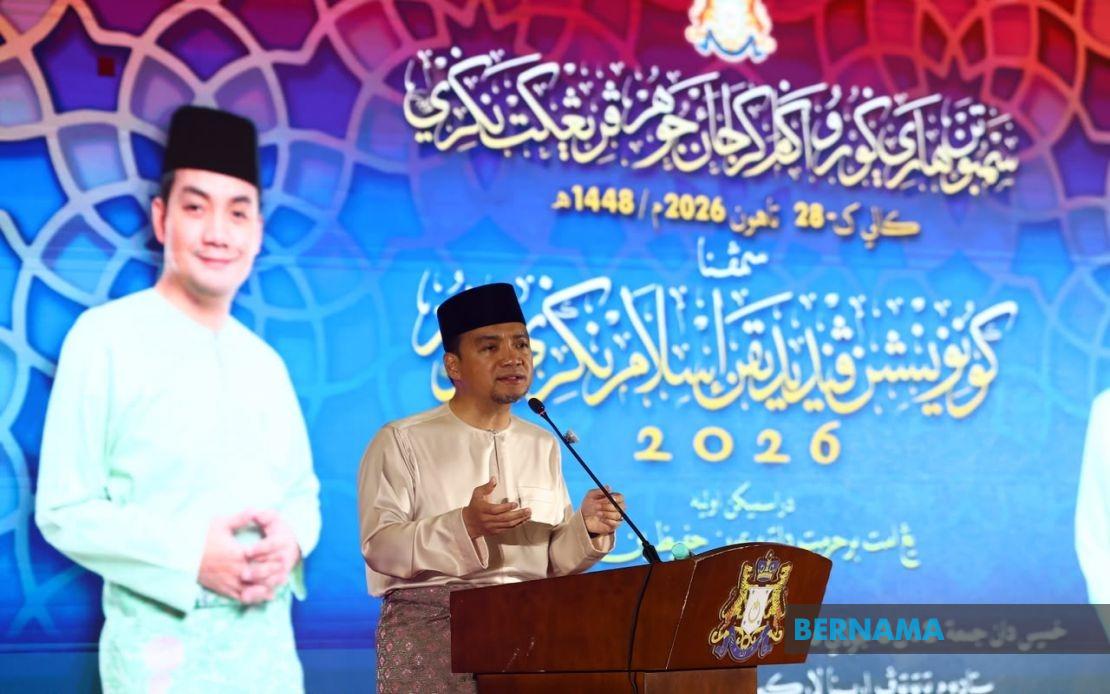
Johor is taking a significant step to modernise its religious education system by bringing its successful reform initiative to Islamic schools. Menteri Besar Datuk Onn Hafiz Ghazi announced that the state will establish the first Sekolah Agama Rintis Bangsa Johor (SARBJ) this year, extending the transformative Sekolah Rintis Bangsa Johor (SRBJ) model into the religious education sector. The expansion represents a comprehensive effort to overhaul the state's approach to both mainstream and Islamic education under a unified framework championed by Tunku Mahkota Ismail, Regent of Johor.
The original SRBJ initiative, which has already established four pilot schools across Johor, operates as a modernisation programme designed to reshape how the state approaches teaching and learning. Two primary schools and two secondary schools currently function under this model: Sekolah Kebangsaan Seri Kota Puteri 4 and Sekolah Menengah Kebangsaan Seri Kota Puteri 2 in Pasir Gudang, alongside Sekolah Kebangsaan Tasek Utara and Sekolah Menengah Kebangsaan Tasek Utara in Johor Bahru. Each institution operates as a testing ground for innovative pedagogical approaches before wider rollout across the state.
The core pillars of the SRBJ approach address several contemporary educational challenges. Digital learning capabilities form a crucial component, recognising that technology integration has become essential in modern classrooms. Equally significant is the emphasis on multilingual proficiency, positioning Johor's students for global competitiveness in an increasingly interconnected world. Character development receives dedicated attention, reflecting broader concerns about nurturing not merely academically accomplished but morally grounded citizens. Teacher empowerment sits at the heart of implementation, acknowledging that systemic educational change depends fundamentally on educator capacity and support. High-quality physical infrastructure rounds out the vision, ensuring that schools have adequate facilities to deliver contemporary education.
By extending this framework to religious education institutions, Johor signals an important shift in how Islamic schools might evolve. Religious education in Malaysia has traditionally operated somewhat separately from mainstream educational policy discussions, yet this integration suggests recognition that religious schools must equally benefit from modernisation efforts. The inaugural SARBJ will be constructed in Kota Iskandar, the state's administrative centre, symbolising the government's commitment to this sector. Datuk Mohd Fared Mohd Khalid, chairman of the State Islamic Religious Affairs Committee, formally announced the government's approval for this construction project.
The timing of this announcement at the 28th Johor Government Religious Teachers' Day celebration carries symbolic weight. By unveiling the SARBJ initiative in a forum dedicated to Islamic educators, the state government emphasises that religious teachers remain central to its educational vision. The State Islamic Education Convention, which concluded on the same occasion, provided a platform for dialogue among stakeholders invested in this sector. This convergence of announcements suggests that consultation and consensus-building among religious education professionals informed this expansion decision.
The implications for Malaysia's broader education landscape warrant consideration. Johor, as one of the peninsula's most developed states and a significant economic hub, often pilots initiatives that influence policy elsewhere. If the SARBJ model demonstrates effectiveness, other states might adopt similar approaches to religious education reform. This could help address persistent questions about how Islamic schools balance religious instruction with contemporary skill development, particularly in digital literacy and English language proficiency.
Further expansion remains planned. The state government intends to introduce the SRBJ approach to early childhood education through a pilot kindergarten programme. This downward extension suggests a philosophy of building educational transformation from the foundational years upward, ensuring that students entering primary schools have already been exposed to the initiative's pedagogical principles. Early intervention in education typically yields substantial long-term benefits, and embedding the SRBJ model at kindergarten level could establish consistent expectations about learning approaches throughout a child's schooling.
The vision emanating from Tunku Mahkota Ismail demonstrates progressive thinking within Johor's leadership regarding education's role in state development. Royal patronage of specific educational initiatives historically signals priority status and resource commitment. By framing SRBJ as the Regent's brainchild, the government underscores this initiative's importance and likely shelters it from short-term political fluctuations that might otherwise affect education policy continuity.
Implementing the SRBJ model across diverse school types presents genuine logistical challenges. Religious schools often operate with distinct governance structures and pedagogical traditions compared to mainstream institutions. Teachers in religious schools may require different professional development approaches to incorporate digital learning and multilingual instruction while maintaining Islamic education's integrity. The government will need to invest substantially in training, curriculum development, and infrastructure across these institutions to ensure consistent quality.
For Malaysian education observers, this initiative deserves monitoring as a case study in educational transformation. Whether the SRBJ model's success in four mainstream schools translates effectively to religious education settings will indicate the initiative's robustness. If religious schools implementing SARBJ demonstrate improved learning outcomes, enhanced digital capabilities, and stronger character development, the model's credibility as a scalable reform framework strengthens considerably. Conversely, implementation difficulties might reveal contextual factors limiting the approach's universal applicability.
The economic dimensions also merit attention. Establishing new pilot schools and retrofitting existing institutions requires substantial capital investment alongside ongoing operational funding. Johor's relative fiscal capacity compared to other Malaysian states enables such ambitions, yet sustainability questions persist regarding how states with more constrained budgets might undertake similar transformations. The state government's willingness to commit resources to religious education alongside mainstream schools suggests recognition that educational excellence cannot be compartmentalised.
Looking forward, success in this expanded initiative could reshape perceptions about religious education's compatibility with modern pedagogical approaches. Many stakeholders assume religious instruction and contemporary educational methods operate in tension, yet the SRBJ framework implicitly argues they can coexist productively. Should SARBJ schools demonstrate this integration effectively, they could influence national conversations about religious education's evolution in contemporary Malaysia, potentially opening pathways for similar initiatives elsewhere.

