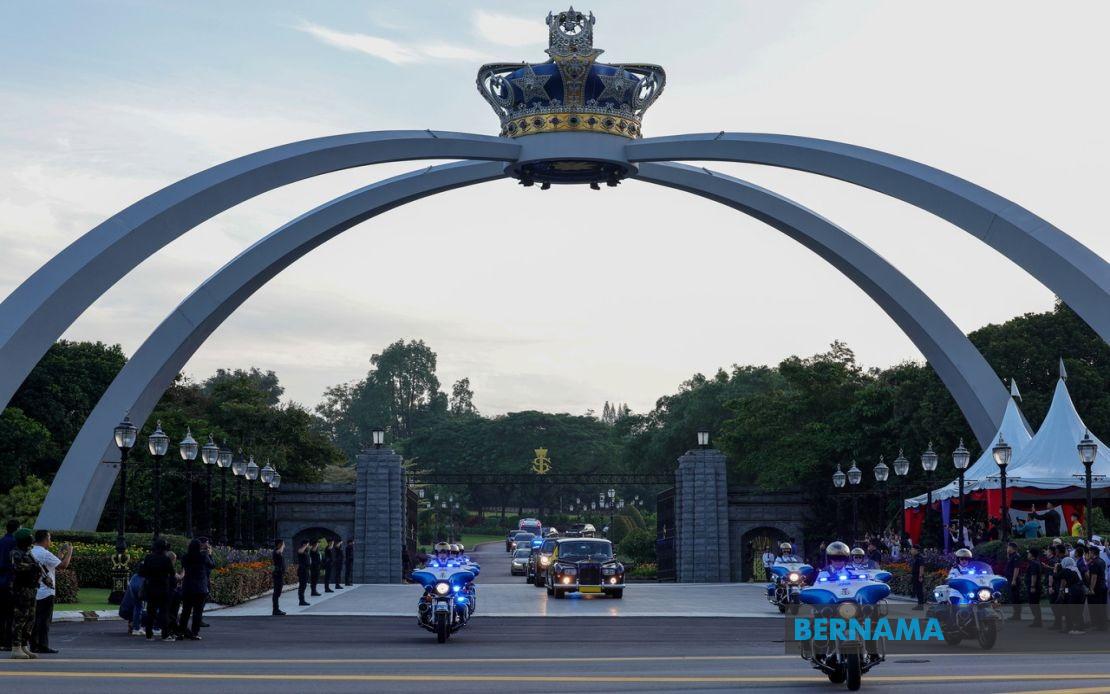
Johor's anticipated State Executive Council swearing-in ceremony has been postponed by one day, moving from Friday to Saturday at Istana Bukit Serene in Johor Bahru. Media personnel received notification of the rescheduling on Friday morning, though authorities did not disclose the rationale for the delay. The ceremony is expected to proceed under the presence of Tunku Mahkota Ismail, the Regent of Johor, alongside other senior figures in the state administration.
The delayed swearing-in represents the formal installation of cabinet members following Menteri Besar Datuk Onn Hafiz Ghazi's re-election to his second consecutive term. The event will bring together key institutional players, including Johor Royal Council president Datuk Dr Rahim Ramli and State Secretary Datuk Mohammed Ridha Abd Kadir, to legitimise the new administration's executive structure. Such ceremonies carry significant constitutional weight in Malaysia's state governance framework, as they formalise the delegation of ministerial portfolios and administrative authority.
Onn Hafiz's reappointment as Menteri Besar came just days earlier, on Sunday, following the successful outcome of the 16th Johor State Election held the previous Saturday. Barisan Nasional's commanding performance delivered 48 out of 56 available seats in the Johor State Legislative Assembly, providing the coalition with a decisive parliamentary majority and strong political legitimacy to form government. The Machap assemblyman's reinstatement marks continuity in Johor's leadership at a time when state-level politics remain fluid across Malaysia.
The postponement, while minor in administrative terms, underscores the complexity of coordinating formal ceremonies involving multiple levels of Malaysia's constitutional hierarchy. Palace schedules, the availability of senior officials, and ceremonial protocols all intersect when swearing-in events take place. For observers of Malaysian political governance, such adjustments are routine operational matters; for the incoming Exco members, however, the delay extends the period of administrative limbo where portfolios remain unassigned and formal decision-making authority rests technically with the outgoing administration.
Barisan Nasional's strong showing in Johor reflects broader patterns in Malaysia's electoral politics, where the coalition continues to dominate in states where it retains traditional support bases. The 48-seat majority in a 56-member assembly grants the Menteri Besar substantial room for legislative manoeuvre without dependence on opposition cooperation. This stability allows the incoming Exco to pursue a full term of policy implementation without constant concern over parliamentary arithmetic, a position increasingly rare in Malaysian state politics where coalitions have fractured and hung assemblies have emerged elsewhere.
Johor's political trajectory over recent years has been notably steadier than many other states, a factor that contributes to investor confidence and administrative consistency in the region. The state remains Malaysia's second-largest economy and a crucial industrial and commercial hub in the southern corridor. Leadership continuity and a decisive electoral mandate therefore carry implications beyond state boundaries, affecting regional economic planning and private-sector investment decisions that depend on predictable governance frameworks.
The swearing-in ceremony, despite its postponement, represents an important symbolic moment in Malaysia's democratic process. Public documentation of Exco members taking constitutional oaths reinforces the principle that executive authority derives from law rather than arbitrary power. In this sense, even procedural delays matter; they demonstrate that formal governance structures are observed and that transitions of power, even within a single administration, follow established protocols rather than ad hoc arrangements.
For Malaysian political observers and regional analysts watching Johor's development, the timing and composition of the incoming Exco will signal the Menteri Besar's governing priorities over his second term. Portfolio allocations typically reflect electoral mandates and serve as indicators of which sectors—whether education, economic development, infrastructure, or social welfare—will receive executive attention and budget allocation. The delayed ceremony means such information remains provisional for another day.
The absence of an official explanation for the postponement is notable, though authorities in Malaysia occasionally withhold reasons for minor scheduling adjustments to avoid speculation or unnecessary commentary. The transparency gap, while common in Malaysian public administration, may prompt observers to consider what logistical or ceremonial considerations prompted the change. Regardless of cause, the Saturday ceremony will proceed as rescheduled, formalising Johor's new Exco and activating the government mandate delivered through the recent ballot.

