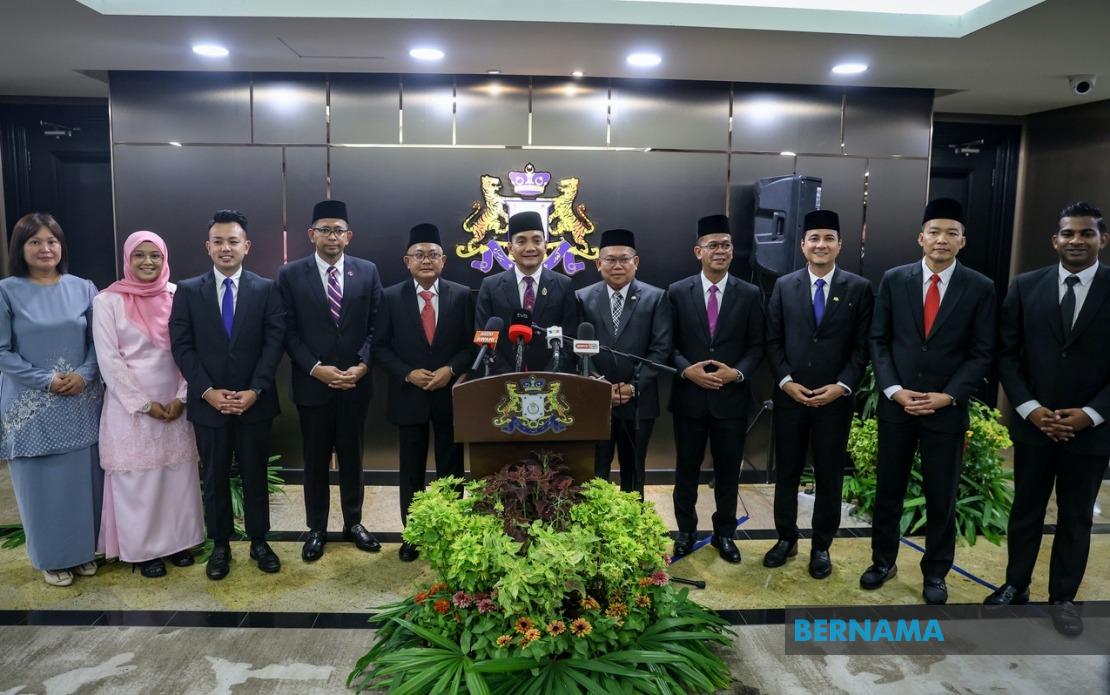
Johor's newly restructured education administration took a significant step forward with the appointment of V. Rugendran as deputy chairman of the State Education and Information Committee, a move designed to streamline operations and deepen engagement with communities across the southern state. Dr Muhammad Naqib Md Ghazali, who chairs the committee, outlined the strategic thinking behind the appointment during a ceremony at the Johor Talent Development Council office in Kota Iskandar, emphasising how shared leadership would allow the department to operate with greater agility and responsiveness.
The deputy chairman role addresses a practical challenge facing modern state administrations: the sheer volume of initiatives and constituencies demanding attention. By dividing responsibilities across two senior figures, the education and information portfolio can now tackle multiple priorities simultaneously rather than relying on a single decision-maker to sequence work. Dr Muhammad Naqib framed this not merely as administrative convenience but as a deliberate investment in the quality of governance, allowing his team to maintain closer contact with the public while ensuring no issue falls through institutional cracks.
For Malaysian readers familiar with how state-level governance operates, this appointment carries particular relevance. Education committees in Malaysia's individual states often struggle to balance competing demands: curriculum implementation, infrastructure development, stakeholder relations with teachers and parents, and alignment with federal educational frameworks. Johor, as one of the nation's most populous and economically significant states, faces these pressures acutely. The delegation of authority to a deputy creates space for more granular problem-solving at the operational level while the chairman retains strategic oversight.
The timing of this move coincides with Johor Menteri Besar Datuk Onn Hafiz Ghazi's broader cabinet restructuring, which included appointing ten deputy chairmen across various state government committees. This wholesale approach to administrative deepening suggests a deliberate management philosophy centred on distributed leadership and faster decision-making cycles. Rather than concentrating power, the Menteri Besar appears intent on creating a more layered structure where issues can be addressed closer to their origin rather than perpetually escalating to the highest authority.
Dr Muhammad Naqib identified education as the cornerstone of his portfolio, positioning it as foundational to developing what he termed a "resilient generation of Bangsa Johor." This framing goes beyond conventional education rhetoric. It speaks to a vision of schooling not merely as knowledge transfer but as preparation for future economic and social challenges. In the context of Southeast Asia's rapid transformation—driven by technological disruption, climate concerns, and shifting labour markets—this emphasis on resilience through education resonates with broader regional priorities articulated by neighbouring governments and international development bodies.
Two flagship initiatives will receive particular attention under the new structure: the Sekolah Rintis Bangsa Johor and the expansion of the Johor Talent Development Council. The pioneer schools programme appears designed to test innovative teaching approaches before potentially scaling them, while the JTDC expansion suggests commitment to vocational and skills-based training. Both initiatives address a recognised gap in Malaysian education: the need for pathways beyond traditional academic routes, particularly as automation reshapes employment in sectors like manufacturing and logistics that have historically absorbed school-leavers in Johor.
The appointment ceremony itself served a ceremonial function in communicating priorities to department and agency heads. By gathering leadership from across the education apparatus, Dr Muhammad Naqib signalled that his mandate stemmed from the highest political authority and that unified effort would be expected. Such gatherings, while sometimes dismissed as mere ceremony, function as important internal communication mechanisms within hierarchical bureaucracies, establishing shared understanding of direction and expectation among officials who may work across disparate organisations.
Dr Muhammad Naqib's acknowledgment of the Menteri Besar's reminder to serve all citizens "regardless of race or religion" reflects Malaysia's constitutional commitment to equality, yet its explicit reiteration in an educational context carries significance. Education has historically been a flashpoint for communal tensions in Malaysia, with concerns about curriculum content, language policy, and institutional access intersecting with ethnic and religious identities. By anchoring his leadership to this principle, the committee chairman staked a position that education administration would transcend parochial concerns.
The appointment structure also has implications for succession planning and institutional memory within state education systems. By creating a deputy role, Johor establishes a pathway where potential future leaders can develop expertise and visibility while the sitting chairman retains strategic control. This contrasts with systems where power is highly concentrated in single individuals, making transitions disruptive. For a state managing complex education systems serving hundreds of thousands of students across multiple districts and diverse communities, institutional continuity matters considerably.
From a Southeast Asian perspective, Johor's administrative innovation reflects patterns visible across the region, where governments seek to improve governance capacity without substantially expanding total government size. Rather than adding entirely new bureaucratic layers, creating deputy and collaborative roles distributes existing authority more effectively. This approach has gained currency partly because it accommodates growing complexity without proportionally increasing expenditure—a concern for governments across the region managing fiscal constraints.
The successful operation of this new structure will ultimately depend on how well Dr Muhammad Naqib and V. Rugendran work together, and whether the intended benefits—faster issue resolution, broader public engagement, and systematic management of diverse initiatives—materialise in practice. Administrative structures are instruments, and their effectiveness hinges on the competence and commitment of the individuals operating them. The public commitment made during the ceremony, however, creates accountability and establishes benchmarks against which performance can be measured.
Looking forward, this appointment provides a test case for how Malaysia's state governments can enhance administrative capacity. If Johor's education sector demonstrates improved delivery and engagement under the new structure, other portfolios and potentially other states may adopt similar approaches. Conversely, if the arrangement creates confusion or duplication, it will serve as a cautionary lesson about the risks of restructuring without clear operational frameworks. For Johor residents and Malaysian education observers, the coming months will reveal whether this administrative investment yields tangible improvements in educational quality and accessibility.

