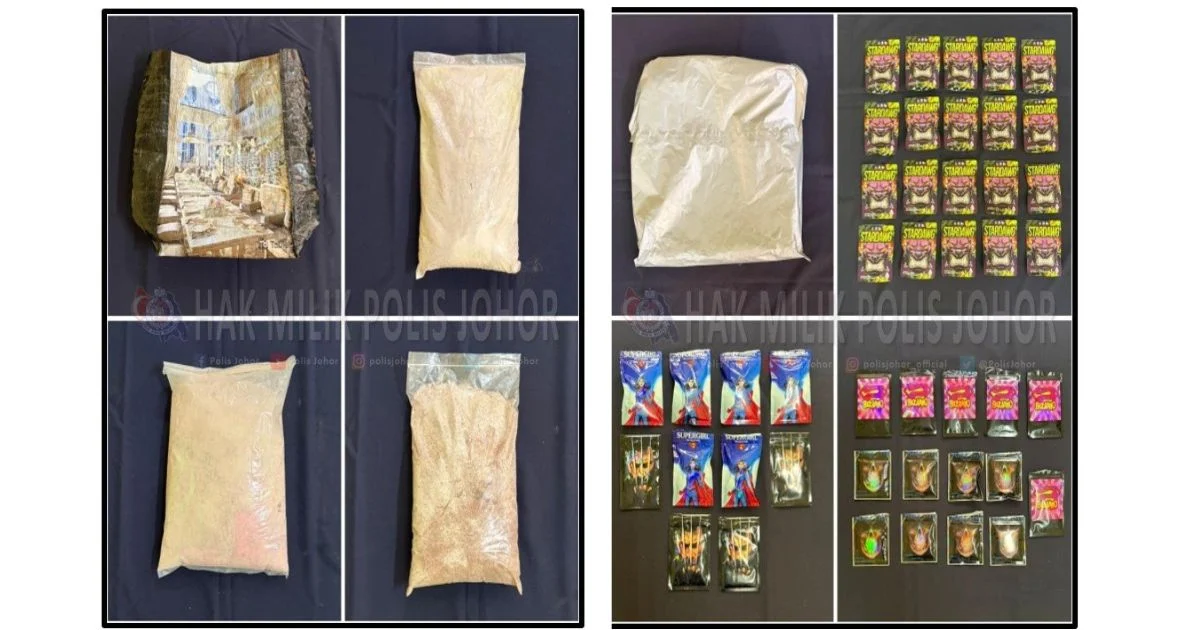
Law enforcement officers in Johor Baru have successfully concluded a major narcotics investigation, culminating in the arrest of a married couple accused of operating a substantial drug trafficking network based in Kulai. The operation represents a significant achievement in the state's ongoing efforts to combat organised drug distribution, with the seized substances valued at approximately RM3.59 million according to police assessments.
The dismantling of this syndicate marks an important breakthrough in disrupting supply chains that have been funnelling illegal substances into the local market. Authorities did not provide extensive operational details, but the scale of the seizure indicates that the couple had developed considerable infrastructure for manufacturing, storing, or distributing controlled substances. The particular targeting of a married partnership suggests investigators had been building evidence over an extended period before executing the arrests.
Johor has long been a focal point for narcotics enforcement due to its geographical position and the volume of cross-border trafficking that characterises the region. The state's proximity to both international boundaries and major transportation hubs makes it a natural corridor for drug distribution networks attempting to reach markets across the peninsula. This latest operation reflects the ongoing challenges that law enforcement agencies face in stemming the flow of illegal substances through increasingly sophisticated networks.
The capture of RM3.59 million worth of narcotics represents substantial confiscated inventory that would have eventually reached consumers across multiple jurisdictions. The street value of the drugs likely exceeds the police assessment, suggesting that the syndicate's operational scope extended beyond simple local distribution. The couple's status as a married team raises questions about whether family-based trafficking networks have become more common in the region, potentially making detection more difficult due to their embedded cover as ordinary residents.
Johor's police force has intensified anti-drug operations as part of a broader national strategy to address substance abuse and organised crime. The success of this particular bust demonstrates the effectiveness of prolonged surveillance and intelligence gathering, techniques that have become increasingly important as traffickers adapt their methods to evade traditional enforcement approaches. The involvement of a husband-and-wife operation suggests that syndicates are exploiting less suspicious relationships and living arrangements to shield their activities from notice.
The arrested couple now face prosecution under Malaysia's stringent drug laws, which carry severe penalties including lengthy prison sentences and substantial fines for trafficking offences. The quantity seized almost certainly qualifies the case as trafficking rather than simple possession, exposing the defendants to the most serious criminal charges. Whether the pair were independently operating or serving as distribution agents for larger criminal organisations will likely emerge during the investigation and subsequent legal proceedings.
This seizure contributes to the cumulative impact of multiple drug busts across the country, where authorities regularly report removing significant quantities of narcotics from circulation. The successful operation highlights the importance of inter-agency cooperation and sustained intelligence work in identifying and targeting trafficking networks before they can expand further. The Johor case exemplifies how patient investigation combined with targeted enforcement action can deliver measurable results against drug crime.
The broader implications for Johor and the wider region suggest that trafficking networks continue to operate at substantial scale despite enforcement pressure. The RM3.59 million haul, while significant, likely represents only a fraction of the total narcotics circulating through Malaysian markets at any given time. The syndicate's capture creates temporary disruption to established supply lines, though experience suggests that competing networks may move to fill the void created by this operation's success.
For residents of Johor, the bust offers modest reassurance that authorities are actively working to intercept drugs before they reach local communities. However, the continued discovery of large-scale trafficking operations underscores the persistent challenge that substance abuse represents in the state. Community cooperation with law enforcement remains essential for identifying suspicious activities and reporting potential trafficking to police, generating the intelligence that enables operations like the Kulai bust to proceed.
The case serves as a reminder that drug trafficking remains a sophisticated criminal enterprise, capable of generating substantial profits and drawing people from all walks of life into participation. The arrested couple's background and specific role within the broader syndicate structure will become clearer as authorities complete their investigation and present evidence through the court system. The success of this operation validates continued investment in narcotics enforcement capabilities and demonstrates that persistent, intelligence-led policing can yield meaningful results against organised drug crime in Johor and beyond.

