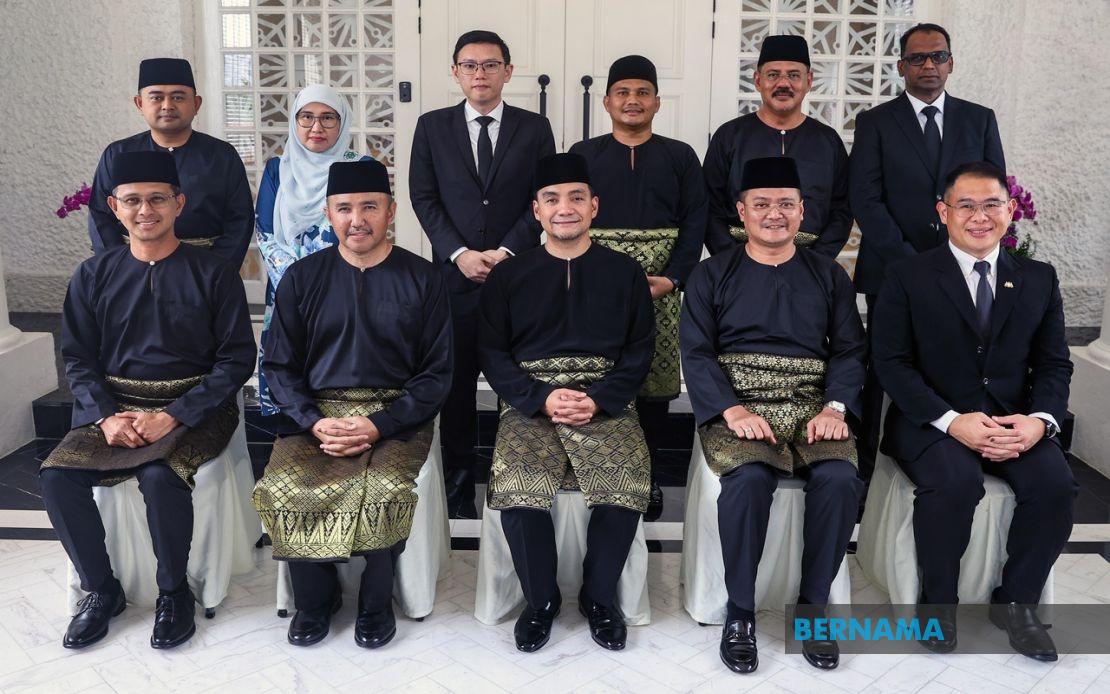
Johor's fresh administrative team took office today as the state solidified its governance structure following a decisive election mandate, with the swearing-in ceremony at Istana Bukit Serene bringing together four new exco members and six colleagues from the outgoing administration. The 10-strong executive council was administered their oaths by Tunku Mahkota Ismail, formalising what constitutes the final piece of the state government's institutional puzzle after Barisan Nasional's resounding success at the ballot box.
The four appointees entering the Johor exco for the first time represent a deliberate infusion of fresh perspectives into the state's decision-making apparatus. Md Israk Abdullah, now overseeing the Agriculture, Agro-Based Industry and Rural Development portfolio, assumes responsibility for sectors fundamental to rural Johor's economic sustainability and food security. P. Pannir Selvam's appointment to champion Unity, Heritage and Culture signals the state's commitment to communal harmony during a period when such initiatives carry particular weight across Malaysian governance. Hasrunizah Hassan's leadership of the Women, Family and Community Development Committee addresses social infrastructure that underpins household welfare and gender equity initiatives. Dr Muhammad Naqib Md Ghazali, heading the Education and Information Committee, inherits stewardship of sectors that shape long-term human capital development and public discourse within the state.
The retention of six exco members from the previous administration reflects strategic continuity in areas demanding institutional memory and established networks. These retained officials—Datuk Mohd Jafni Md Shukor, Mohd Hairi Mad Shah, Mohd Fared Mohd Khalid, Ling Tian Soon, Lee Ting Han, and Mohamad Fazli Mohamad Salleh—maintain their existing portfolio responsibilities spanning housing, youth development, religious affairs, health, investment promotion, and infrastructure. This calibrated mix of experience and renewal suggests the state government has consciously balanced the need for administrative stability with opportunities for generational transition.
The restructuring of Johor's executive authority concludes the formal establishment of governance mechanisms following Menteri Besar Onn Hafiz's swearing-in last Sunday. Hafiz, who retained his Machap seat with a commanding margin of 15,375 votes, assumes his second consecutive term at the helm of Malaysia's southernmost peninsular state. His dual role as Johor Barisan Nasional chairman underscores the alignment between party structure and state administration that has characterised recent Malaysian political configurations.
Barisan Nasional's performance in Johor's 16th state election delivered a mandate of substantial proportions, securing 48 of 56 available seats and establishing working room for the coalition government that extends well beyond minimal parliamentary survival. This electoral outcome contrasts sharply with competitive margins seen in several other Malaysian states and provides the Johor government with genuine latitude to pursue medium-term policy initiatives without constant coalition management preoccupations. For Malaysian observers, the result demonstrated that despite national political volatility, traditional coalitional politics retain demonstrable organisational strength in certain state jurisdictions.
The composition of the exco reveals deliberate attention to sectoral balance across Johor's economy and society. The inclusion of agricultural leadership acknowledges the continued importance of primary industries across Johor's interior regions and agribusiness sectors, despite the state's significant urban concentrations. Investment and trade oversight carries particular resonance for Johor, given its geographical adjacency to Singapore and its role as a crucial component in Malaysian manufacturing and logistics networks. The emphasis on education reflects state-level recognition that human capital development remains central to regional competitiveness.
Gender representation within the exco structure merits examination within the broader context of Malaysian political participation. Hasrunizah Hassan's appointment to the Women, Family and Community Development portfolio introduces female representation into Johor's top-tier decision-making body, addressing longstanding patterns of male dominance in state-level executive positions. However, the single female appointee among ten members illustrates the incremental pace of gender diversification within Malaysian state administrations, a pattern that invites comparison with federal initiatives and other state governments.
The religious affairs portfolio, entrusted to Mohd Fared Mohd Khalid, assumes heightened significance given Islam's constitutional position in Malaysia and recent years of intensified religious policy debates. Johor's particular context—spanning urban centres, industrial zones, and rural Muslim-majority communities—makes religious affairs administration a sensitive nexus where state legitimacy intersects with constituents' spiritual and communal concerns. The appointment reflects Barisan Nasional's calculus regarding religious credential maintenance in a political environment where such considerations influence electoral outcomes.
For Malaysian and Southeast Asian readers, Johor's administrative restructuring carries implications extending beyond state-level governance. As Malaysia's second-largest state economy and a crucial commercial bridge to Singapore and broader Southeast Asian trade networks, Johor's administrative competence influences regional economic dynamics. The exco's capacity to coordinate investment facilitation, infrastructure development, and regulatory consistency shapes the business environment that multinational enterprises and regional investors evaluate when making location decisions throughout Southeast Asia. Governance quality at the Johor level therefore possesses externalities that transcend state boundaries.
The appointment process itself illustrates Malaysia's continued reliance on constitutional procedures and established protocols for administrative succession, even amid broader political turbulence characterising other aspects of the Malaysian political system. The ceremonial elements—the presence of the Regent, the formal oath-taking, the presentation of letters—reaffirm institutional legitimacy and demonstrate that despite partisan competition, fundamental administrative processes maintain public character and constitutional grounding. This consistency provides predictability for businesses and populations dependent on state administrative continuity.
Looking forward, the Johor exco's effectiveness will depend substantially on its members' capacity to translate portfolios into tangible governance outcomes. The range of committees spans economic development, social welfare, public infrastructure, and communal harmony—precisely the domains where Malaysian voters increasingly evaluate government performance. The four new members will encounter institutional learning curves as they navigate bureaucratic machinery and intergovernmental coordination networks that characterise Malaysian federalism, where state executives must continuously negotiate with federal counterparts across overlapping jurisdictions.

