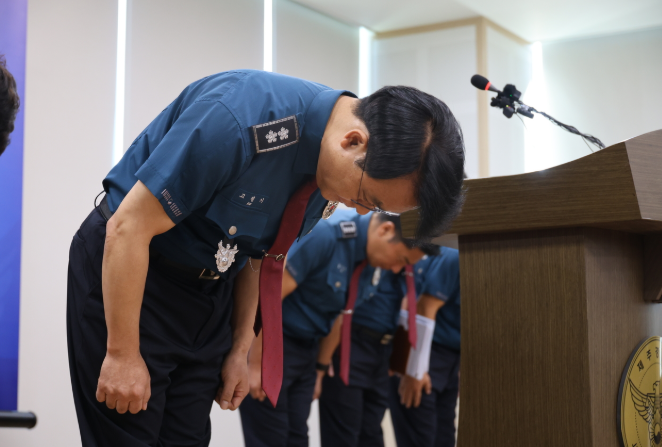
The Jeju Provincial Police Agency faced significant scrutiny this week when Commissioner Ko Pyeong-gi made a formal public apology on Thursday following revelations that a police officer had closed missing person investigations through deception, with tragic consequences. The commissioner's statement came after two individuals whose cases had been improperly dismissed were subsequently discovered dead, casting serious doubt on the integrity of the department's missing persons procedures and raising questions about officer accountability across South Korea's regional law enforcement agencies.
The scandal centres on the conduct of a police officer identified by surname as Bu, who stands accused of systematically falsifying evidence to prematurely close investigations. In one case, Bu allegedly fabricated contact with Jang Mi-ran, a 37-year-old woman reported missing in May, claiming he had personally spoken with her despite having conducted no such interaction. This false assertion allowed him to formally close the investigation, removing it from active police resources. Jang Mi-ran's body was subsequently discovered on Monday, August 24, prompting an immediate examination of how her case had been handled and leading authorities to scrutinise other investigations managed by the same officer.
The pattern of misconduct extended beyond the Jang case. Investigators uncovered that Bu had employed identical tactics to close the missing person investigation of a man in his sixties, using fabricated contact claims to justify administrative closure. The man's body was found on Saturday, just days before Jang Mi-ran's discovery. The sequential revelation of two bodies linked to cases closed through false documentation suggests a potentially systemic problem rather than isolated human error, raising serious concerns about how Jeju police have managed missing persons investigations and what other cases might warrant reopening.
In his formal statement, Commissioner Ko acknowledged the profound breach of public trust. "A police officer has a responsibility to protect the safety and lives of the people, yet he disregarded that duty and lied, leaving permanent scars on the families," Ko stated, addressing not only the deceased but also the bereaved families left to process both the loss of their loved ones and the realisation that institutional failures may have prevented earlier recovery of the bodies. The commissioner's use of language emphasising permanent damage and institutional responsibility reflected the gravity with which authorities were treating the matter, suggesting recognition that procedural negligence represented a fundamental betrayal of police duty.
Ko's apology extended to the broader Jeju community, acknowledging that the incident undermines public confidence in law enforcement's capacity to handle sensitive investigations. In South Korean society, where institutional trust remains essential for effective policing, such public scandals can create lasting reputational damage to regional forces and complicate future community cooperation with police operations. The commissioner's willingness to accept direct responsibility rather than deflect onto individual officers demonstrated an attempt to address systemic accountability, though questions remained about how such oversight failures had persisted undetected.
The police agency immediately initiated two parallel investigations into the scandal. First, a thorough examination into the conduct of officer Bu and the circumstances surrounding the two cases would determine whether criminal charges should be filed and whether additional misconduct could be identified. Second, and potentially more significant for institutional reform, the Jeju Provincial Police Agency announced a comprehensive review of all missing person cases handled on the island to identify whether similar patterns of negligence or fabrication existed elsewhere in their files.
This systematic review represents an unusual public commitment by a regional police force to self-examination and represents an acknowledgment that the misconduct, if isolated only to officer Bu, would nonetheless indicate deeper problems in supervision, case management procedures, and accountability mechanisms. The announcement suggested that Jeju police recognised they needed to demonstrate not merely that Bu would face consequences, but that systemic safeguards would be implemented to prevent recurrence. Such reviews typically examine investigative standards, documentation practices, and supervisory oversight protocols.
The incident highlights vulnerabilities in missing persons investigations across South Korea that have broader implications for the region. Missing person cases often receive less intensive scrutiny than criminal investigations, and officers managing such cases may face less rigorous supervision. The tendency to administratively close cases when initial leads prove fruitless, combined with limited oversight mechanisms, creates opportunities for corner-cutting or falsification of evidence. For Malaysian and other Southeast Asian observers, the Jeju scandal underscores the importance of robust procedural controls and transparent reporting mechanisms in police missing persons units, where institutional incentives can sometimes encourage case closures over persistent investigation.
The families of Jang Mi-ran and the unnamed man in his sixties face the compounded tragedy of losing loved ones while simultaneously discovering that police procedures failed to conduct appropriate investigations. Their cases will likely prompt broader discussion in South Korea about missing persons investigative standards, officer training requirements, and the appropriate balance between administrative efficiency and thorough investigation. The incident also raises questions about what independent oversight mechanisms exist to audit police case management practices before years pass without detection.
Commissioner Ko's pledge of transparency and thoroughness will be tested as the dual investigations proceed. The outcome will likely influence police reform discussions nationally and could prompt other regional agencies to conduct similar comprehensive reviews of their missing persons caseloads. For the Jeju community specifically, the scandal represents both a moment of institutional crisis and an opportunity for demonstrable reform that could eventually restore public confidence in local law enforcement's commitment to finding missing persons, regardless of administrative convenience.
The Jeju case serves as a cautionary reminder that even in advanced democracies with established police institutions, systemic failures can allow individual officers to circumvent accountability for extended periods. Whether the subsequent reforms prove sufficient to prevent future instances of similar misconduct remains to be seen, but the public nature of the apology and investigation commitment represents at minimum an acknowledgment of institutional responsibility that extends beyond blaming a single officer.

