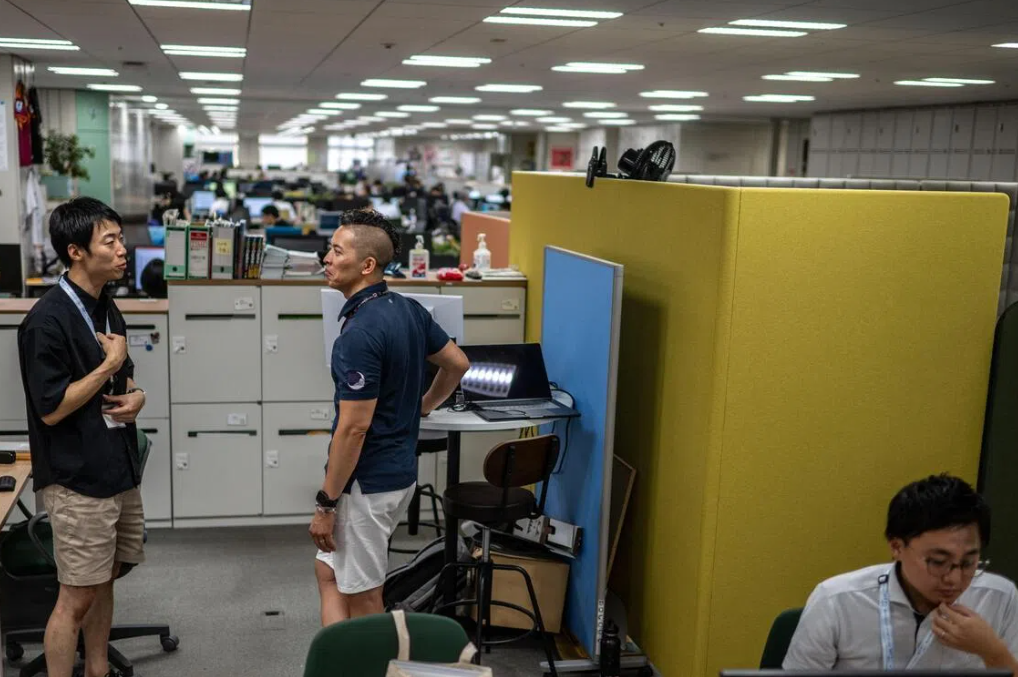
Japan's ongoing struggle with extreme summer temperatures has prompted Tokyo's metropolitan government to expand its long-running casual dress initiative, but the push to embrace shorts and informal clothing has collided with unexpected social friction over workplace propriety and personal grooming standards. The expanded Cool Biz campaign, announced in April, represents an escalation of a workplace culture shift that began nearly two decades ago, yet the move has exposed deeper anxieties about workplace norms and bodily presentation in a society still grappling with formal conventions.
The campaign encourages office employees to abandon traditional business suits, ties, and long trousers in favour of T-shirts, casual trainers, and notably, shorts during Japan's sweltering summer months when heat and humidity create genuinely hazardous working conditions. Environmental official Noboru Watanabe framed the initiative as a pragmatic health measure and a step toward worker autonomy, telling the BBC that authorities simply wish to expand wardrobe options rather than dictate appearance standards. The underlying rationale reflects Japan's chronic struggle with summer temperatures and the corresponding pressure on energy grids from widespread air-conditioning use, a concern that gained urgency following the 2011 earthquake and tsunami crisis.
Yet implementation has collided with a phenomenon some Japanese workers have begun calling "sunehara," a neologism translating roughly to "leg hair harassment," which captures the discomfort some female workers express when encountering male colleagues displaying visible shin hair in office settings. The term itself signals how social media and online discourse have amplified what might once have been private grumbling into a recognisable workplace grievance with its own vocabulary. This linguistic crystallisation suggests the issue carries more weight in contemporary Japanese workplace culture than dismissive outsiders might assume, tapping into broader anxieties about bodily presentation and professional decorum.
A survey conducted in June by Gorilla Clinic, a men's cosmetic treatment enterprise, revealed the depth of public ambivalence surrounding shorts in professional contexts. The poll found 53.5 per cent of respondents opposed workplace shorts, while 46.5 per cent supported the practice, indicating near-even division but with a slight lean toward traditional dress codes. Concerns about body shape and body hair emerged as leading objections among those opposing the shorts initiative, with female respondents substantially outnumbering male participants in the survey group. The demographic skew suggests women may feel more distressed by the prospect of regular exposure to male colleagues' leg hair, though the data also hints at broader anxieties about bodily exposure and professional appearance that cut across gender lines.
The survey results have reverberated through Japan's cosmetic treatment industry, with aesthetic clinics reporting increased demand from men seeking leg hair removal. Akifumi Funatsu, a director at Gorilla Clinic, noted that male clients increasingly frame laser hair removal not as a purely cosmetic indulgence but as a social obligation when adopting shorts as workplace attire. This shift in consumer motivation reveals how workplace dress code changes can cascade through consumer behaviour and personal grooming practices, as men internalise perceived expectations about bodily presentation to maintain workplace comfort and professional relationships. The phenomenon demonstrates how ostensibly neutral dress codes encode assumptions about acceptable bodily display.
The Cool Biz campaign itself represents a relatively recent evolution in Japanese workplace culture, having originated in 2005 when then-environment minister Yuriko Koike, who later became Tokyo governor, introduced the initial program focused on short-sleeved shirts and the elimination of jackets and ties. The campaign gained institutional momentum when then Prime Minister Junichiro Koizumi appeared publicly in Cool Biz attire, lending executive endorsement to more casual workplace dress. Following the 2011 crisis, the government escalated the initiative into "Super Cool Biz," further loosening workplace dress restrictions and establishing a foundation for the contemporary casual workplace norm now visible at Japanese technology firms and start-ups.
Japan's expansion of casual dress codes reflects the genuine physical hazards posed by its summer climate, which combines extreme temperatures with high humidity that impairs the body's natural cooling capacity through perspiration. Fire and Disaster Management Agency data documented seven heat-related fatalities and 4,580 hospitalisations between July 6 and July 12, underscoring the genuine public health emergency driving policy innovation. Government officials have encouraged residents to maintain hydration, utilise air-conditioning, and gradually acclimate to seasonal heat extremes. Simultaneously, Japanese consumers have embraced technological solutions to summer discomfort, from battery-powered clothing fans to cooling wipes and heat-blocking umbrellas, suggesting the market recognises both the severity of summer conditions and consumer appetite for innovative responses.
The leg hair controversy illustrates how workplace modernisation initiatives can encounter unexpected cultural resistance rooted in implicit social assumptions about bodily presentation. While Tokyo officials framed shorts approval as simply offering expanded wardrobe options without prescribing appearance standards, the social response reveals how deeply embedded professional dress codes remain in Japanese workplace culture, even as formal restrictions relax. The distinction between official policy and lived social expectation has created ambiguity about what constitutes acceptable professional appearance, leaving individual workers navigating uncertain social terrain.
For regional observers, the Japanese leg hair debate offers insights into how workplace culture evolution proceeds unevenly across East and Southeast Asia, where formal dress codes remain entrenched despite rising temperatures and evolving generational attitudes toward workplace flexibility. The tension between practical health considerations and inherited professional norms visible in Japan's Cool Biz evolution reflects broader regional patterns where economic modernisation, climate adaptation, and cultural conservatism intersect in workplace practices. Whether Japan's ultimate resolution of the shorts question favours pragmatic heat relief or traditional formality may signal future directions for workplace dress codes across the region as climate pressures intensify.

