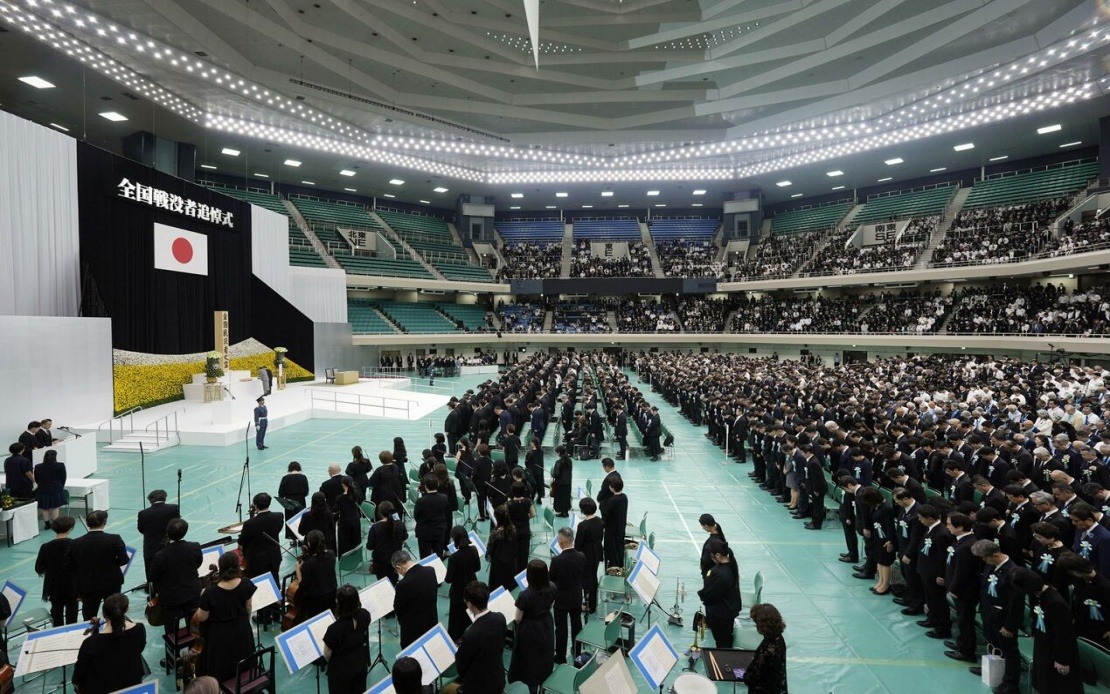
Japan observed the 81st anniversary of its surrender in World War II on Saturday with a formal state ceremony in Tokyo, though the occasion was marked by a notable rhetorical shift in how the nation's leadership addressed its wartime legacy. Prime Minister Sanae Takaichi, attending the memorial for the first time since assuming office last October, pledged Japan's commitment to peace but conspicuously refrained from using the language of "remorse" that characterised the previous year's commemoration, signalling a potential recalibration of official attitudes toward one of Asia's most sensitive historical episodes.
The annual gathering, held to honour approximately 2.3 million military personnel and around 800,000 civilians killed during the war, drew both Emperor Naruhito and Empress Masako, underscoring its significance as a government-sponsored occasion of national importance. Takaichi's careful wording—emphasising that Japan "consistently walked the path of a nation that values peace and made all possible efforts for world peace and prosperity"—avoided the more explicit acknowledgment of historical responsibility that her predecessor Shigeru Ishiba had articulated just twelve months earlier. This linguistic divergence, though subtle to casual observers, reflects deeper tensions within Japan's ruling Liberal Democratic Party regarding how to frame the nation's twentieth-century history.
Ishiba's previous year speech had marked a turning point, as he became the first Japanese prime minister in over a decade to explicitly invoke the concept of "remorse" at the August 15 ceremony, alongside his "resolute pledge to renounce war." Ishiba, considered a more moderate voice within the LDP's conservative establishment, had attempted to restore language patterns that had been standard among Japanese leaders before the late Shinzo Abe—Takaichi's political mentor—took office for his second premiership in December 2012. The contrast between successive prime ministerial statements thus reflects divergent approaches to historical accountability, with Takaichi aligning more closely with Abe's revisionist trajectory than with the brief return to traditional commemorative language represented by her immediate predecessor.
The shift carries particular significance given Takaichi's well-documented hawkish orientation on national security matters. Her avoidance of mentioning Japan's wartime aggression across Asia, including against China and the Korean Peninsula, follows patterns established during the Abe era, when such acknowledgments largely disappeared from official state rhetoric. This represents a notable departure from the post-1945 consensus that had prevailed until 2012, when Japanese prime ministers routinely made explicit reference to the nation's aggressive expansion and colonial conquest throughout the region. By sidestepping this terminology, Takaichi and her political faction effectively reframe the war as a historical event to be mourned and reflected upon rather than as a period requiring specific acknowledgment of Japanese responsibility.
Emperor Naruhito, however, maintained the annual tradition of expressing what palace communications describe as "deep remorse" during his own remarks at the ceremony. The Emperor's consistent use of this language, maintained every year without exception, provides a counterbalance to fluctuations in prime ministerial rhetoric and suggests an institutional commitment to acknowledging the war's human costs and moral dimensions that transcends short-term political shifts. His statement that he sincerely hopes people will "pass down the memories of the suffering endured during and after the war" emphasises continuity with the previous year's messaging, even as his government's chief executive adopted noticeably different phrasing.
The 2024 commemoration occurs against a backdrop of substantial changes in Japan's defence posture and strategic priorities. The nation has significantly increased its national security spending and relaxed regulations governing the export of defence equipment, moves that align with Takaichi's security-focused approach but which some observers argue require careful historical contextualisation. These policy shifts, undertaken in response to perceived regional security challenges and a more assertive geopolitical environment in East Asia, nonetheless carry implications that extend beyond purely military considerations into questions of how Japan frames its contemporary role internationally and how it reconciles present-day strategic choices with historical memory.
The ceremony itself concluded with a moment of silence observed at noon Tokyo time, the precise hour when the late Emperor Hirohito announced Japan's unconditional surrender via radio broadcast on August 15, 1945. This ritual observance, maintained consistently across successive commemoration ceremonies, preserves institutional memory of the war's conclusion and provides a solemn anchor point for the nation's reflection on that transformative historical moment. The continuity of this practice across decades, regardless of which political faction controls the government, testifies to the deep significance the date holds within Japanese national consciousness.
For regional observers, particularly in Southeast Asia and across East Asia, the nuances of how Tokyo's leadership addresses WWII history carry implications extending beyond ceremonial language. Malaysia and other neighbouring nations experienced Japanese occupation during the war, with civilian populations enduring severe hardships and lasting trauma. The manner in which Japan's current government frames its wartime conduct thus intersects with ongoing historical reconciliation efforts throughout the region and influences perceptions of how contemporary Japan views its relationship with neighbours who suffered Japanese aggression decades ago. Takaichi's rhetorical choices therefore resonate beyond Tokyo's political arena.
The apparent retreat from explicit language of remorse also reflects broader factional dynamics within Japan's conservative political establishment. Takaichi's ascendancy and her relatively hawkish positioning suggest a consolidation of the revisionist approach that Abe championed, implying that her tenure as prime minister may see a sustained period where official state commemoration ceremonies emphasise national unity and peace aspirations while minimising direct engagement with historical accountability. This trajectory contrasts with international trends toward greater historical honesty and intergenerational acknowledgment of wartime harm, a development that could strain Japan's diplomatic relationships and complicate efforts toward comprehensive historical reconciliation throughout Asia.

