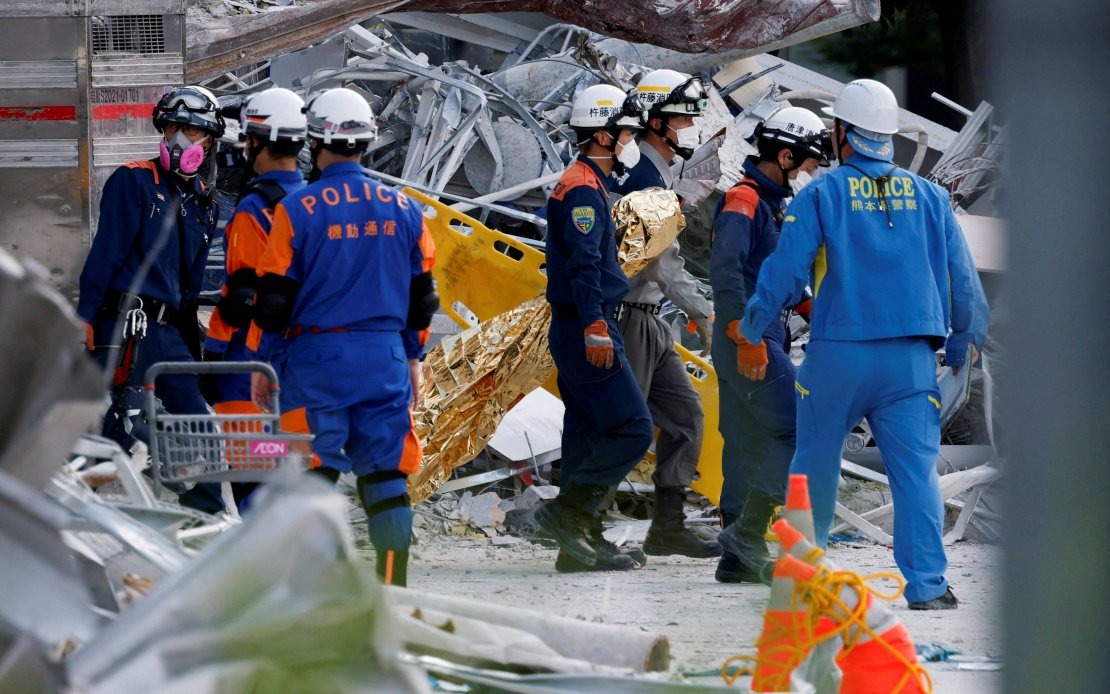
Rescue workers scrambled to locate survivors across Kumamoto Prefecture in southwestern Japan on Thursday morning, two days after a devastating magnitude 7.1 earthquake struck the region, leaving at least 34 people dead and hundreds more injured. The disaster, which struck at around 4:27 pm local time on Tuesday, has plunged the prefecture into a humanitarian crisis compounded by infrastructure failures, environmental hazards and the relentless psychological toll of ongoing seismic activity. The earthquake registered the highest intensity on Japan's seismic scale, a level at which people cannot remain standing and may be thrown violently into the air, making the destruction both rapid and comprehensive.
Transportation into the affected area remains severely compromised, forcing rescue personnel and supply convoys to navigate overland routes from neighbouring Fukuoka after the runway at Kumamoto Airport closed due to structural damage. The journey into the disaster zone reveals the extent of disruption to everyday life: lengthy queues form at petrol stations as fuel becomes scarce, vehicles move at crawling speeds along congested roads, and the usual rhythm of regional commerce has ground to a halt. This transportation crisis threatens to slow the delivery of emergency supplies, medical personnel and rescue equipment to areas where they are most urgently needed. The knock-on effects will persist for weeks as the region attempts to restore basic connectivity and restore supply chains.
The Aeon Mall Kumamoto shopping complex in Kashima has become a focal point of the crisis and illustrates the catastrophic nature of the earthquake's impact. The structure experienced a violent explosion following the initial tremor, with massive sections of its exterior walls and glass facades collapsing onto surrounding areas. The building's steel framework now lies exposed beneath heaps of rubble, twisted metal and countless tonnes of shattered glass. Nearby roads remain blocked by debris, and the entire zone has been cordoned off as firefighters, police and emergency teams conduct painstaking search and rescue operations. A taxi driver working in the mall's carpark at the moment of impact described an overwhelming wall of white dust engulfing his surroundings following a thunderous blast. Vehicles parked dozens of metres away suffered severe damage, including a refrigerated truck whose heavy stainless steel exterior bore visible dents from the force of the explosion.
Investigators have focused on a suspected gas leak as the probable cause of the mall explosion, with Chief Cabinet Secretary Minoru Kihara confirming that rescue personnel detected the unmistakable smell of gas inside the structure during search operations on Wednesday. As of Thursday, prefectural officials reported that 12 people have been rescued from the mall, though the toll includes six confirmed dead, one person in cardiac arrest, and five others sustaining injuries. At least one additional person remains missing within the building's ruins, keeping rescue teams working through the night to locate and extract survivors before deteriorating conditions or further structural collapse make recovery impossible. This search operation has become a race against time as each passing hour reduces the likelihood of finding people alive beneath the rubble.
Residents living in proximity to the disaster zone describe an experience of profound shock and mounting anxiety. A woman identified as Kushiyama, who lives near the mall, told reporters that the earthquake arrived without warning and produced violent shaking far exceeding her memories of the Kumamoto earthquakes from a decade earlier. The psychological trauma has prevented her from sleeping, with every minor tremor causing her to jolt awake in fear. Her account reflects the experience of tens of thousands across the prefecture: the terror of the initial strike has given way to sustained dread as the Japan Meteorological Agency recorded over 250 aftershocks through Thursday morning alone. This relentless aftershock sequence compounds both physical danger and mental exhaustion, keeping residents in a state of heightened anxiety.
The earthquake has created a cascading infrastructure collapse that affects the most basic requirements for human survival and dignity. Kushiyama described how tap water at her residence had turned cloudy and become unsafe for consumption, while toilet systems ceased functioning entirely, leaving residents unable to bathe or maintain basic hygiene. These conditions are not isolated incidents but part of a broader pattern: as of Thursday morning, approximately 75,000 households across Kumamoto Prefecture had lost access to water entirely, while some 23,000 households remained without electricity. More than 10,000 people were staying in evacuation centres, many of whom have experienced trauma, injury, and the loss of their homes. The absence of clean water in a region sweltering under extreme heat creates acute risks of dehydration and waterborne disease outbreaks.
The timing of the earthquake has created a particularly dangerous confluence of hazards that threatens to overwhelm both rescue capacity and human resilience. The Japan Meteorological Agency issued warnings that dangerous heatwave conditions would persist across wide areas of Japan, with Kumamoto Prefecture specifically identified as a region likely to experience scorching temperatures. For residents already traumatised by the earthquake, forced to remain in evacuation centres or makeshift shelters, enduring continuous aftershocks and lacking access to clean water, the extreme heat poses genuine risks to life. Heat-related illnesses progress rapidly in vulnerable populations, particularly among the elderly and young children, and the stress placed on already-compromised bodies increases mortality risk. Emergency services face the grim challenge of managing mass casualties from earthquake injuries, infections from contaminated water, and heat-related emergencies simultaneously.
The designation of this event as the 2026 Kumamoto Earthquake by the Japan Meteorological Agency marks its official recognition as a major disaster, though the implications for Southeast Asian observers are significant. Japan's experience with large-magnitude earthquakes and tsunami risks provides instructive lessons for regional nations including Malaysia, which sits near active seismic zones in the western Pacific. The speed at which critical infrastructure fails—runways, water systems, electricity networks, transportation links—demonstrates that even a technologically advanced nation with sophisticated disaster preparedness systems can be overwhelmed by a sufficiently powerful earthquake. The cascade of secondary disasters, from gas explosions to water contamination to heat stress, shows how initial disaster response must anticipate and plan for multiple simultaneous crises rather than treating each problem in isolation.
The broader implications for regional disaster management are sobering. Kumamoto Prefecture's response has involved mobilising prefectural authorities, national government coordination through the Cabinet Secretariat, and local emergency services. Yet despite these resources, the prefecture struggled to prevent major casualties and to respond comprehensively to the immediate aftermath. For nations in Southeast Asia with more limited disaster response infrastructure, lower population dispersion and lower building codes, similar magnitude earthquakes could produce far more catastrophic outcomes. The lesson is not that Japanese preparedness has failed, but rather that the forces unleashed by magnitude 7.1 earthquakes exceed the capacity of any human system to fully mitigate. Preparation must focus on resilience, rapid resource mobilisation, and psychological support for survivors coping with both immediate trauma and the extended recovery period that lies ahead.

