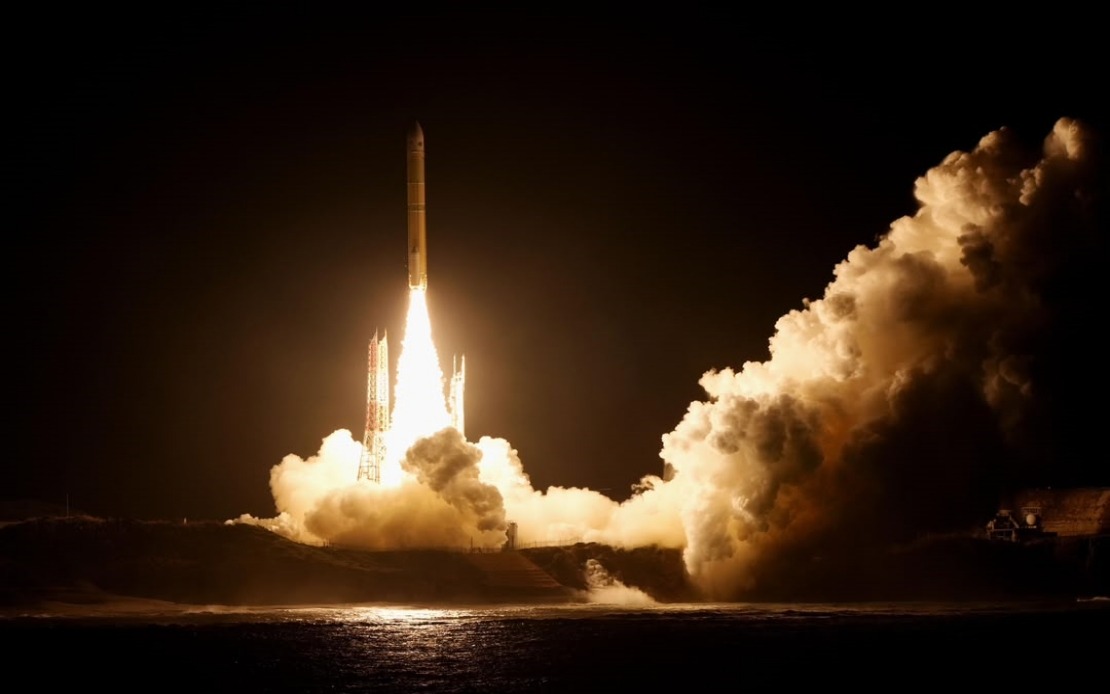
Japan has taken another significant stride in establishing autonomous space infrastructure, with the Japan Aerospace Exploration Agency successfully launching the H3 rocket from the Tanegashima Space Centre early on Tuesday. The mission deployed the Michibiki No. 7 positioning satellite into orbit, reinforcing Japan's commitment to reducing dependence on foreign navigation systems and strengthening its technological sovereignty in the region.
The Tanegashima facility, situated on a remote island in southwestern Japan, has long served as the nation's primary launch hub for civilian space missions. The H3 rocket designated as vehicle number 9 carried the latest addition to Japan's Quasi-Zenith Satellite System, a network specifically engineered to provide precise positioning data across East Asia and the Pacific. This capability extends far beyond consumer applications, supporting critical infrastructure operations and emergency response systems that increasingly rely on accurate geolocation technology.
The launch sequence itself encountered multiple delays before achieving liftoff. Originally scheduled for the previous Friday, bad weather forced postponement to Monday, with another day added to the calendar after meteorological conditions around the facility remained unfavourable. Such delays are routine in space operations, yet they underscore the technical precision required to ensure mission success. The H3 programme has had to navigate its own turbulent conditions following a significant setback in December.
That earlier December failure involved the H3 number 8 rocket, which prevented the Michibiki No. 5 satellite from reaching its intended orbit. This mishap cascaded through the programme timeline, pushing back the planned February launch window for the No. 7 satellite by several months. The incident exposed vulnerabilities in Japan's transition from its proven H2A rocket family, which had accumulated an impressive operational record over more than two decades as the nation's workhorse launch vehicle.
The current success marks the second consecutive H3 launch without incident, following a June mission that successfully deployed multiple miniature satellites. This recovery trajectory demonstrates both JAXA's technical problem-solving capabilities and the resilience of Japan's aerospace engineering community. The agency invested considerable effort in diagnosing and correcting the systemic issues that led to the December mishap, a process that required detailed engineering analysis and rigorous testing protocols.
Currently, five Michibiki satellites are actively providing positioning services across the region. However, Japan's strategic vision extends to a complete constellation of seven operational satellites, which would enable the nation to deliver uninterrupted coverage independent of foreign systems. This architectural goal holds particular significance for Southeast Asian nations, including Malaysia, which currently rely heavily on international navigation networks. A fully autonomous Japanese system would provide the region with an alternative positioning infrastructure, reducing vulnerability to external dependencies and enhancing regional technological autonomy.
The Michibiki system represents more than merely duplicating capabilities already offered by existing global networks. Instead, it embodies Japan's determination to develop indigenous technological capabilities that support both civilian and strategic objectives. For Malaysia and other regional partners, the availability of this independent navigation infrastructure could facilitate enhanced coordination in maritime operations, disaster response, and infrastructure development across Southeast Asia.
The H3 rocket programme itself carries broader implications for Japan's space ambitions. Having already transitioned beyond the H2A generation, Japan is establishing a more advanced launch platform intended to serve national requirements for decades ahead. The mixed initial track record—one failure and two successes across the first operational flights—reflects the inherent risks associated with introducing new space systems, yet the trajectory points toward operational maturity.
This latest achievement also signals Japan's determination to maintain competitive positioning in global space markets. While international launch providers have proliferated in recent years, Japan's commitment to developing reliable, domestically-managed launch capacity ensures the nation retains independent access to space. For regional security and economic considerations, this independence carries strategic weight in an increasingly multipolar technological landscape.
The positioning satellite network itself addresses practical needs that extend throughout the Asia-Pacific region. Consumer applications including smartphone navigation and vehicle guidance systems benefit from enhanced accuracy, while agricultural operations, precision engineering, and emergency management services all rely on dependable geolocation infrastructure. As these applications expand and become more sophisticated, the availability of alternative, redundant positioning systems becomes increasingly valuable.
Looking ahead, Japan must sustain this operational momentum to achieve its seven-satellite constellation objective. Each successive successful launch builds confidence in the H3 platform and demonstrates JAXA's commitment to overcoming the initial challenges that marked the programme's introduction. The December failure, rather than derailing the effort, appears to have catalysed the engineering improvements necessary for reliable, repeatable operations.
For Malaysia and regional observers, Japan's progress in establishing autonomous space capabilities serves as an instructive case study in technological development and strategic independence. The investment required, the patience demanded through inevitable setbacks, and the commitment to long-term objectives all reflect the characteristics necessary for nations aspiring to advanced technological capabilities. Japan's Michibiki system ultimately represents not merely a satellite constellation, but a demonstration of sustained engineering excellence and strategic vision in the increasingly important domain of space technology.

