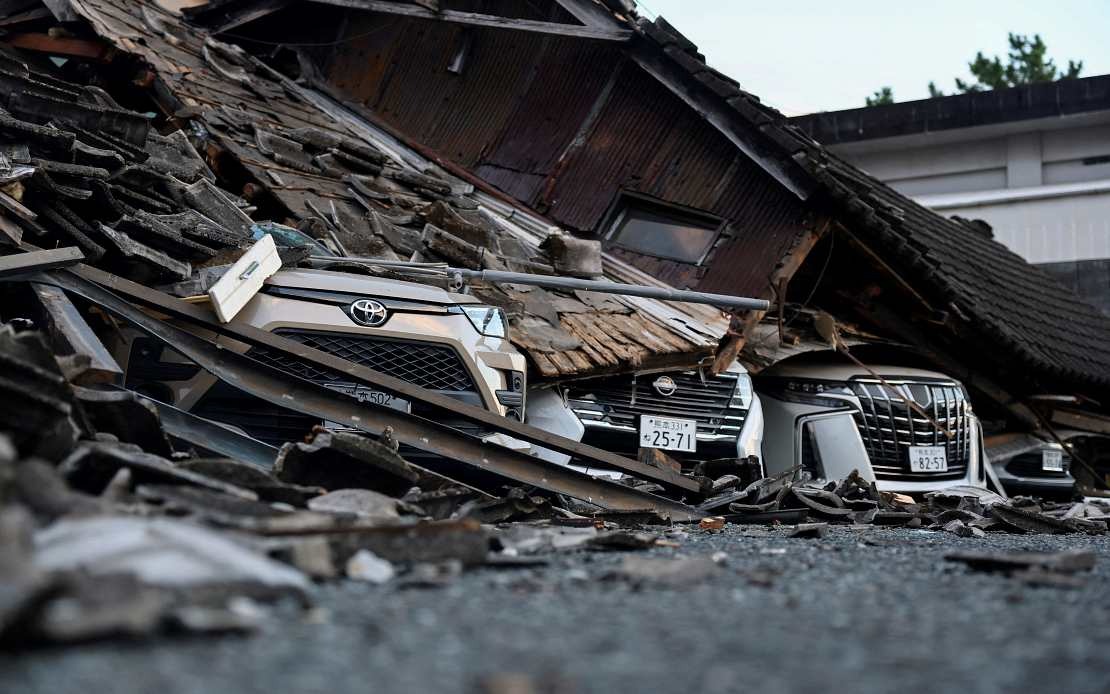
A Japanese retail chain has admitted to a decision that proved fatal when two of its employees were instructed to return inside an Aeon shopping mall in Kumamoto Prefecture immediately after a powerful earthquake struck southwestern Japan. The acknowledgment came as the operator Habita faced mounting scrutiny over whether the directive to secure cash from the store contributed to the deaths of the two women in the subsequent explosion that engulfed the facility.
The catastrophic sequence of events unfolded on Tuesday when a magnitude 7.1 earthquake—registering at level 7 on Japan's seismic intensity scale, the highest classification—struck the region. Following the initial tremors, the two employees had successfully evacuated from Aeon Mall Kumamoto in Kashima Town, having left the building to safety as proper emergency protocols would suggest. However, their reprieve from danger proved tragically short-lived when management made the fateful call to send them back.
Koji Yuse, the 64-year-old sales manager at Habita's Kumamoto headquarters, confirmed on Monday that he had personally ordered the store manager to dispatch the two employees back into the building. The explicit instruction was to collect the day's cash receipts from the second-floor store location and transport them to a safe positioned on the first floor. One of the deceased was just 22 years old, highlighting the youth and vulnerability of those caught in the decision-making hierarchy.
Within moments of the employees re-entering the mall, a massive explosion tore through the Aeon Mall Kumamoto building, ultimately claiming seven lives, including the two Habita staff members. Yuse later expressed profound regret, telling reporters that he believed the order he had given was inappropriate—an admission that carries heavy implications for workplace safety culture and the prioritization of financial assets over human life. The company has since apologized to the bereaved families and provided a written account of the incident to authorities.
The incident raises critical questions about corporate decision-making during natural disasters and the pressure employees face when instructions from management conflict with their personal safety. In the chaotic moments following a major seismic event, when aftershocks remain a genuine threat and structural integrity of buildings becomes uncertain, the instruction to return indoors to handle currency rather than remaining in a secure external location represents a fundamental misalignment of priorities. This case will likely resonate across Southeast Asia and beyond, where similar retail operations face comparable scenarios.
Japan's earthquake response framework is considered world-leading, yet this incident demonstrates that institutional preparedness alone cannot override poor judgment at the operational level. The company's acknowledgment that the order was inappropriate signals an awareness of the ethical breach involved, though such recognition comes only after lives have been lost. The written apology and formal statement appear to be Habita's attempt to contain reputational damage while the families grieve irreplaceable losses.
The broader context of the disaster shows that the Kumamoto prefectural government confirmed 36 deaths directly attributable to the earthquake as of Tuesday morning, with two additional deaths still under investigation. The explosion at the shopping mall therefore represents a significant portion of the overall casualty toll, yet it stands apart as one of the few instances where deaths appear preventable through different decision-making by corporate leadership rather than the natural disaster itself.
For Malaysian readers and businesses operating across Southeast Asia, this incident underscores the importance of clear, legally-mandated disaster response protocols that cannot be overridden by standard operational concerns. Many retail and commercial operations in the region face similar earthquake, flooding, or other natural disaster risks, and the question of whether financial recovery takes precedence over employee safety should be settled unambiguously before emergencies occur. Written policies that explicitly prohibit re-entry into compromised structures except for life-saving purposes should be standard practice.
The Habita case also highlights the vulnerability of lower-level employees who may feel unable to refuse direct orders from management, even when those orders conflict with their instinct for self-preservation. The store manager who received Yuse's instruction and the employees who complied with the directive to re-enter were all operating within a hierarchical structure that presumably left little room for questioning the decision. Creating workplace cultures where safety concerns can be raised without career consequences remains an aspirational goal in many regional organizations.
Moving forward, the incident will likely prompt Japanese retailers and their counterparts throughout Asia to review and strengthen their business continuity plans, particularly regarding cash handling during disasters. Insurance and financial loss should never be justification for exposing employees to elevated physical risk. Habita's public acknowledgment of this principle, while necessary, cannot undo the consequences already suffered by the two women and their families, nor does it address the systemic factors that led to such a decision being made in the first place.

